
Abstract
Egypt, located on the isthmus of Africa, is an ideal region to study historical population dynamics due to its geographic location and documented interactions with ancient civilizations in Africa, Asia and Europe. Particularly, in the first millennium BCE Egypt endured foreign domination leading to growing numbers of foreigners living within its borders possibly contributing genetically to the local population. Here we present 90 mitochondrial genomes as well as genome-wide data sets from three individuals obtained from Egyptian mummies. The samples recovered from Middle Egypt span around 1,300 years of ancient Egyptian history from the New Kingdom to the Roman Period. Our analyses reveal that ancient Egyptians shared more ancestry with Near Easterners than present-day Egyptians, who received additional sub-Saharan admixture in more recent times. This analysis establishes ancient Egyptian mummies as a genetic source to study ancient human history and offers the perspective of deciphering Egypt’s past at a genome-wide level.
Introduction
Egypt provides a privileged setting for the study of population genetics as a result of its long and involved population history. Owing to its rich natural resources and strategic location on the crossroads of continents, the country had intense, historically documented interactions with important cultural areas in Africa, Asia and Europe ranging from international trade to foreign invasion and rule. Especially from the first millennium BCE onwards, Egypt saw a growing number of foreigners living and working within its borders and was subjected to an almost continuous sequence of foreign domination by Libyans, Assyrians, Kushites, Persians, Greeks, Romans, Arabs, Turks and Brits. The movement of people, goods and ideas throughout Egypt’s long history has given rise to an intricate cultural and genetic exchange and entanglement, involving themes that resonate strongly with contemporary discourse on integration and globalization1.
Until now the study of Egypt’s population history has been largely based on literary and archaeological sources and inferences drawn from genetic diversity in present-day Egyptians. Both approaches have made crucial contributions to the debate but are not without limitations. On the one hand, the interpretation of literary and archaeological sources is often complicated by selective representation and preservation and the fact that markers of foreign identity, such as, for example, Greek or Latin names and ethnics, quickly became ‘status symbols’ and were adopted by natives and foreigners alike2,3,4. On the other hand, results obtained by modern genetic studies are based on extrapolations from their modern data sets and make critical assumptions on population structure and time5. The analysis of ancient DNA provides a crucial piece in the puzzle of Egypt’s population history and can serve as an important corrective or supplement to inferences drawn from literary, archaeological and modern DNA data.
Despite their potential to address research questions relating to population migrations, genetic studies of ancient Egyptian mummies and skeletal material remain rare, although research on Egyptian mummies helped to pioneer the field of ancient DNA research with the first reported retrieval of ancient human DNA6. Since then progress has been challenged by issues surrounding the authentication of the retrieved DNA and potential contaminations inherent to the direct PCR method7. Furthermore, the potential DNA preservation in Egyptian mummies was met with general scepticism: The hot Egyptian climate, the high humidity levels in many tombs and some of the chemicals used in mummification techniques, in particular sodium carbonate, all contribute to DNA degradation and are thought to render the long-term survival of DNA in Egyptian mummies improbable8. Experimental DNA decay rates in papyri have also been used to question the validity and general reliability of reported ancient Egyptian DNA results9. The recent genetic analysis of King Tutankhamun’s family10 is one of the latest controversial studies that gave rise to this extensive scholarly debate11. New data obtained with high-throughput sequencing methods have the potential to overcome the methodological and contamination issues surrounding the PCR method and could help settle the debate surrounding ancient Egyptian DNA preservation8. However, the first high-throughput sequences obtained from ancient Egyptian mummies12 were not supported by rigorous authenticity and contamination tests.
Here, we provide the first reliable data set obtained from ancient Egyptians using high-throughput DNA sequencing methods and assessing the authenticity of the retrieved ancient DNA via characteristic nucleotide misincorporation patterns13,14 and statistical contamination tests15 to ensure the ancient origin of our obtained data.
By directly studying ancient DNA from ancient Egyptians, we can test previous hypotheses drawn from analysing modern Egyptian DNA, such as recent admixture from populations with sub-Saharan16 and non-African ancestries17, attributed to trans-Saharan slave trade and the Islamic expansion, respectively. On a more local scale, we aim to study changes and continuities in the genetic makeup of the ancient inhabitants of the Abusir el-Meleq community (Fig. 1), since all sampled remains derive from this community in Middle Egypt and have been radiocarbon dated to the late New Kingdom to the Roman Period (cal. 1388BCE–426CE, Supplementary Data 1). In particular, we seek to determine if the inhabitants of this settlement were affected at the genetic level by foreign conquest and domination, especially during the Ptolemaic (332–30BCE) and Roman (30BCE–395CE) Periods.
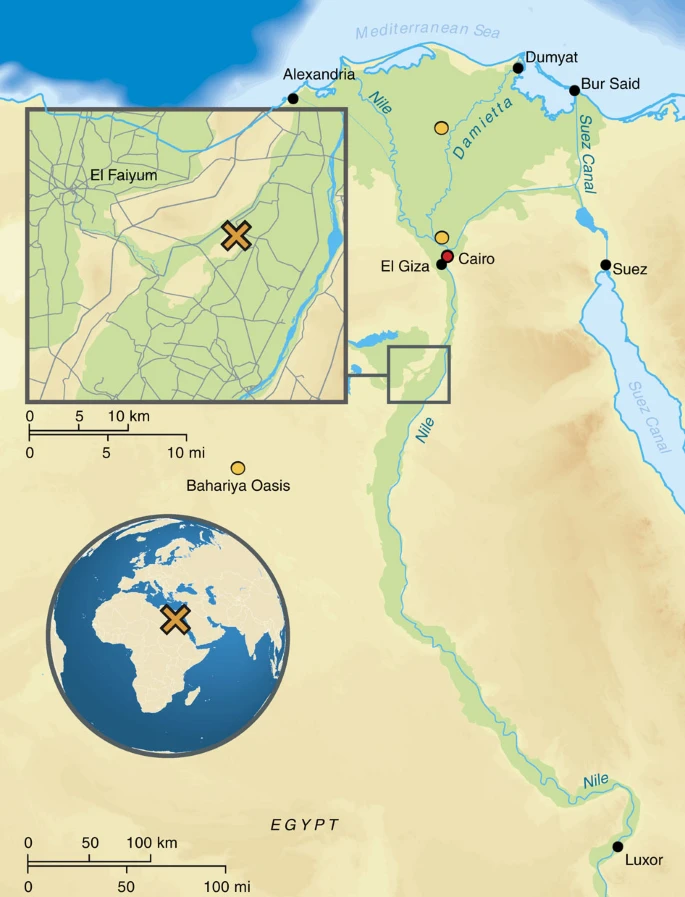
Map of Egypt depicting the location of the archaeological site Abusir-el Meleq (orange X) and the location of the modern Egyptian samples (orange circles) (design of the graphic by Annette Günzel).
Results
Samples and anthropological analysis
All 166 samples from 151 mummified individuals (for details of the 90 individuals included in the later analysis, see Supplementary Data 1) used in this study were taken from two anthropological collections at the University of Tübingen and the Felix von Luschan Skull Collection, which is now kept at the Museum of Prehistory of the Staatliche Museen zu Berlin, Stiftung preußischer Kulturbesitz (individuals: S3533, S3536, S3544, S3552, S3578, S3610). According to the radiocarbon dates (Supplementary Data 1, see also ref. 18), the samples can be grouped into three time periods: Pre-Ptolemaic (New Kingdom, Third Intermediate Period and Late Period), Ptolemaic and Roman Period. During their conservation in the Tübingen and Berlin collections the remains underwent different treatments: some were preserved in their original mummified state, while others were macerated for anthropological analysis or due to conservation problems19.
In most cases, non-macerated mummy heads still have much of their soft tissue preserved. Some of the remains (individuals analysed in our study: 1543, 1547, 1565, 1577, 1611) have traces of gold leaf near the mouth and the cheekbone, which is characteristic for mummies from the Ptolemaic Period onwards20. In most cases the brain was removed and the excerebration route was highly likely transnasal, resulting in visible defects on the cribriform plate (for the individuals analysed in our study, see Supplementary Data 1). In summary, the excellent bone preservation and the more or less good soft tissue preservation made a wide-ranging analysis possible19.
Recently, various studies were conducted on these remains, including a study on ancient Egyptian embalming resins, two ancient DNA studies and an anthropological examination of the macerated crania12,18,19,21. While the possibilities of a demographic reconstruction based on anthropological finds are naturally limited—due to incompleteness of the assemblage, the following anthropological observations were made on the assemblage: For a first assessment, computer tomographic scans of 30 mummies with soft tissue preservation were produced to describe sex (Supplementary Data 1), age at death (Supplementary Data 1) and the macroscopic health status; the six macerated mummies were examined directly. It is notable that most of the individuals are early and late adults, and that subadult individuals are underrepresented (Supplementary Data 1). It is possible that the sample’s demographic profile is the result of different burial treatments for adults and subadults, but it seems more likely that it is due to collection bias, with collectors favouring intact adult skulls. Almost all of the teeth show significant dentine exposure up to a total loss of the crown. This abrasion pattern is likely due to the food and food preparation itself, in particular for a cereal-rich diet containing a high proportion of coarse sandy particles. These particles act to abrade the dental tissues, allowing bacteria to penetrate the interior of the teeth. As a result, carious lesions or periapical processes appear in the analysed individuals (Supplementary Data 1)19.
For the DNA analysis we sampled different tissues (bone, soft tissue, tooth), macerated and non-macerated, to test for human DNA preservation.
Processing and sequencing of the samples
We extracted DNA from 151 mummified human remains and prepared double-stranded Illumina libraries with dual barcodes22,23. Then we used DNA capture techniques for human mitochondrial DNA24 and for 1.24 million genomic single nucleotide polymorphisms (SNPs)25 in combination with Illumina sequencing, through which we successfully obtained complete human mitochondrial genomes from 90 samples and genome-wide SNP data from three male individuals passing quality control.
Comparison of the DNA preservation in different tissues
We tested different tissues for DNA preservation and applied strict criteria for authenticity on the retrieved mitochondrial and nuclear DNA to establish authentic ancient Egyptian DNA. First, DNA extracts from several tissues (that is, bone, teeth, soft tissue and macerated teeth) from 151 individuals were screened for the presence of human mitochondrial DNA (mtDNA) resulting in a total of 2,157 to 982,165 quality filtered mitochondrial reads per sample, and 11- to 4,236-fold coverage. To estimate, identify and filter out potential contamination we applied the program schmutzi15 with strict criteria for contamination and kept only samples with less than 3% contamination for further analysis. For a comparison of different source material (soft tissue, bone and teeth) ten individuals (Supplementary Table 1) were sampled multiple times. Yields of preserved DNA were comparable in bone and teeth but up to ten times lower in soft tissues (Fig. 2a, Supplementary Table 1). Nucleotide misincorporation patterns characteristic for damaged ancient human DNA allowed us to assess the authenticity of the retrieved DNA13,14. The observed DNA damage patterns differed for the source materials with on average 19% damage in soft tissues and around 10% damage in bone tissue and teeth (Fig. 2b,c, Supplementary Table 1). Importantly, mtDNA haplotypes were identical for all samples from the same individuals. Our results thus suggest that DNA damage in Egyptian mummies correlates with tissue type. The protection of bone and teeth by the surrounding soft tissue or the embalmment of soft tissue may have contributed to the observed differences.
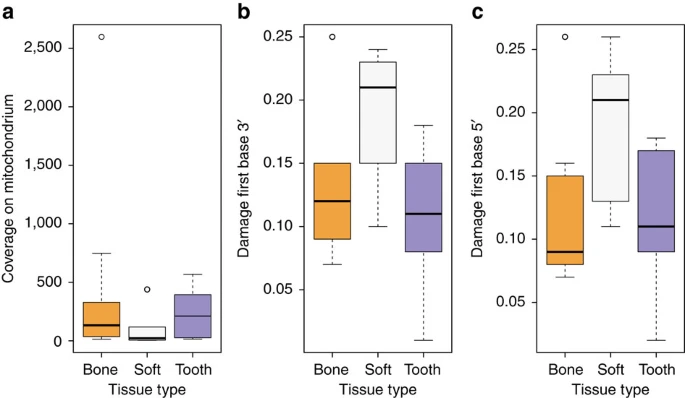
(a) coverage boxplots separated by tissue type (bone, mummified tissue, teeth), (b) boxplots showing damage of first base at the 3′ end separated by tissue type according to a, (c) damage on first base at the 5′ end of mapped reads separated by tissue type according to a and b.
Generation of nuclear data
In order to analyse the nuclear DNA we selected 40 samples with high mtDNA coverage and low mtDNA contamination. Using in solution enrichment for 1.2 million genome-wide SNPs26, we obtained between 3,632 and 508,360 target SNPs per sample (Supplementary Data 2). Overall, the nuclear DNA showed poor preservation compared to the mtDNA as depicted by a high mitochondrial/nuclear DNA ratio of on average around 18,000. In many samples, nuclear DNA damage was relatively low, indicating modern contamination. We sequenced two libraries per sample: one untreated library to assess DNA damage, and one library treated with enzymatic damage repair27, which was used for downstream analysis. We applied strict criteria for further analysis: we considered only male samples with at least 8% average cytosine deamination rates at the ends of the reads from the untreated library, and with at least 150 SNPs on the X chromosome covered at least twice, in order to estimate contamination levels reliably. Three out of 40 samples fulfilling these criteria had acceptable nuclear contamination rates: Two samples from the Pre-Ptolemaic Periods (New Kingdom to Late Period) had 5.3 and 0.5% nuclear contamination and yielded 132,084 and 508,360 SNPs, respectively, and one sample from the Ptolemaic Period had 7.3% contamination and yielded 201,967 SNPs. As shown below, to rule out any impact of potential contamination on our results, we analysed the three samples separately or replicated results using only the least contaminated sample.
Analysis of mitochondrial genomes
The 90 mitochondrial genomes fulfilling our criteria (>10-fold coverage and <3% contamination) were grouped into three temporal categories based on their radiocarbon dates (Supplementary Data 1), corresponding to Pre-Ptolemaic Periods (n=44), the Ptolemaic Period (n=27) and the Roman Period (n=19) (Supplementary Data 1). To test for genetic differentiation and homogeneity we compared haplogroup composition, calculated FST-statistics28 and applied a test for population continuity29 (Supplementary Table 2, Supplementary Data 3,4) on mitochondrial genome data from the three ancient and two modern-day populations from Egypt and Ethiopia, published by Pagani and colleagues17, including 100 modern Egyptian and 125 modern Ethiopian samples (Fig. 3a). We furthermore included data from the El-Hayez oasis published by Kujanová and colleagues30. We observe highly similar haplogroup profiles between the three ancient groups (Fig. 3a), supported by low FST values (<0.05) and P values >0.1 for the continuity test. Modern Egyptians share this profile but in addition show a marked increase of African mtDNA lineages L0–L4 up to 20% (consistent with nuclear estimates of 80% non-African ancestry reported in Pagani et al.17). Genetic continuity between ancient and modern Egyptians cannot be ruled out by our formal test despite this sub-Saharan African influx, while continuity with modern Ethiopians17, who carry >60% African L lineages, is not supported (Supplementary Data 5). To further test genetic affinities and shared ancestry with modern-day African and West Eurasian populations we performed a principal component analysis (PCA) based on haplogroup frequencies and Multidimensional Scaling of pairwise genetic distances. We find that all three ancient Egyptian groups cluster together (Fig. 3b), supporting genetic continuity across our 1,300-year transect. Both analyses reveal higher affinities with modern populations from the Near East and the Levant compared to modern Egyptians (Fig. 3b,c). The affinity to the Middle East finds further support by the Y-chromosome haplogroups of the three individuals for which genome-wide data was obtained, two of which could be assigned to the Middle-Eastern haplogroup J, and one to haplogroup E1b1b1 common in North Africa (Supplementary Table 3). However, comparative data from a contemporary population under Roman rule in Asia Minor, from the Roman city Ağlasun today in Turkey31, did not reveal a closer relationship to the ancient Egyptians from the Roman period (Fig. 3b,c).

(a) Mitochondrial DNA haplogroup frequencies of three ancient and two modern-day populations, (b) Principal Component Analysis based on haplogroup frequencies: (sub-Saharan Africa (green), North Africa (light green), Near East (orange), Europe (yellow), ancient (blue), (c) MDS of HVR-I sequence data: colour scheme as above; note that ancient groups were pooled, (d) Skygrid plot depicting effective population size estimates over the last 5,000 years in Egypt. Vertical bars indicate the ages of the analysed 90 mitochondrial genomes (three samples with genome-wide data highlighted in red). Note that the values on y axis are given in female effective population size times generation time and were rescaled by 1:14.5 for the estimation of the studied population size (assuming 29-year generation time and equal male and female effective population sizes) (images by Kerttu Majander).
Population size estimation using BEAST
The finding of a continuous population through time allowed us to estimate the effective population size (Ne) from directly radiocarbon-dated mitochondrial genomes using BEAST32. Our results show similar values of effective population size in the different ancient time periods with an average value of between ca. 48,000 and 310,000 (average 95% CI) inhabitants in the region and period under investigation (Fig. 3d, Supplementary Fig. 2, Supplementary Table 4). This is important as it is the first time that such estimates can be contrasted with reported historic Egyptian census numbers from the neighbouring Fayum in the early Ptolemaic Period, which had a reported total population size of 85,000–95,000 inhabitants33.
Population genetic analysis of nuclear DNA
On the nuclear level we merged the SNP data of our three ancient individuals with 2,367 modern individuals34,35 and 294 ancient genomes36 and performed PCA on the joined data set. We found the ancient Egyptian samples falling distinct from modern Egyptians, and closer towards Near Eastern and European samples (Fig. 4a, Supplementary Fig. 3, Supplementary Table 5). In contrast, modern Egyptians are shifted towards sub-Saharan African populations. Model-based clustering using ADMIXTURE37 (Fig. 4b, Supplementary Fig. 4) further supports these results and reveals that the three ancient Egyptians differ from modern Egyptians by a relatively larger Near Eastern genetic component, in particular a component found in Neolithic Levantine ancient individuals36 (Fig. 4b). In contrast, a substantially larger sub-Saharan African component, found primarily in West-African Yoruba, is seen in modern Egyptians compared to the ancient samples. In both PCA and ADMIXTURE analyses, we did not find significant differences between the three ancient samples, despite two of them having nuclear contamination estimates over 5%, which indicates no larger impact of modern DNA contamination. We used outgroup f3-statistics38 (Fig. 5a,b) for the ancient and modern Egyptians to measure shared genetic drift with other ancient and modern populations, using Mbuti as outgroup. We find that ancient Egyptians are most closely related to Neolithic and Bronze Age samples in the Levant, as well as to Neolithic Anatolian and European populations (Fig. 5a,b). When comparing this pattern with modern Egyptians, we find that the ancient Egyptians are more closely related to all modern and ancient European populations that we tested (Fig. 5b), likely due to the additional African component in the modern population observed above. By computing f3-statistics38, we determined whether modern Egyptians could be modelled as a mixture of ancient Egyptian and other populations. Our results point towards sub-Saharan African populations as the missing component (Fig. 5c), confirming the results of the ADMIXTURE analysis. We replicated the results based on f3-statistics using only the least contaminated sample (with <1% contamination estimate) and find very similar results (Supplementary Fig. 5), confirming that the moderate levels of modern DNA contamination in two of our samples did not affect our analyses. Finally, we used two methods to estimate the fractions of sub-Saharan African ancestry in ancient and modern Egyptians. Both qpAdm35 and the f4-ratio test39 reveal that modern Egyptians inherit 8% more ancestry from African ancestors than the three ancient Egyptians do, which is also consistent with the ADMIXTURE results discussed above. Absolute estimates of African ancestry using these two methods in the three ancient individuals range from 6 to 15%, and in the modern samples from 14 to 21% depending on method and choice of reference populations (see Supplementary Note 1, Supplementary Fig. 6, Supplementary Tables 5–8). We then used ALDER40 to estimate the time of a putative pulse-like admixture event, which was estimated to have occurred 24 generations ago (700 years ago), consistent with previous results from Henn and colleagues16. While this result by itself does not exclude the possibility of much older and continuous gene flow from African sources, the substantially lower African component in our ∼2,000-year-old ancient samples suggests that African gene flow in modern Egyptians occurred indeed predominantly within the last 2,000 years.

(a) Principal Component Analysis-based genome-wide SNP data of three ancient Egyptians, 2,367 modern individuals and 294 previously published ancient genomes, (b) subset of the full ADMIXTURE analysis (Supplementary Fig. 4).

(a) Outgroup f3-statistics measuring shared drift of the three ancient Egyptian samples and other modern and ancient populations, (b) The data shown in a, compared with the same estimates for modern Egyptians, ordered by shared drift with modern Egyptians, (c) Admixture f3-statistics, testing whether modern Egyptians are mixed from ancient Egyptians and some other source. The most negative Z-scores indicate the most likely source populations.
Estimating phenotypes
Finally, we analysed several functionally relevant SNPs in sample JK2911, which had low contamination and relatively high coverage. This individual had a derived allele at the SLC24A5 locus, which contributes to lighter skin pigmentation and was shown to be at high frequency in Neolithic Anatolia41, consistent with the ancestral affinity shown above. Other relevant SNPs carry the ancestral allele, including HERC2 and LCT, which suggest dark-coloured eyes and lactose intolerance (Supplementary Table 9).
Discussion
This study demonstrates that the challenges of ancient DNA work on Egyptian mummies can be overcome with enrichment strategies followed by high-throughput DNA sequencing. The use of ancient DNA can greatly contribute towards a more accurate and refined understanding of Egypt’s population history. More specifically, it can supplement and serve as a corrective to archaeological and literary data that are often unevenly distributed across time, space and important constituents of social difference (such as gender and class) as well as modern genetic data from contemporary populations that may not be fully representative of past populations.
The archaeological site Abusir el-Meleq was inhabited from at least 3250BCE until about 700CE and was of great religious significance because of its active cult to Osiris, the god of the dead, which made it an attractive burial site for centuries2. Written sources indicate that by the third century BCE Abusir el-Meleq was at the centre of a wider region that comprised the northern part of the Herakleopolites province, and had close ties with the Fayum and the Memphite provinces, involving the transport of wheat, cattle-breeding, bee-keeping and quarrying42. In the early Roman Period, the site appears to have been the main centre in its own district42. Abusir el-Meleq’s proximity to, and close ties with, the Fayum are significant in the context of this study as the Fayum in particular saw a substantial growth in its population during the first hundred years of Ptolemaic rule, presumably as a result of Greek immigration33,43. Later, in the Roman Period, many veterans of the Roman army—who, initially at least, were not Egyptian but people from disparate cultural backgrounds—settled in the Fayum area after the completion of their service, and formed social relations and intermarried with local populations44. Importantly, there is evidence for foreign influence at Abusir el-Meleq. Individuals with Greek, Latin and Hebrew names are known to have lived at the site and several coffins found at the cemetery used Greek portrait image and adapted Greek statue types to suit ‘Egyptian’ burial practices2,45. The site’s first excavator, Otto Rubensohn, also found a Greek grave inscription in stone as well as a writing board inscribed in Greek46. Taken together with the multitude of Greek papyri that were written at the site, this evidence strongly suggests that at least some inhabitants of Abusir el-Meleq were literate in, and able to speak, Greek45. However, a general issue concerning the site is that several details of the context of the individuals analysed in this study were lost over time. All of the material was excavated by Rubensohn in the early twentieth century, whose main interest was to obtain literary papyri from cartonnage rather than to excavate human remains47. As is customary for the time, Rubensohn’s archaeological records are highly incomplete and many of the finds made by him were removed undocumented from their contexts. Furthermore, many of his excavation diaries and notes were destroyed during the Second World War19. This lack of context greatly diminishes the possibility of ‘thick description’ of the analysed individuals, at least in terms of their names, titles and materially expressed identity. However, the finds nevertheless hold much promise for a long-term study of population dynamics in ancient Egypt. Abusir el-Meleq is arguably one of the few sites in Egypt, for which such a vast number of individuals with such an extensive chronological spread are available for ancient DNA analysis. Although we only analysed mummified remains, there is little reason to believe that the burials Rubensohn excavated belonged exclusively to a group of prosperous inhabitants on the basis of the far published references to excavation diaries and Rubensohn’s preliminary reports that permit a basic reconstruction. Rather it seems arguable that the complete spectrum of society is represented, ranging from Late Period priests’ burials that stand out by virtue of their size and contents to simple inhumations that are buried with little to no grave goods2. The widespread mummification treatments in the Ptolemaic and Roman Periods in particular, leading to a decline in standards and costs48 and the generally modest appearance of many burials further supports this assessment.
By comparing ancient individuals from Abusir el-Meleq with modern Egyptian reference populations, we found an influx of sub-Saharan African ancestry after the Roman Period, which corroborates the findings by Henn and colleagues16. Further investigation would be needed to link this influx to particular historic processes. Possible causal factors include increased mobility down the Nile and increased long-distance commerce between sub-Saharan Africa and Egypt49. Trans-Saharan slave trade may have been particularly important as it moved between 6 and 7 million sub-Saharan slaves to Northern Africa over a span of some 1,250 years, reaching its high point in the nineteenth century50. However, we note that all our genetic data were obtained from a single site in Middle Egypt and may not be representative for all of ancient Egypt. It is possible that populations in the south of Egypt were more closely related to those of Nubia and had a higher sub-Saharan genetic component, in which case the argument for an influx of sub-Saharan ancestries after the Roman Period might only be partially valid and have to be nuanced. Throughout Pharaonic history there was intense interaction between Egypt and Nubia, ranging from trade to conquest and colonialism, and there is compelling evidence for ethnic complexity within households with Egyptian men marrying Nubian women and vice versa51,52,53. Clearly, more genetic studies on ancient human remains from southern Egypt and Sudan are needed before apodictic statements can be made.
The ancient DNA data revealed a high level of affinity between the ancient inhabitants of Abusir el-Meleq and modern populations from the Near East and the Levant. This finding is pertinent in the light of the hypotheses advanced by Pagani and colleagues, who estimated that the average proportion of non-African ancestry in Egyptians was 80% and dated the midpoint of this admixture event to around 750 years ago17. Our data seem to indicate close admixture and affinity at a much earlier date, which is unsurprising given the long and complex connections between Egypt and the Middle East. These connections date back to Prehistory and occurred at a variety of scales, including overland and maritime commerce, diplomacy, immigration, invasion and deportation54. Especially from the second millennium BCE onwards, there were intense, historically- and archaeologically documented contacts, including the large-scale immigration of Canaanite populations, known as the Hyksos, into Lower Egypt, whose origins lie in the Middle Bronze Age Levant54.
Our genetic time transect suggests genetic continuity between the Pre-Ptolemaic, Ptolemaic and Roman populations of Abusir el-Meleq, indicating that foreign rule impacted the town’s population only to a very limited degree at the genetic level. It is possible that the genetic impact of Greek and Roman immigration was more pronounced in the north-western Delta and the Fayum, where most Greek and Roman settlement concentrated43,55, or among the higher classes of Egyptian society55. Under Ptolemaic and Roman rule, ethnic descent was crucial to belonging to an elite group and afforded a privileged position in society55. Especially in the Roman Period there may have been significant legal and social incentives to marry within one’s ethnic group, as individuals with Roman citizenship had to marry other Roman citizens to pass on their citizenship. Such policies are likely to have affected the intermarriage of Romans and non-Romans to a degree55. Additional genetic studies on ancient human remains from Egypt are needed with extensive geographical, social and chronological spread in order to expand our current picture in variety, accuracy and detail.
However, our results revise previous scepticism towards the DNA preservation in ancient Egyptian mummies due to climate conditions or mummification procedures8. The methodology presented here opens up promising avenues for future genetic research and can greatly contribute towards a more accurate and refined understanding of Egypt’s population history.
Methods
Ancient DNA extraction and library preparation
All pre-amplifications steps were carried out in clean room facilities dedicated to ancient DNA work at the University of Tübingen. Before the sampling all samples were UV irradiated for 60 min to reduce modern contamination. In addition, the surface of the bone or tissue samples was removed and the teeth were sampled from inside of the tooth pulp. DNA was extracted from 50 mg bone powder for bone or tooth samples, from 100 mg tissue for soft tissue samples, respectively. A silica purification protocol was applied as described in ref. 56 using the following modifications: the Zymo-Spin V funnels (Zymo Research) were bleached and UV irradiated for 60 min and the total elution volume was raised to 100 μl. Aliquots of 20 μl extract were converted into double-stranded Illumina libraries following a well-established protocol22 and sample specific barcodes were added to both sides of the fragments via amplification22,23. Extraction and library blanks were treated accordingly.
Subsequently, the indexed libraries were amplified using 100 μl reactions for each library containing 5 μl library template, 4 units AccuPrime Taq DNA Polymerase High Fidelity (Invitrogen), 1 unit 10 × AccuPrime buffer (containing dNTPs) and 0.3 μM IS5 and IS6 primers22, and the following thermal profile: 2-min initial denaturation at 94 °C, followed by 4–17 cycles consisting of 30-s denaturation at 94 °C, a 30-s annealing at 60 °C and a 2-min elongation at 68 °C and a 5-min final elongation at 68 °C. The amplified libraries were then purified using the MinElute PCR purification kit (Qiagen, Hilden, Germany), quantified with Agilent 2100 Bioanalyzer DNA 1000 chips and were used for the enrichment of the human mitochondrial DNA.
For the nuclear capture two additional libraries for selected 40 samples using 20 μl extract were created as described above with the addition of a UDG treatment27 (see Supplementary Note 2 for details).
Mitochondrial DNA enrichment and sequencing for sample processing
All samples were enriched for human mitochondrial DNA via bead capture hybridization as detailed elsewhere33. After enrichment the libraries were amplified in 100 μl reactions with 15 μl template, 2 units Phusion High Fidelity DNA polymerase, 1 unit 5 × HF buffer, 0.25 mM dNTPs and 0.3 μM IS5 and IS6 primers22, and the following thermal profile: 5-min initial denaturation at 95 °C, followed by 16–23 cycles consisting of 30-s denaturation at 95 °C, a 30-s annealing at 60 °C and a 45-s elongation at 72 °C and a 5-min final elongation at 72 °C. Subsequently, the libraries were purified and quantified as described before and paired-end dual index sequencing was carried out on an Illumina HiSeq 2500 platform by 2 × 100+7+7 cycles following the manufacturer’s protocols for multiplex sequencing (TruSeq PE Cluster Kit v3-cBot-HS).
Mitochondrial DNA sequence processing and alignment
The resulting FastQ files have been processed using EAGER v1.92 (ref. 57). To achieve improved coverages at both ends of the mitochondrial reference, we used the CircularMapper option in EAGER. All reads with a mapping quality of at least 30 were kept for the subsequent analysis. Duplicate reads have been removed using DeDup v0.9.10, included in the EAGER pipeline. The coverage and statistics calculation has been performed inside the EAGER pipeline and indels have been realigned using RealignerTargetCreator and IndelRealigner from the GATK58. Mitochondrial haplogroups have been determined using HaploGrep 2 (ref. 59). Further details of the analysis parameters can be found in Supplementary Note 3. As can be seen in Supplementary Data 1, we achieved coverages ranging from 11-fold up to 4284-fold on the mitochondrial genome, with an average of 408-fold.
Mitochondrial DNA authentication and contamination assessment
Accompanying measures to limit contamination of the libraries in the laboratory work, in silico analysis has been done in order to authenticate samples and further determine the amount of potential contamination on the mitochondrial level. Negative controls were processed in parallel with samples. The former show no substantial mapping rates and suggest that the amount of DNA introduced during laboratory work could be kept on a minimal level. The authenticity of the samples has been further assessed by applying a number of methods and criteria. MapDamage 2.0 (ref. 60) has been used to evaluate fragment lengths and nucleotide misincorporation patterns of the provided samples, all of which showed levels that are characteristic for ancient DNA13. The degree of mitochondrial DNA contamination as well as contamination estimates based on the deamination patterns have been assessed using schmutzi15, generating consensus sequences of both contaminant and supposedly endogenous DNA simultaneously. Furthermore, only samples with less than 3% estimated contamination based on deamination and degree of mitochondrial contamination have been used for further downstream analysis. We furthermore determined whether there are inconsistencies between our haplogroup assignments of the mitochondrial and the nuclear capture respectively, but did not find any (see Supplementary Data 3 for details). As can be seen in Supplementary Table 1, our samples showed damage on both 3′ and 5′ ends of reads in the range of 5% up to 49%, with an average of 14%. Furthermore, the contamination estimation methods showed very low levels of contamination after comparison to a database of putative contaminants, as provided by the used method schmutzi. For all samples, the observed contamination estimates prove to be less than our defined threshold of 3%, except for three samples (JK2879, JK2883, JK2896) where a visual inspection of sequence assemblies was done as described in Posth et al.61 to identify potential contaminating lineages and ensure consistency of the generated consensus mitochondrial genome. As an additional measure, we used the built-in feature ‘log2fasta’ of the tool schmutzi to only incorporate bases in our final consensus sequence with a significant likelihood to be non-contaminated as defined by the method itself. In order to do this, we applied several quality thresholds (q=0,20,40,80) in our analysis and used a moderate filtering value that did not change our consensus sequence to undefined positions to a larger extent. We ultimately chose a value of q=20 for filtering with ‘log2fasta’, but even more strict filtering with q=40 preserved our haplotyping calls to be consistent. However, filtering even stricter introduced more undefined positions (‘N’) due to missing support, potentially hindering sequence-based analysis more dramatically than our frequency-based analysis, which is why we kept a quality threshold of q=20, following cutoffs that other authors have been using, too61.
Nuclear DNA capture
The non-UDG and UDG treated libraries were enriched by hybridization to probes targeting approximately 1.24 million genomic SNPs as described previously25. The target SNPs consist of panels 1 and 2 as described in Mathieson et al.41 and Fu et al.26 (see Supplementary Note 2 for details).
For each of the 40 samples, we sequenced two captured libraries: one with enzymatic damage repair (UDG), one without (non-UDG). For all samples, we used the EAGER pipeline version 1.92.15 (ref. 57), with default parameters, and with the option to keep only merged reads. We determined the sex of each sample by obtaining the average coverage on X chromosome, Y chromosome and autosomal SNPs in the capture pool using a custom script. We flagged samples as ‘male’ when the ratio of X and autosomal coverage was lower or equal than 0.75 and the ratio of Y and autosomal coverage was greater or equal than 0.25. We flagged samples as ‘female’ when the ratio of X and autosomal coverage was greater than 0.75 and the ratio of Y and autosomal coverage was lower than 0.25. For all male samples that had at least a total number of 150 SNPs on chromosome X covered twice, we obtained contamination estimates using the ANGSD software62, using the ‘MoM’ estimate from ‘Method 1’ and the ‘new_llh’ likelihood computation. Supplementary Data 2 summarizes all these results. In some cases, ANGSD finished with an error, as indicated in the table. Entries with ‘n/a’ are either female or have insufficient coverage on the X chromosome.
Three samples were selected for down-stream analysis: JK2134, JK2888 and JK2911. In all three of these samples, contamination estimates were acceptable, and similar in both UDG and non-UDG libraries as can be seen in Supplementary Data 2. Furthermore, in all three samples the non-UDG library showed DNA damage over 8% in the first base pair of reads, which is within the expected range of damage for ancient DNA of this age.
Nuclear data analysis: genotyping
We called genotypes from the UDG treated data for the three individuals by sampling a random read per SNP in the SNP-capture panel, using a custom tool ‘pileupCaller’, available at https://github.com/stschiff/sequenceTools. The resulting genotypes were merged with data from two other data sets: First, 2,367 modern individuals genotyped on the Affymetrix Human Origins Array34,35; second, 294 ancient genomes36.
Nuclear data analysis: ADMIXTURE
We used the ADMIXTURE software on the merged data set to cluster ancestry proportions using different numbers of clusters37. The lowest cross-validation error was obtained using K=16 and we show the results of that run in Supplementary Fig. 4. A subset is shown in Fig. 4b.
Nuclear data analysis: PCA
We performed PCA on the joined data set using the ‘smartpca’ software from the Eigensoft package63. For the plot shown in Supplementary Fig. 3, we used a selected set of European populations as shown in Supplementary Note 2.
Nuclear data analysis: f3-statistics
We used the ‘qp3pop’ tool from the Admixtools package39 to compute Outgroup f3-statistics of the form f3(Mbuti; Egyptian, X), where ‘Egyptian’ means either ancient and modern Egyptian, and ‘X’ runs over all populations in the merged data set. For the plot in Fig. 5b, we ordered all results based on the result using the modern Egyptian samples and show the top hits. For the map plot in Fig. 5a we placed all modern populations on their sampling locations obtained from Lazaridis et al.34, and added selected ancient populations that stood out from the background, as shown in Figure 5b. We then used the ‘qp3pop’ tool to compute f3-statistics of the form f3(Egyptian; Ancient Egypt, X), where X runs over all populations in the merged data set. Fig. 5c shows a similar plot as in Fig. 5a, but with the colour code indicating the Z score for this latter f3-statistics, where a negative Z score indicates a probable source for admixture.
Since two of the three selected samples had contamination rate estimates over 5%, we repeated this analysis using only sample JK2911, which has the highest SNP coverage and a contamination estimate of below 1%. The result is shown in Supplementary Fig. 5, with very similar results as when using all three samples, indicating no effect of contamination on our results.
Sequence-based mitochondrial analysis
In order to detect genetic similarities or distances between our three ancient Egyptian populations (n=90) and present-day populations (see Supplementary Note 4), we collated a data set of Egyptian (n=135) and Ethiopian (n=120) mtDNA sequences from the literature for the respective area in upper Egypt, the El-Hayez oasis30 and Ethiopia17. We calculated genetic distances (FST) based on the full mtDNA of these individuals. FST values were calculated using Arlequin v3.5.2.2 (ref. 28), applying the Tamura and Nei substitution model64 and a respective gamma value of 0.260. To determine the most suitable parameter set and substitution method, we used jModelTest v2.1.10 (ref. 65) and selected the parameters suggested by the Akaike and Bayesian information criterion (AIC and BIC). P values for the calculated FST values were corrected for multiple comparisons to minimize the probability of type I errors (false positives) using the Benjamini–Hochberg method66, a false discovery rate-based method implemented in the p.adjust function in R 3.2.3 (The R Project for Statistical Computing 2011, https://www.r-project.org/). We split our individuals in three groups (Pre-Ptolemaic, Ptolemaic and Roman Period) based on the 14C dates obtained from the samples (Supplementary Data 1). However, as the intra-group distances of our three ancient populations were not significantly different from each other, we merged all three ancient populations in a single set to perform FST analyses between modern populations and the ancient meta population with more statistical power than keeping the individual populations separate. Our results can be found in Supplementary Table 2.
Sequence-based mitochondrial analysis: multidimensional scaling (MDS) analysis
To determine the relationships between our ancient samples from the Pre-Ptolemaic, Ptolemaic and Roman time periods in contrast to modern populations in the respective areas, we performed a multi-dimensional scaling (MDS) analysis of the HVR-1 sequences (Supplementary Data 4).
The genetic distances were calculated in Arlequin v3.5.2.2 using the Tamura and Nei substitution model and a gamma shape value of 0.26, determined to be the best setting for the data using jModelTest v2.1.10. We selected the best parameters suggested by the Akaike and Bayesian information criterion (AIC and BIC).
We used the linearized Slatkin’s FST values67 based on our data set of HVR-1 sequences and visualized the calculated FST values in a two-dimensional MDS plot with GNU R 3.2.4 using customized R script embedded in the vegan package (Fig. 3c). Our ancient Egyptian samples have been pooled here in order to provide more significant statistical evidence in the analysis, which can be justified due to their relatively small intraspecific differences between our three investigated time periods in the previous Fst analysis on their full mitochondrial genomes. The closest populations on the MDS with respect to our ancient meta population (AEGY) are modern populations from Saudi-Arabia, Kuwait, the United Arab Emirates, Yemen and other Near-East populations, whereas the individuals from another ancient population from Turkey (TRO) show more relatedness to modern North-African and populations from the Levantine. For details on the geographic mapping, see Supplementary Note 4.
Sequence-based mitochondrial analysis: effective population size estimation using BEAST
We used the 90 mitochondrial genomes obtained in this study, together with 135 modern Egyptian mtDNA genomes from Pagani and colleagues17 and Kujanova and colleagues30 for Bayesian reconstruction of population size changes through time. We partitioned the alignment using the krmeans algorithm in PartitionFinder2 (ref. 68) with a search through all models available excluding I+G models as it has been argued that gamma-invariable models are not biologically meaningful for data sampled at intraspecies level69. The BIC best-fit partitions (three partitions: 7212, 2367 and 6999 nt, assigned TRN, K81uf+I and TRN+I, respectively, as the best model) were used for BEAST v 1.8.3 analysis32 with unlinked site and clock models and linked tree model. We used averages from the calibrated radiocarbon age ranges for each ancient sample as tip dates for molecular clock calibration. We conducted Bayesian inference using strict clock with an uninformative CTMC reference prior for each partition and Bayesian SkyGrid tree prior with 50 parameters (gamma prior with shape 0.001 and scale 1,000). MCMC chain was run for 300 million steps with sampling every 30,000th step and initial 10% discarded as burn-in. We inspected mixing and convergence in Tracer v 1.6 (ref. 70). Effective sample size for all parameters exceeded 100.
The obtained Bayesian SkyGrid plot indicates a fairly stable slightly decreasing effective population size for the studied population over the last 5,000 years (Fig. 3d and Supplementary Fig. 2). The average median population size over the sampled ancient period, expressed as female effective population size times generation time, was estimated to 1,625,187 (95% HPD 693,670–4,490,725), which assuming generation time of 29 years and equal male and female effective population size rescales to 112,082 (95% HPD 47,839–309,705) individuals (see Supplementary Table 4).
Frequency-based mitochondrial analysis: principal component analysis
We performed a PCA to define relationships between our three ancient Egyptian populations based on their haplogroup compositions and modern, present-day populations from Europe, the Near East, West Asia and Africa. To generate the PCA, we divided our haplogroups in the following 20 groups: H, HV, I, J, K, L0, L1, L2, L3, L4, M1, N, R, R0, T, T1, T2, U, W, X and all remaining other haplogroups (see Supplementary Data 1 for haplogroups). Subsequently, we generated a table of the respective intra-population frequencies. The PCA was performed using the prcomp function for categorical PCA implemented in GNU R 3.2.4 and plotted in a two-dimensional space, displaying the first and second principal components and shown in Fig. 3b.
Frequency-based mitochondrial analysis: test of population continuity (TPC)
Our intent was to determine whether we can detect traces of genetic continuity between our three ancient populations and two comparative modern data sets. The applied method was first used and described by Brandt et al.29. We generated counts of 22 haplogroups determined manually to be most descriptive for our three ancient populations and chose a set of priors for effective population size, generation length and furthermore evaluated further parameters (see Supplementary Note 5). Especially since we are unable to determine a real value of population size during this time period, we relied on historic records for the Fayum oasis and estimated a conservative population size from this (Supplementary Table 4). To even further ensure that these chosen values are not changing our results drastically, we evaluated ranges around these assumptions to test whether our results changed significantly.
Y-chromosomal and phenotypic analysis
We determined the Y chromosomal haplogroups for our three nuclear captured individuals by examining the state of phylogenetic relevant SNPs present in ISOGG version 11.228 (accessed 19 August 2016). The assignment was performed with reads that show a mapping quality of more than 30 only. We derived the haplogroups by identifying the most derived Y chromosomal SNPs in each individual (see Supplementary Table 3 for details).
Our analysis furthermore shows that derived alleles for the genes SLC24A5, known to be responsible for partially lighter skin pigmentation were present in both JK2888 and JK2911 (see Supplementary Note 6 for details). For further genes such as SLC45A2, LCT and EDAR we were unable to find derived alleles for both JK2888 and JK2911. For JK2134, there was no sufficient coverage after quality filtering at all the specific sites, which is why the analysis revealed no further clues.
Data availability
The mapped BAM files for the 90 mitochondrial samples and three nuclear samples are deposited in the European Nucleotide Archive (http://www.ebi.ac.uk/ena) with the study ID ERP017224.
Additional information
How to cite this article: Schuenemann, V. J. et al. Ancient Egyptian mummy genomes suggest an increase of Sub-Saharan African ancestry in post-Roman periods. Nat. Commun. 8, 15694 doi: 10.1038/ncomms15694 (2017).
Publisher’s note: Springer Nature remains neutral with regard to jurisdictional claims in published maps and institutional affiliations.
References
Shaw, I. The Oxford History of Ancient Egypt Oxford University Press (2000).
Riggs, C. The Beautiful Burial in Roman Egypt: Art, Identity, and Funerary Religion Oxford University Press (2005).
Coussement, S. ‘Because I am Greek’: Polynymy as an Expression of Ethnicity in Ptolemaic Egypt. Studia Hellenistica 55 (Peeters Publishers, 2016).
Broux, Y. Double Names and Elite Strategy in Roman Egypt. Studia Hellenistica 54 (Peeters Publishers, 2016).
Shriner, D. & Keita, S. O. Migration route out of Africa unresolved by 225 Egyptian and Ethiopian whole genome sequences. Front. Genet. 7, 98 (2016).
Paabo, S. Molecular cloning of ancient Egyptian mummy DNA. Nature 314, 644–645 (1985).
Paabo, S. Ancient DNA: extraction, characterization, molecular cloning, and enzymatic amplification. Proc. Natl Acad. Sci. USA 86, 1939–1943 (1989).
Gilbert, M. T. et al. Long-term survival of ancient DNA in Egypt: response to Zink and Nerlich (2003). Am. J. Phys. Anthropol. 128, 110–114 discussion 115–118 (2005).
Marota, I., Basile, C., Ubaldi, M. & Rollo, F. DNA decay rate in papyri and human remains from Egyptian archaeological sites. Am. J. Phys. Anthropol. 117, 310–318 (2002).
Hawass, Z. et al. Ancestry and pathology in King Tutankhamun’s family. Jama 303, 638–647 (2010).
Lorenzen, E. D. & Willerslev, E. King Tutankhamun’s family and demise. Jama 303, 2471 author reply 2473–2475 (2010).
Khairat, R. et al. First insights into the metagenome of Egyptian mummies using next-generation sequencing. J. Appl. Genet. 54, 309–325 (2013).
Briggs, A. W. et al. Patterns of damage in genomic DNA sequences from a Neandertal. Proc. Natl Acad. Sci. USA 104, 14616–14621 (2007).
Stoneking, M. & Krause, J. Learning about human population history from ancient and modern genomes. Nat. Rev. Genet. 12, 603–614 (2011).
Renaud, G., Slon, V., Duggan, A. T. & Kelso, J. Schmutzi: estimation of contamination and endogenous mitochondrial consensus calling for ancient DNA. Genome Biol. 16, 224 (2015).
Henn, B. M. et al. Genomic ancestry of North Africans supports back-to-Africa migrations. PLoS Genet. 8, e1002397 (2012).
Pagani, L. et al. Tracing the route of modern humans out of Africa by using 225 human genome sequences from Ethiopians and Egyptians. Am. J. Hum. Genet. 96, 986–991 (2015).
Lalremruata, A. et al. Molecular identification of falciparum malaria and human tuberculosis co-infections in mummies from the Fayum depression (Lower Egypt). PLoS ONE 8, e60307 (2013).
Welte, B. Zeitzeugen aus dem Wüstensand- die altägyptischen Mumienschädel aus Abusir el-Meleg Dissertation. BioArchaeologica no. 6, Marie-Leidorf Verlag (2016).
Dunand, F. & Lichtenberg, R. Mummies and Death in Egypt Cornell University Press (2006).
Nicholson, T. M. et al. Enlightening the past: analytical proof for the use of Pistacia exudates in ancient Egyptian embalming resins. J. Sep. Sci. 34, 3364–3371 (2011).
Meyer, M. & Kircher, M. Illumina sequencing library preparation for highly multiplexed target capture and sequencing. Cold Spring Harbor Protoc. 2010, pdb.prot5448 (2010).
Kircher, M., Sawyer, S. & Meyer, M. Double indexing overcomes inaccuracies in multiplex sequencing on the Illumina platform. Nucleic Acids Res. 40, e3 (2012).
Maricic, T., Whitten, M. & Paabo, S. Multiplexed DNA sequence capture of mitochondrial genomes using PCR products. PLoS ONE 5, e14004 (2010).
Fu, Q. et al. DNA analysis of an early modern human from Tianyuan Cave, China. Proc. Natl Acad. Sci. USA 110, 2223–2227 (2013).
Fu, Q. et al. An early modern human from Romania with a recent Neanderthal ancestor. Nature 524, 216–219 (2015).
Briggs, A. W. et al. Removal of deaminated cytosines and detection of in vivo methylation in ancient DNA. Nucleic Acids Res. 38, e87 (2010).
Excoffier, L. & Lischer, H. E. Arlequin suite ver 3.5: a new series of programs to perform population genetics analyses under Linux and Windows. Mol. Ecol. Resour. 10, 564–567 (2010).
Brandt, G. et al. Ancient DNA reveals key stages in the formation of central European mitochondrial genetic diversity. Science 342, 257–261 (2013).
Kujanova, M., Pereira, L., Fernandes, V., Pereira, J. B. & Cerny, V. Near eastern neolithic genetic input in a small oasis of the Egyptian Western Desert. Am. J. Phys. Anthropol. 140, 336–346 (2009).
Ottoni, C. et al. Comparing maternal genetic variation across two millennia reveals the demographic history of an ancient human population in southwest Turkey. R. Soc. Open Sci. 3, 150250 (2016).
Drummond, A. J., Suchard, M. A., Xie, D. & Rambaut, A. Bayesian phylogenetics with BEAUti and the BEAST 1.7. Mol. Biol. Evol. 29, 1969–1973 (2012).
Clarysse, W. & Thompson, D. J. Counting the people in Hellenistic Egypt Cambridge University Press (2004).
Lazaridis, I. et al. Ancient human genomes suggest three ancestral populations for present-day Europeans. Nature 513, 409–413 (2014).
Haak, W. et al. Massive migration from the steppe was a source for Indo-European languages in Europe. Nature 522, 207–211 (2015).
Lazaridis, I. et al. Genomic insights into the origin of farming in the ancient Near East. Nature 536, 419–424 (2016).
Alexander, D. H., Novembre, J. & Lange, K. Fast model-based estimation of ancestry in unrelated individuals. Genome Res. 19, 1655–1664 (2009).
Raghavan, M. et al. Upper Palaeolithic Siberian genome reveals dual ancestry of native Americans. Nature 505, 87–91 (2014).
Patterson, N. et al. Ancient admixture in human history. Genetics 192, 1065–1093 (2012).
Loh, P. R. et al. Inferring admixture histories of human populations using linkage disequilibrium. Genetics 193, 1233–1254 (2013).
Mathieson, I. et al. Genome-wide patterns of selection in 230 ancient Eurasians. Nature 528, 499–503 (2015).
Falivene, M. R. The Herakleopolite Nome: a Catalogue of Toponyms with Introduction and Commentary Scholars Press (1998).
Rathbone, D. W. Villages, land and population in Graeco-Roman Egypt. Proc. Cambridge Philolog. Soc. 36, 103–142 (1990).
Alston, R. Soldier and Society in Roman Egypt: A Social History New York (1995).
Broux, Y. & Depauw, M. in Social Informatics (eds Aiello, L. M., McFarland, D.) 304–313 (Springer, 2015).
Rubensohn, O. Griechisch-römische Funde in Ägypten. Archäol. Anz. 20, 65–70 (1905).
Rubensohn, O. & Knatz, F. Berichte über die Ausgrabungen bei Abusir el Mäläq im Jahre 1903. Leipzig: Z. Ägypt. Sprache Alt. Bd. 41, 1–21 (1904).
David, R. in Ancient Egyptian Materials and Technology (eds Nicholson, P. T., Shaw, I.) 372–389 (Cambridge, 2000).
Lydon, G. On Trans-Saharan Trails Cambridge University Press (2009).
Wright, J. The Trans-Saharan Slave Trade Routledge (2007).
Smith, S. T. in Nubia in the New Kingdom: Lived experience, pharaonic control and local traditions (eds Spencer, N., Stevens, A. & Binder M.) 613–628.
Smith, S. T. Wretched Kush: Ethnic Identities and Boundaries in Egypt’s Nubian Empire Routledge (2003).
Van Pelt, W. P. Revising Egypto-Nubian relations in New Kingdom Lower Nubia: From Egyptianization to cultural entanglement. Cambridge Archaeol. J. 23, 523–550 (2013).
Mumford, G. D. Egypt and the Levant, The Oxford Handbook of the Archaeology of the Levant: c. 8000-332 BCE Oxford (2014).
Vandorpe, K. Idnetity in Roman Egypt, 260–276 (Oxford University Press, 2012).
Dabney, J. et al. Complete mitochondrial genome sequence of a Middle Pleistocene cave bear reconstructed from ultrashort DNA fragments. Proc. Natl Acad. Sci. USA 110, 15758–15763 (2013).
Peltzer, A. et al. EAGER: efficient ancient genome reconstruction. Genome Biol. 17, 60 (2016).
McKenna, A. et al. The Genome Analysis Toolkit: a MapReduce framework for analyzing next-generation DNA sequencing data. Genome Res. 20, 1297–1303 (2010).
Weissensteiner, H. et al. HaploGrep 2: mitochondrial haplogroup classification in the era of high-throughput sequencing. Nucleic Acids Res. 44, W58–W63 (2016).
Jonsson, H., Ginolhac, A., Schubert, M., Johnson, P. L. & Orlando, L. mapDamage2.0: fast approximate Bayesian estimates of ancient DNA damage parameters. Bioinformatics 29, 1682–1684 (2013).
Posth, C. et al. Pleistocene mitochondrial genomes suggest a single major dispersal of non-Africans and a late glacial population turnover in Europe. Curr. Biol. 26, 827–833 (2016).
Korneliussen, T. S., Albrechtsen, A. & Nielsen, R. ANGSD: analysis of next generation sequencing data. BMC Bioinform. 15, 356 (2014).
Patterson, N., Price, A. L. & Reich, D. Population structure and eigenanalysis. PLoS genet. 2, e190 (2006).
Tamura, K. & Nei, M. Estimation of the number of nucleotide substitutions in the control region of mitochondrial DNA in humans and chimpanzees. Mol. Biol. Evol. 10, 512–526 (1993).
Darriba, D., Taboada, G. L., Doallo, R. & Posada, D. jModelTest 2: more models, new heuristics and parallel computing. Nat. Methods 9, 772 (2012).
Benjamini, Y. & Hochberg, Y. Controlling the false discovery rate: a practical and powerful approach to multiple testing. J. R. Stat. Soc. 57, 289–300 (1995).
Slatkin, M. A measure of population subdivision based on microsatellite allele frequencies. Genetics 139, 457–462 (1995).
Frandsen, P. B., Calcott, B., Mayer, C. & Lanfear, R. Automatic selection of partitioning schemes for phylogenetic analyses using iterative k-means clustering of site rates. BMC Evol. Biol. 15, 13 (2015).
Jia, F., Lo, N. & Ho, S. Y. The impact of modelling rate heterogeneity among sites on phylogenetic estimates of intraspecific evolutionary rates and timescales. PLoS ONE 9, e95722 (2014).
A. S. Rambaut, M. A., Xie, D. & Drummond, A. J. Tracer v1.6. Available from http://beast.bio.ed.ac.uk/Tracer (2014).
Acknowledgements
We thank Gabriel Renaud for the help with the contamination estimation; Guido Brandt and Anna Szécsényi-Nagy for sharing the mtDNA database; Annette Günzel for designing the publication graphics for Fig. 1; Kerttu Majander for drawing icons and images for Fig. 3d of the publication; Sarah Inskip for comments on the manuscript; Claus D. Claussen for his support with scanning the mummified heads. M.M. was supported by the Foundation for Polish Science. K.H. is supported by the Deutsche Forschungsgemeinschaft (DFG FOR 2237).
Author information
Authors and Affiliations
Contributions
V.J.S., W.H., S.S. and J.K. designed the experiments. K.H. and B.T. provided samples for analysis. V.J.S, B.W., C.U. and M.F. performed the skeletal sampling. V.J.S., A.F., C.U. and E.R. performed the ancient DNA experiments. A.P., S.S., W.H., M.M., C.-C.W. and K.N. analysed the data. V.J.S., A.P., W.P.vP., W.H., S.S. and J.K. wrote the manuscript with contributions from all co-authors. All authors read and approved the manuscript.
Corresponding authors
Ethics declarations
Competing interests
The authors declare no competing financial interests.
Supplementary information
Supplementary Data 1 (download XLSX )
Sample Name (XLSX 46 kb)
Supplementary Data 2 (download XLSX )
Nuclear capture results (XLSX 51 kb)
Supplementary Data 3 (download XLSX )
Comparison of mitochondrial and nuclear Haplogroups. As the nuclear results do not have any specific enrichment applied for mitochondrial DNA retrieval, there are cases where the position was either not covered (yellow) or covered with less than 3 reads (red). Matching mutations were marked in green respectively between both captures. (XLSX 46 kb)
Supplementary Data 4 (download XLSX )
Results of the genetic distance computation with Arlequin between 56 populations from Europe, Africa, the middle East, Asia and the Ancient Egyptian metapopulation investigated in this study. (XLSX 126 kb)
Supplementary Data 5 (download XLSX )
Results and details of a population continuity test between our investigated three ancient Egyptian populations and modern populations from Egypt and Ethiopia in the respective region. (XLSX 49 kb)
Supplementary Information (download PDF )
Supplementary Figures, Supplementary Tables, Supplementary Notes and Supplementary References (PDF 2204 kb)
Rights and permissions
Open Access This article is licensed under a Creative Commons Attribution 4.0 International License, which permits use, sharing, adaptation, distribution and reproduction in any medium or format, as long as you give appropriate credit to the original author(s) and the source, provide a link to the Creative Commons license, and indicate if changes were made. The images or other third party material in this article are included in the article’s Creative Commons license, unless indicated otherwise in a credit line to the material. If material is not included in the article’s Creative Commons license and your intended use is not permitted by statutory regulation or exceeds the permitted use, you will need to obtain permission directly from the copyright holder. To view a copy of this license, visit http://creativecommons.org/licenses/by/4.0/
About this article
Cite this article
Schuenemann, V., Peltzer, A., Welte, B. et al. Ancient Egyptian mummy genomes suggest an increase of Sub-Saharan African ancestry in post-Roman periods. Nat Commun 8, 15694 (2017). https://doi.org/10.1038/ncomms15694
Received:
Accepted:
Published:
DOI: https://doi.org/10.1038/ncomms15694
This article is cited by
-
Genetic affinities between the ancient Greek colony of Amvrakia and its metropolis
Genome Biology (2026)
-
First human genome from ancient Egypt sequenced from 4,800-year-old teeth
Nature (2025)
-
Genomics of rare diseases in the Greater Middle East
Nature Genetics (2025)
-
A genome from ancient Egypt
Nature (2025)
-
Whole-genome ancestry of an Old Kingdom Egyptian
Nature (2025)

OldBoris
I suppose we wuz kangz after all.
Rodfire Replied to OldBoris
"However, we note that all our genetic data were obtained from a single site in Middle Egypt and may not be representative for all of ancient Egypt. It is possible that populations in the south of Egypt were more closely related to those of Nubia and had a higher sub-Saharan genetic component, in which case the argument for an influx of sub-Saharan ancestries after the Roman Period might only be partially valid and have to be nuanced."
Brandon Pilcher Replied to Rodfire
Cosigning this. Not to mention that the vast majority of the mummies are from the Third Intermediate to Roman periods, which are very late in Egypt's history. Earlier studies have in fact found that Egyptian skeletal remains from later periods look physically different from those from earlier periods, which further casts doubt on how representative this one community is of ancient Egypt as a whole:
http://3.bp.blogspot.com/-B...
Drake Childers Replied to Brandon Pilcher
You took the words right out of my mouth. I definitely agree, these results, so far, appear biased to a time period as well as area of the whole 'big picture' of Ancient Egypt.
It does yield further insight from ref 55, which would make sense if Romans required other Romans to marry and so on for citizenship purposes. This could certainly cause a decline in this time period.
Very interesting, I'm glad the story is finally expanding without the ridiculous bias I've noticed in the past.
Flavio Replied to Drake Childers
Did you even bother to read the article? This is why we need these studies. Our view on history shouldn't be influenced by the American ideological and racial conflicts (either by white supremacists or black ideologues suffering from inferiority complex). Further studies are needed as always but this study is convincing. Have some respect towards the researchers.
Rodfire Replied to Flavio
I quoted the article itself, also these mommies were discovered by Otto Rubensohn and Georg Möller in 1905 from a village called Abu Sir al-Malaq in Egypt. It was known from day one that these tombs belonged to the "Hyksos", a sematic race, that invaded Egypt and actually ruled it as the 15th and 17th dynasties, and their DNA will match perfectly with the findings.
So these mummies might not represent the ancient Egyptian population, and using this technique of DNA testing on other mummies discovered in other areas around Egypt might give a much better understanding of the origins of the ancient Egyptians.
Flavio Replied to Rodfire
Rodfire, I replied to Drake's comment not yours. I agree with you. Further research is needed.
Rango Replied to Rodfire
The mummies come from all periods. The Levantine people called "Hyksos," were settled in only a few sites in the eastern Delta, and did not "invade." Dynasties 16 and 17 are Theban in any event. As far as I am aware, there are no known "Hyksos" (i.e., Levantine) burials at Abu Sir al-Malaq at all. There are of course burials from the Second Intermediate Period, but this does not mean they are "Hyksos" per se.
Rodfire Replied to Rango
"As far as I am aware, there are no known "Hyksos" (i.e., Levantine) burials at Abu Sir al-Malaq at all. "
This is common knowledge.
"Under the auspices of Georg Möller excavated the Pre-dynastic cemetery in 1905-6 also exposing several burials of Hykos peroid (15-16 dynasties)"
https://books.google.co.uk/...öller+in+1905&source=bl&ots=nMaFXikKQQ&sig=61KV1IIrb4hUaC9I5FLyIZ6fhts&hl=en&sa=X&ved=0ahUKEwjo_Ib155nUAhXMB8AKHaBuANwQ6AEIKDAA#v=onepage&q=Otto%20Rubensohn%20and%20Georg%20M%C3%B6ller%20in%201905&f=false
Flavio Replied to Rodfire
Mummies from the Hyksos period are not necessarily Hyksos mummies. But Rango has already explained that.
Rango Replied to Rodfire
Ah, I see, though it is hardly "common knowledge." Ultimately that goes back to:
Möller, Georg Christian Julius, and Alexander Scharff. 1926. Das vorgeschichtliche Gräberfeld von Abusir el-Meleq. Volume 1: Die archaeologischen Ergebnisse des vorgeschichtlichen Gräberfeldes von Abusir el-Meleq. Ausgrabungen der Deutschen Orient-Gesellschaft auf dem vorgeschichtlichen Gräberfeld von Abusir el-Meleq 1 (Wissenschaftliche Veröffentlichung der Deutschen Orient-Gesellschaft 49). Leipzig: J. C. Hinrichs’schen Buchhandlungen.
You can download it here: http://jhir.library.jhu.edu...
Möller did claim there were eight “Hyksos” burials on the basis of two scarabs naming “Hyksos” kings and some ceramics. However, Bourriau has since pointed out that Möller’s assessment "is not correct, because the burials, with body extended supine, and grave goods are entirely Egyptian in character. The pottery suggests, by analogy with that from deposits at the top of the Memphis sand layer, that they belong to the end of the Second Intermediate Period or very early Eighteenth Dynasty, that is, to the period of the Hyksos wars. The pottery belongs emphatically to the New Kingdom style.” See:
Bourriau, Janine D. 1997. “Beyond Avaris: The Second Intermediate Period in Egypt outside the eastern delta.” In The Hyksos: New historical and archaeological perspectives, edited by Eliezer D. Oren. University Museum Monograph 98. Philadelphia: The University of Pennsylvania Museum of Archaeology and Anthropology. 159–182. [citing p. 167]
So, again, yes, there are Second Intermediate Period burials at Abu Sir al-Malaq, but they are not Levantine in character. [If you don't know who Bourriau is, she is a specialist of AE ceramics, and particularly Second Intermediate Period ceramics.]
What might be relevant here is that there are masses of Early Bronze Age ceramic types from the site that are paralleled by types from the southern Levant (i.e., Canaan). These are particularly common in the Delta, indicating Predynastic and Protodynastic contact with Canaan, which is paralleled at other sites.
Drake Childers Replied to Flavio
Yes, entirely. Put simply my point was that the dataset here is restricted to a time period and area. It's not difficult to understand that. I definitely respect the researchers and contributors in the field, they are the ones that provide new facts to this big puzzle after all.
There is much more insight to be yielded in the future I would imagine. It would be foolish to make conclusions from this alone.
Flavio Replied to Drake Childers
It was my impression that you have already decided what future studies must find. I hope I am wrong.
Rango Replied to Brandon Pilcher
And skeletal data has nothing to do with this study. It looks, rather, at the mtDNA present in a series of mummies, which can be associated with haplogroups known to have origins outside of Egypt.
Amfabo Replied to OldBoris
If you ignored all the parts about middle easterners and Anatolians, then yeah.
kent Replied to OldBoris
More like Ancient Egyptians wuz Arab Bedouins. This so called study says so.
Dave
Phenotype and Genotype do not always line up with these studies.
Black African populations were present in Egypt prior to the 25th dynasty. I am not even trying to buy into the lie: Haplogroup = Phenotype of a race.
What also is funny is that they merge the various time periods and average them out when obviously PERSIAN influence came at a distinct period, and GREEK influence came at another distinct period.
So you can have Black people of any "Haplotype" I mean come on guys, you find Black people over thousands of years as far away as Australia, S.E. Asia, Philippines, India...
Yea, they are black, yea they have very different Haplotypes than Equatorial Africans.
Drake Childers Replied to Dave
My sentiment exactly. I'm curious what others who are educated about this may have to say about this in the upcoming weeks.
Flavio Replied to Dave
This is a scientific question not a matter of belief. Were you in Egypt before the 25th dynasty or how do you know that "black Africans" were there. If yes, maybe you are the one we should study.
Damiyon Damo Everly Replied to Flavio
<<<scientific question?="" "were="" you="" in="" egypt="" before="" the="" 25th="" dynasty="" or="" how="" do="" you="" know="" that="" "black="" africans"="" were="" there."="">>> Evolution is Scientific, and no you don't need to be present during the Organisms billions of years of process, nor be present for the transition to invertebrates, vertebrates, reptiles, amphibians, mammals and primates, and then the transition to human life, in Africa, moving from australopithecines to Homo sapient sapiens, took place over a 5.5 million year time span. (too many references to type, quick reference check "African Time [Universe to 1896AD], by KMT press" Second, <<<<"how do you know blacks where there?">>>> The complete series of fossils specimens which document the five stages of Hominid formation were found exclusively in Africa: 1.Australophithecines (4.2 million)2. Homo habilis (2.5 million)3.Homo erectus (1 mil)4. Homo sapient Neanderthal (200,000)l 5. Homo sapien sapiens (150,000). These five species of the African humanity which gone through a sequence of evolutions and revolutions spanning 5.5 million years to graduate to what we call mordoern day Homo sapient sapiens. Study Paleontology: History of life. The "doubt" of "Black Africans" has been dealt with "Scientifically" a long time ago. I am but a humble students of science and life. "If you know better then do better". Try learning to read Sesh Medew Netcher (Hieroglyphics), learn to read what the "Black Africans" have to say by reading the Script yourself off the walls and temples and Papyrus. Please apply more Rigor in you research in your study. I can tell what you have not read or don't know by the things you say, Sm m Htp (go in peace)
Flavio Replied to Damiyon Damo Everly
If you would be a troll I would commend you for this masterful attempt. Unfortunately, I think you were serious and the only possible reaction to that is *facepalm*. Of course, I will apply more rigor in my research. Double pinky promise! You too and take care! :)
Damiyon Damo Everly Replied to Flavio
Naw, no Troll here..I.e. profile public, not private...Check Mdw-ntr.com , see the work we do..you take care!
LetsGetTheTRUTH Replied to Damiyon Damo Everly
Yes...The Piltdown Man. Edom is the most truthful scientists on the planet.
Increase Peace Replied to Damiyon Damo Everly
Don't even bother. Afrocentrists have been owned so many times that it's not even funny anymore. DNA trumps whatever garbage you have.
Rango Replied to Dave
The word "black" was mentioned precisely zero times in this article, nor was skin color (which is what I presume you mean by "black") the point of this study at all.
You are absolutely correct on one thing: haplotype does not equal phenotype. Haplogroups are populations of people with mtDNA signatures from a common female ancestor thousands of years in the past. (Another recent mtDNA study in Iceland, for example, detected "Asian" ancestry in a particular village, probably the result of Icelanders bring back Native American women about 1000 years ago.)
This study demonstrates that in the mummies they studied, there was a marked statistical tendency for the mtDNA to derive from populations more associated with the Levant, etc. than Sub-Saharan Africa until recently. I don't think that is particularly surprising given both the geographic proximity and the barrier of the Sahara in historic times (albeit not as much in the Predynastic). Essentially they demonstrated what is known from other evidence.
If you are looking for "Persians," the J-haplogroup has Iranian origins, though it is also found (today) quite extensively in Turkey and the Balkans.
Fault_Eve Replied to Dave
Somehow, the word "black" has become synonymous with being African, and it really shouldn't be. Black populations originated in the southern hemisphere which includes all of the areas you listed above. It's quite possible humans developed regionally, rather than out-of-Africa, especially given the idea of these landmasses being once connected (Gondwana). I would say the Abbos are black, but not African. And, if we're going to get into skin color, there are some indigenous African populations whose skin-tone isn't so black!
jbmaine
The supplementary file on mtDNA haplogroup for the 3 fossils are M1a, U6a2 and J1d. M1, U6 and J1 mtDNA occurs in fossil mtDNA all across North Africa, and emerged around 20,000 years ago, and occurs among present day descendent Egyptian, Berber and Arab-speaking populations. J and T-mtDNA were carried from the Near East into Europe during the Neolithic. J1 also high in Iranians and into Europe.
By the way, of all nations in Europe, Germans are top of those with most mixed number of haplogroups from West Asia and Middle East along with Mesolithic locals. Least mixed are Wales and Catalonia areas. That pretty much sinks the entire false theory of 'Aryan' purity promoted by the Nazis and and currently alt-Right.
tylerkent Replied to jbmaine
This is precisely the kind of genetic research the Nazis would have carried out.
Disillusioned_beyond_belief Replied to tylerkent
Precisely wrong.
Andreas Henschel Replied to jbmaine
Interesting. Do you have a pointer to the source? Thanks
jbmaine Replied to Andreas Henschel
The three mummy haplotypes are found in the Supplementary Data 3.
The data on mtDNA by area of Europe I added up from
http://www.eupedia.com/euro...
jbmaine Replied to jbmaine
It can be further noted that 'white' skin, 'red' and 'blonde' hair are pigments only found in Neanderthal genes. So when African descendents came into European area around 50,000 years ago some interbreeding of Homo sapiens sapiens and neanderthals resulted in survival of Neanderthal skin color which is more adaptive to level of sunlight in northern Europe.
kent Replied to jbmaine
Agree the Nazis were the ones who started the ethnic purity hoax
Смбат Тороян
В армянских источниках есть упоминание того, что Нефертити дочь митанийского царя. и само её имя на египетском звучит как "красавица пришла". В погоне за генетическими фактами не надо забывать фак того, что "Портасар" - Гёбекли тепе на армянском нагорье, древнее Египта на многие тысячи лет. Утверждая о генетическом сходстве древних египтян с жителями Анатолии и Ближнего Востока, надо подумать и о генах жителей Чайеню и Портасара и о генофонде нынешних армян. Иначе евреи быстро притянут сюда Тору,Библию и прочие легенды и приватизируют Ваши открытия. Примеров чего не счесть. Желаю успехов!
Disillusioned_beyond_belief Replied to Смбат Тороян
Maybe you are on the wrong page. The article is written in English.
William David Bland
Saying that Egyptians are more closely related to West Asians is like saying your grandfather looks like you, instead of you looking like your grandfather. Asians are descendant from Africans. This has been researched by many already. What most people consider as Egypt was influenced by central Africa, this also has been proven. The pyramids and so forth in Egypt are not where it started.
Disillusioned_beyond_belief Replied to William David Bland
Nope. Your comment is just totally out of the loop. What the article is doing is constructing a more sophisticated analysis using the latest tools about how the human world developed. Genetic research is not derivative of historical statements or beliefs: it stands on its own and needs to be integrated with older knowledge.
Flavio Replied to William David Bland
"West Asians". I have never heard this racial label before. I am guessing Europeans are the "most western Asians" or the "most northern Africans" then. :D Thanks for sharing! You will always remind us how important it is to invest in education.
Disillusioned_beyond_belief Replied to Flavio
I interpret West Asia as being the Levant -- but I know the term only as a geographical designation.
Flavio Replied to Disillusioned_beyond_belief
Yes, although I don't think anyone identifies as "West Asian" in West Asia. The American racial terminology shouldn't be used to describe the "Old World" in my opinion. It's always inaccurate and sometimes offensive.
LetsGetTheTRUTH Replied to Flavio
Well, it could be an admission that Europe is a faux continent. It's literally the western tip of Asia and other beings occupied that western tip before the pink race of people conquered it and called themselves "white" and "European".
OgreTactics Replied to William David Bland
It's called scientific racism. They recently made pseudo-discoveries that the first men were actually from Europe, as well as the first civilisation artefact, now the pharaos, next they'll tell you that China's great wall as well the invention of zero or discovery of fire was made by white people. Be sharper and more directe when you know the agenda behind...
Disillusioned_beyond_belief Replied to OgreTactics
The agenda is called "scientific method", but probably you have never heard of it. It is with this approach over millennia (but excluding the Dark Ages, which Trump and his cretinous followers wish to recreate) that we have progressed from living in caves to the current technological achievements. Presumably, even you have learned to master a computer keyboard: try to show some respect to those with superior intellect and training. Without them, you would be stuck in a cave and likely die before 30.
Actually, come to think of it, maybe this is the solution for Trump supporters. Give up internet and find some caves to pollute.
Flavio Replied to OgreTactics
You are raving.
OgreTactics
The many racist comments are not out of place at all. So now since very recent pseudo-scientific "studies" that contradict the past 5000 to 10.000 years of history say that the first civilisation was from Europe, as well as the first men, and now even the pyramids...yeah right. This scientific racism at a moment when racist propaganda and condition is at it's maximum...except this time the "internet" doesn't forget and when history repeats it's not so that we make the same mistakes again...
Sterling Archer Replied to OgreTactics
lol DNA isn't pseudo-science, and this study just affirms what many people figured. Your Afrocentric POV of Ancient Egypt was fiction before this study.
StoryTeller Replied to Sterling Archer
DNA can be masked out, this is called ghosting populations. And that is what has happened in this eurocentric paper.
This is one settlement, and the data tells that the mummies had Levantine Canaan origin. The other mummy clearly relates to Sahara-Sahel populations.
JK2888
Bahariyya Egyptians E-V22 score = 21,95%
Mixed Ethiopiansa E-V22 score = 25.00%
—Fulvio Cruciani (2007)
Fulani E-V22 score = 27.2%
E-V22 accounts for 27.2% and its highest frequency appears to be among Fulani, but it is also common in Nilo-Saharan speaking groups.
—Hisham Y. Hassan, Peter A. Underhill, Luca L. Cavalli-Sforza, and Muntaser E. Ibrahim
Y-Chromosome Variation Among Sudanese: Restricted Gene Flow, Concordance With Language, Geography, and History
"U6a2 comprises mainly of Ethiopian sequences with some outsiders"
"In the present study, the U6a2 branch shows an important radiation centered in Ethiopia (Table 2) at around 20 kya (see Additional file 2)."
—B Secher - 2014
The history of the North African mitochondrial DNA haplogroup U6
ClassyRebel Replied to StoryTeller
Lol that mitochondrial DNA is from Western Eurasia. Once again you copy and paste without contextualising your information, making yourself look stupid to be honest.
StoryTeller Replied to ClassyRebel
LOL Sorry to debunk another myth. And even if it did arose in mythical eurasia, so what? Fact is U6a2 is found in the Sahara-Sahel region. lol
Introduction
After the dispersal of modern humans Out of Africa, around 50–70 ky cal BP1,2,3,4 or earlier based on fossil evidence5, hominins with similar morphology to present-day humans appeared in the Western Eurasian fossil record around 45–40 ky cal BP, initiating the demographic transition from ancient human occupation [Neandertals] to modern human [Homo sapiens] expansion on to the continent1"
[...]
The haplogroup of PM1 falls within the U clade [Fig. 1B and Supplementary Table 3], which derived from the macro-haplogroup N possibly connected to the Out of Africa migration around 60–70 ky cal BP1,2,3,4. In line with this, the Peştera cu Oase individual that lived on the current territory of Romania, albeit slightly earlier than PM1 [37–42 ky cal BP] also displays haplogroup N9.
—Hervella et al. 2016
Flavio Replied to OgreTactics
What are you talking about? This study does not assert Egyptians were "Europeans". It only says ancient Egyptians were more closely related to their eastern neighbours than to the Sub-Saharan African population. And this assertion is based on DNA evidence. The first civilizations (Egyptian, Sumer, the Indus Valley and China) were all "non-Europeans". So Sub-Saharan Africans are not the only ones who don't have known well-organized early civilizations. But maybe they had ancient civilizations just those did not produce lasting physical remnants.
LetsGetTheTRUTH Replied to Flavio
I agree. Ancient Egyptians did not dress like modern-day Arabs (e.g. covered up from head to toe). Ancient Egyptian clothing was revealing to some extent. Now imagine if Egypt was built by Europeans: the hot sun, the desert... Europeans can barely survive California without staggering skin cancer levels and that's with the invention of sunscreen.
ClassyRebel Replied to LetsGetTheTRUTH
You do realize Middle Easterners and Europeans are both Caucasian in terms of population genetics? They both originate in the Middle East, around Anatolia. Not all Caucasians are pale skinned, just like not all Sub-Saharan Africans are black skinned i.e the Khoi and San groups in Southern Africa.
LetsGetTheTRUTH Replied to ClassyRebel
This is what I realize, ClassyRebel: The "Caucasian" phenotypebone structure was first birthed by so-called black people. From kinky hair to straight hair, from wide nose to narrow nose. Also, I realize this, ClassyRebel, there is not an abundance of Pyramids in countries NORTH of Egypt (e.g. countries in the Middle East and in Europe where light brown complexioned Arabs and Pink-skinned Caucasians dwell in abundance); there is an abundance of Pyramids further SOUTH of Egypt where dark-brown skinned people are in abundance people are https://www.youtube.com/wat...
If Europeans are the heirs to pyramids, surely we would see an abundance of them all across Europe (North of Egypt) rather than an abundance in the opposite direction of where Europe is. Think, silly Edomite.
ClassyRebel Replied to LetsGetTheTRUTH
Arab is not a race, it is a language, they are all Caucasians by "race" in terms of genetics. Yes, it would make sense that there are pyramids further down the Nile, seeing as present day Sudan formed part of the Nubian empires such as the Kingdom of Kush, which in fact, conquered and ruled Egypt during the 25th dynasty. Yet this by no means tells us that they were the same people. You are conflating the continuity of a culture with ethnicity. The Sumerians first started agriculture, which was soon replicated by most cultures around the world, yet this does not mean every culture around the globe is part of a Sumerian diaspora.
LetsGetTheTRUTH Replied to ClassyRebel
Oh you Edomites. LOL When you find an abundance of Pyramids in the Middle East and Europe built by Ishmael and Edom, let me know.
Sterling Archer
sheeeeeiiiiiitttttttttt
Nephthys
As well as the headline discovery, it's interesting to note from the PCA that Turks position closer to Europeans, as opposed to Middle Easterners, relative to Ancient Anatolians. History would lead you to assume the opposite. It seems that the Greek, Roman and Celtic peopling of Anatolia has been more disorienting than the later Ottoman and Turk settlement, at least with regard to the Hittite samples. You could speculate that this is because of rapid population growth during Greco-Roman period which has helped depress the relative share of the Anatolian contribution in modern Turks.
That it also shows that Turks are more Central Asian than the Anatolians goes without saying.
Amfabo
I'm confused by the repeated references to neolithic Europeans throughout this study, especially with how they're not identified at all in Figure 4, in both a and b. Modern Europeans have little relation to Ancient Egyptians going by "a", and the closest ancient group to Europeans, ancient Anatolians, are a distant second in "b" among the contributions to Ancient Egyptians.
Is the repeated references to neolithic Europeans a claim of relative genetic distance, in how SS african ancestry is so distinct that Europeans, whether ancient or modern, are closer to ancient Egyptians than modern ones?
But I don't know if that's totally accurate either- while the study says this:
"We found the ancient Egyptian samples falling distinct from modern
Egyptians, and closer towards Near Eastern and European samples (Fig. 4a, Supplementary Fig. 3, Supplementary Table 5)."
Figure 4a doesn't readily support that. Modern Egyptians fall outside of the boundaries of the middle eastern groups examined (and cluster with modern Algerians and Yemenis, groups known to have significant SS african ancestry), but they're still closer to ancient Egyptians than Europeans, since the only European groups showing up in the magnified area are Greeks and Cypriots, at the very edge on the top.
Or am I reading this incorrectly, and any group shifted to the right from ancient Egyptians is more distantly related to them than any group shifted to the left? If that's the case, then I imagine that would mean the SS african ancestry (which is found in many middle eastern groups) is causing this shift. Because the way this study is variously worded and how it's been reported, it gives the impression Ancient Egyptians were partially (or wholly, as many would like to believe) of European descent, or were closely related to them, when it's really about how SS african ancestry, however minor, is causing great dissimilarity from the Ancient Egyptians, to the point where even Europeans register as closer.
Geoffrey Watson Replied to Amfabo
I found this very confusing as well. If you read the reviewers' comments, one criticism was that there was no real hypothesis in the paper. This shows up in the tables etc. - there are so many bits and pieces of analysis and no cohesive rationale presented.
Re your specific comment, the authors do use the phrase "Near Eastern and Europeans" quite often - and if you look at Supplementary Fig. 3 and Supplementary Table 5 (both in the supplementary pdf) then they have specifically done these analyses using just these two groups (NE and Eur) combined.
Re reading Figure 4a - you realise that it is the output from a Principal Component Analysis? PCAs are great for recognising clusters, but not easy to interpret in other ways, since it is usually the case that the axes (PC1 and PC2) don't actually mean anything.
You can read 4a as showing that the vertical "smear" above PC1 = 0 indicates that the component PC1 clumps all those points together and that the (orthogonal) axis PC2 gives a way of separating them out. So with respect to component PC 1 the AE and NE and Eur data are similar.
Amfabo Replied to Geoffrey Watson
I haven't read PCA's in awhile, and my original interpretation was that regardless of the position of a point, whatever it's distance from another, it's the same degree of distance. To be specific, I originally read the chart as implying that Europeans and East Africas are about the same distance from Ancient Egyptians, just in different directions. But now I'm getting the impression any group to the right of ancient Egyptians is further from them than any group to the left of them. And it is known that SS africans are very genetically distant from non-africans, and even though the SS african ancestry in modern egyptians is in the single digits according to this study (though I've gotten the impression and read before it's higher than that), their distinctiveness leaves even groups like Europeans closer to them than modern Egyptians.
Van Replied to Amfabo
I just wanted to get a better understanding of Supplementary fig.1 which shows that Modern Egyptians have the shortest genetic distance when compared to the 3 Ancient Egyptian groups analyzed while Europeans and Ethiopians have the among the longest. I was under the impression that the longer genetic distance means less genetic relation. No explanation of that appears in the article at all, not to mention that this figure is not referred to in the text. In general, the conclusion of the article is very unclear.
Fault_Eve Replied to Amfabo
Maybe this will help.
http://www.npr.org/sections...
StoryTeller Replied to Fault_Eve
There are a few oddities in there.
Proto-Natufians relate to Central Sudanese, tool industry by Natufians shows origin in Central Sudan.
"However, our analysis shows that East African ancestry is significantly better modelled by Levantine early farmers than by Anatolian or early European farmers, implying that the spread of this ancestry to East Africa was not from the same group that spread Near Eastern ancestry into Europe (Extended 283 Data Fig. 4; Supplementary Information, section 8)" [p. 9]."
--Lazaridis et al.,
The genetic structure of the world's first farmers, bioRxiv preprint, posted June 16, 2016,
"Alternatively, evidence for gene flow between the Near East and Africa 32, and African morphology in pre-farming Natufians 33 from Israel, may also be consistent with the population representing a later movement of humans out of Africa and into the Near East."
-- I Lazaridis - 2013
Ancient human genomes suggest three ancestral
populations for present-day Europeans
ClassyRebel Replied to StoryTeller
Lol Natufians did not come from Sudan.
If you read the study instead of just copying and pasting you would see that the Natufians studied exhibited West Eurasian DNA. Lazaridis also stated that there is no affinity between Sub Saharan Africans and Natufians. Instead he says that these Eurasians moved back into Africa in different waves
StoryTeller Replied to ClassyRebel
Natufians did come from Sudan, They were a Sudanese population who became admixed with populations from surrounding the area of the Levant. This why Brace stated that they have sub Saharan traits. lol
Natufians
I0861: E1b1b1b2(x E1b1b1b2a, E1b1b1b2b)
I1069: E1b1(xE1b1a1, E1b1b1b1)
I1072: E1b1b1b2(xE1b1b1b2a, E1b1b1b2b)
I1685: CT
I1690: CT
South-Central Sudanese:
>>E-M78 represents 74.5% of haplogroup E, the highest frequencies observed in Masalit and Fur populations.<< E-M33 (5.2%) is largely confined to Fulani and Hausa, whereas E-M2 is restricted to Hausa. E-M215 was found to occur more in Nilo-Saharan rather than Afro-Asiatic speaking groups.
--Hassan HY1, Underhill PA, Cavalli-Sforza LL, Ibrahim ME.
The Natufian tool industry originated from the Central Sudan. Not my words.
"microburin technique and “microlithic forms such as arched backed bladelets and La Mouillah points" as well as the parthenocarpic figs found in Natufian territory originated in the Sudan."
--Bar-Yosef O., Pleistocene connections between Africa and South West Asia: an archaeological perspective. The African Archaeological Review; Chapter 5, pg 29-38; Kislev ME, Hartmann A, Bar-Yosef O, Early domesticated fig in the Jordan Valley. Nature 312:1372–1374.
"the intensive use of plants among the Natufians was first found in Africa, as a precursor to the development of farming in the Fertile Crescent."
--Ehret (2002) The Civilizations of Africa: A History to 1800. Charlottesville: University Press of Virginia
>>Building on and refining stone tool typologies from North Africa,21,22 the foundation for EP research in the Levant was provided by O. Bar-Yosef 23 in his seminal work identifying and defining EP cultures of the southern Levant based on these tools and other site features.<<
[...]
Early models of culture change associated with pre-agricultural societies of the Levant focused on the sudden, late origin of settled farming villages triggered by climate change. Accompanying this new economic and living situation was durable stone-built architecture; intensified plant and animal use; a flourishing of art and decoration; new mortuary traditions, including marked graves and cemeteries; elaborate ritual and symbolic behavior— a new way of life. This new life style arguably had a slow start, but really took off during the Epipaleolithic period (EP), spanning more than 10,000 years of Levantine prehistory from c. 23,000-11,500 cal BP. The last EP phase, immediately preceding the Neolithic, is by far the best-studied in terms of its cultural and economic contributions to questions on the origins of agriculture.
[...]
Figure 2 presents globally and locally recognized climatic events from 23,000 to 11,500 cal BP and the approximate dates for major EP phases.
[...]
In 2000, McBrearty and Brooks provided compelling evidence that the origin of modern human behavior was not an Upper Palaeolithic revolution, as it has often been interpreted, but that the components of modern human behavior developed over tens or even hundreds of thousands of years of prehistory within Africa.14 In the Near East, Gordon Childe coined the term ‘‘Neolithic revolution’’ to refer to the development of human control over the reproduction and evolution of plants and animals,111 which arguably was the single most significant social, cultural, and biological transition since the origin of our species
— LA Maher
Evolutionary Anthropology 21:69–81 (2012)
The Pre-Natufian Epipaleolithic: Long-Term Behavioral Trends in the Levant
>However, our analysis shows that East African ancestry is significantly better modelled < by Levantine early farmers than by Anatolian or early European farmers, implying that the spread of this ancestry to East Africa was not from the same group that spread Near Eastern ancestry into Europe (Extended 283 Data Fig. 4; Supplementary Information, section 8)" [p. 9].
--Lazaridis et al.,
The genetic structure of the world's first farmers, bioRxiv preprint, posted June 16, 2016
LOL
http://www.egyptprivatetour...
Chris King
Its Interesting how racist are using this as fuel. Why is Science so repulsed by Africans? Why do they only focus on the Armana period mummy sites? Why not go back further? Is anyone goin to mention the fact that they compared the 90 genomes to only 3 males? 2 of which were E1b1b1. last I checked E1b1b1 is from Africa.
StoryTeller Replied to Chris King
True, anthropology and archeology tells us that proto-Egytians rose from the South, Sahara-Sahel region. And even in this paper we see these genetic traces, which they have tried to mask out.
This is one settlement, and the data tells that the mummies had Levantine Canaan origin. The other mummy clearly relates to Sahara-Sahel populations.
JK2888
Bahariyya Egyptians E-V22 score = 21,95%
Mixed Ethiopiansa E-V22 score = 25.00%
—Fulvio Cruciani (2007)
Fulani E-V22 score = 27.2%
E-V22 accounts for 27.2% and its highest frequency appears to be among Fulani, but it is also common in Nilo-Saharan speaking groups.
—Hisham Y. Hassan, Peter A. Underhill, Luca L. Cavalli-Sforza, and Muntaser E. Ibrahim
Y-Chromosome Variation Among Sudanese: Restricted Gene Flow, Concordance With Language, Geography, and History
"U6a2 comprises mainly of Ethiopian sequences with some outsiders"
"In the present study, the U6a2 branch shows an important radiation centered in Ethiopia (Table 2) at around 20 kya (see Additional file 2)."
—B Secher - 2014
The history of the North African mitochondrial DNA haplogroup U6
ClassyRebel Replied to StoryTeller
Haplogroup U6 originated in Western Eurasia and spread into North Africa.
Lol claiming they tried to mask out DNA, sorry Storyteller, this study was thoroughly peer-reviewed.
StoryTeller Replied to ClassyRebel
" thoroughly peer-reviewed."
Have you not read the responses? lol They had to correct a substantial amount. And still it is lacking variables. lol But even if U6 arose in mythical "Eurasia" during the "Paleolithic", it still makes no difference since U6a2 is in Sahara-Sahel region.
So I have shown that JK2888 was masked from Saharan-Sahel populations. Now go cry yourself to sleep.
By the way,
Introduction
After the dispersal of modern humans Out of Africa, around 50–70 ky cal BP1,2,3,4 or earlier based on fossil evidence5, hominins with similar morphology to present-day humans appeared in the Western Eurasian fossil record around 45–40 ky cal BP, initiating the demographic transition from ancient human occupation [Neandertals] to modern human [Homo sapiens] expansion on to the continent1"
[...]
The haplogroup of PM1 falls within the U clade [Fig. 1B and Supplementary Table 3], which derived from the macro-haplogroup N possibly connected to the Out of Africa migration around 60–70 ky cal BP1,2,3,4. In line with this, the Peştera cu Oase individual that lived on the current territory of Romania, albeit slightly earlier than PM1 [37–42 ky cal BP] also displays haplogroup N9.
—Hervella et al. 2016
Fault_Eve Replied to StoryTeller
Oh god! I have to read this, but...Although U6 has been classified as Near East in origin, there doesn’t seem to be anything definitive on this matter. One Wikipedia article states the greatest diversity for U6 is in both Near East and NE Africa???. https://www.ncbi.nlm.nih.go... U6 is most prevalent in the Canary Islands, which is considered a part of Spain, but geographically looks closer to Africa (probably was once connected to NW Africa), NW Africa, and Horn of Africa. It’s postulated that U6 entered the Iberian Peninsula by way of NW Africa.
kent Replied to Chris King
It's true that most mummies from the Old Kingdom period belong to the E1b1b1 haplogroup.
kent Replied to Chris King
This haplogroup belong to North African nations from Egypt to Morocco, and also to East Africans. Thus an African Haplogroup indeed.
Samuel Rothenberg Replied to Chris King
The amarna period pharaohs were all from central Africa according DNA tribes. That is Akhenaten and Tutanckamun family
Emprah
"Science is ebil whitey devil triknology! Yakub made them after Egypt so da crackas cant be pharaohs an shieeeeet."
-The average poster here, woefully ignoring that most egyptian statues and imaginery shows a diverse but mostly arabic image.
Eve Bellini Replied to Emprah
Cleopatra was a Greek Pharaoh.
Samuel Rothenberg Replied to Eve Bellini
True. But we don't know who her mother was
StoryTeller Replied to Emprah
This is one settlement, and the data tells that the mummies had Levantine Canaan origin. The other mummy clearly relates to Sahara-Sahel populations.
JK2888
Saho, Eritrea (N=94) E-V22: score = 88.3%
Turkana, Kenya (N=6) E-V22: score = 33.3%
Gurage, Ethiopia (N=7) E-V22: score = 28.6%
--Trombetta et al.
Bahariyya Egyptians E-V22 score = 21,95%
Mixed Ethiopiansa E-V22 score = 25.00%
--Fulvio Cruciani (2007)
Fulani E-V22 score = 27.2%
E-V22 accounts for 27.2% and its highest frequency appears to be among Fulani, but it is also common in Nilo-Saharan speaking groups.
--Hisham Y. Hassan, Peter A. Underhill, Luca L. Cavalli-Sforza, and Muntaser E. Ibrahim
Y-Chromosome Variation Among Sudanese: Restricted Gene Flow, Concordance With Language, Geography, and History
"U6a2 comprises mainly of Ethiopian sequences with some outsiders"
"In the present study, the U6a2 branch shows an important radiation centered in Ethiopia (Table 2) at around 20 kya (see Additional file 2)."
--B Secher - 2014
The history of the North African mitochondrial DNA haplogroup U6
These two characterize Sahara-Sahel ethnic groups
(sub Sahara).
The paper is clearly prejudice, to promote white supremacy.
ClassyRebel Replied to StoryTeller
This is one settlement that had been settled prior to dynastic Egypt and is in Middle Egypt. They used a sample of 151 mummies over the course of 1300 years and they still showed this predominantly West Eurasian maternal and paternal DNA, showing they were the same people for the duration of the Dynastic era. Nice unsubstantiated claims that it is prejudicial, when even the information you seem to be copying and pasting supports the conclusions of this study.
StoryTeller Replied to ClassyRebel
Dude you are stupid, literally showed you Sahara-Sagel extraction.
And we have sequenced K-resolutions used in this supposed study, with even more detrimental results for you.
Anyway,
"The ancient settlement of Abusir el-Malek sat on a small rise in the fertile floodplain between the Faiyum and the Nile. By 1500 B.C., it was a prosperous settlement with many temples and a vast burial ground and buildings stretching across a large area.
Excavations in the early twentieth century revealed burials centered on a cult honoring Osiris, the Egyptian god of the afterlife. The earliest evidence of occupation at the site dates from around 3000 B.C., with the majority of burials beginning 1,500 years later. The cemetery continued to be used for centuries, with the earlier shaft tombs being filled with later burials from the Greek, Roman, and Islamic periods. Thousands of individuals were buried at the site over hundreds of years of use."
https://www.wmf.org/project...
So how are the authors going to explain this?
http://www.britishmuseum.or...
Fault_Eve Replied to StoryTeller
Wow! Amazing! That certainly would explain a lot!
StoryTeller Replied to ClassyRebel
To resume, our results clearly reject the scenario put forward so far of a strict correlation between the Arab expansion in historical times and the overall pattern of distribution of J1-related chromosomes. Similarly, the causal association between STR-defined haplotypes and ethnic groups appear without any robust support, making its use inadequate for forensic or genealogical purposes. Instead, J1 variation provided the genetic background to correlate climatic changes to human demographic and socio-cultural events scarcely documented in the archaeological record – the dispersal of hunter gatherers after the termination of glacial conditions in the late Pleistocene and the desertification-driven retreat of tribes of Saharan and Arabian foragers in the transition to a food-producing economy.
—Sergio Tofanelli et al.
J1-M267 Y lineage marks climate-driven pre-historical human displacements
European Journal of Human Genetics (2009) 17, 1520 – 1524
Augustus Baldur Nero
Anyone who studied the evidence knows that the ancient Egyptians were white,this is not about being ''racist'' a term I might add coined by the commie bastard Trotsky to silence discution,this is about accepting reality and drawing the correct conclusions.
I'll keep it short:In the early days of the Egyptian kingdom,the population was 100% white,however as time went on they expanded,and brought negro slaves into their kingdom to use them for various works.
Slowly but surely the Egyptians began mixing with their negro slaves and destroyed their civilization.
The modern Egyptians are mulattoes.
If the modern Egyptians are the same as the ancient Egyptians why the civilization decayed,why Egypt today is a hellhole stricken by poverty.
The conclusion is simple:race mixing destroys civilization ALWAYS,this whole multikulti business needs to end.
Diversity is a codeword for antiwhite.
The ancient Egyptians were white period.
Just one look at these great kings and queens prove this:
https://uploads.disquscdn.c... https://uploads.disquscdn.c...
whatupdoe Replied to Augustus Baldur Nero
https://www.theguardian.com...
BlackSuperman Replied to Augustus Baldur Nero
You sir are a fool. Number one Ancient Egyptian were never white. This study even as flaw it is (because the sample mummies were from the Roman's reign in Egypt) doesn't even say they are white. They have more in common with middle easterns it says, which makes sense because middle easterns have invaded Egypt frequently. You talk about mixing race as if it is bad or something. But facts prove the Ancient Egyptian's were a very mixed race. Never has any pale skin blue eye blond hair person ever step foot in Ancient Egypt (unless maybe during trades with the Empire). The Roman themselves came after the Egyptians welcomed Alexander the Great. In fact in reality Ramses III has Haplogroup E (which is found in predominantly Sub Saharan Africans). The Kush that conquered Egypt also were Sub Saharan. So any of you Eurocentric's claiming their weren't black pharaohs need a reality check. Also no empire has ever crumbled because of race mixing doofus.
kent Replied to Augustus Baldur Nero
Do you have low IQ? Same goes for Ancient Greece and the current Greece, Ancient Iraq and the current Iraq, Ancient Lebanon and the current Lebanon. All are still the same people yet their countries are not civilizations any more. What an incredibly stupid reply.
kent Replied to Augustus Baldur Nero
And Nefertiti looks North African (typical Egyptian, Moroccan..etc) not European you low IQ creature. Dark brown eyes, olive skin. A typical North African. And they used henna you genuis, henna is native to Egypt.
Fault_Eve
These articles are so misleading. This information does not imply ancient Egyptians were Middle Eastern, but suggests a ME population influx occurred during that time, which makes sense when you read the bible. Furthermore, every supposed DNA study on "ancient Egypt" turns out not to be so ancient after all. By circa 1500BC, Egypt was so mixed up you wouldn't know who the real Egyptians were (most were probably dead). Look at the states as an example, in less than 500 years an entire population has been supplanted and all but wiped out. Four thousand years from now, someone will dig up Americans and claim ancient Americans were Europeans (and please remember Natives burned their dead).
ClassyRebel Replied to Fault_Eve
Except there was no genocide in egypt. The study shows that genetics stayed consistent between the New Kingdom and Ptolmaic Period, suggesting foreign influx did not replace the population, until the Trans-Saharan Slave trade. These genetic groupings would suggest a population moved into Egypt from ME/Anatolia during the Neolithic Period, which was 10 000 years ago.
Fault_Eve Replied to ClassyRebel
I'm not an egyptologist, or geneticist, but the periods you refer to are even later than 1500BC, which is usually considered the biblical era (at least that's what I was taught). During the biblical period, Egypt had long been in a sort of Babylonian (mixed races) state. Yes, people from the ME had already infiltrated Egypt, changing the population both physically and genetically. Though, I don't know how this study proves this happened as many as 10 000 years ago. Genetically speaking, I understand there's been another more recent change (Re-Africanized) in the population.
ClassyRebel Replied to Fault_Eve
The study notes that the genetic composition of the 151 mummies that they tested showed a close relationship with Neolithic Middle Easterners and Europeans - key word being Neolithic. During the neolithic revolution which started in the Fertile Crescent in the Near East, in which agriculture and farming replaced hunting and gathering, a migratory expansion took place whereby these peoples from the Anatolian part of the Near East moved into Europe, North Africa, further down the Arabian peninsula as well as eastwards into Iran, Afghanistan and parts of present day Pakistan and India.
Thus, the neolithic DNA markers present in these Egyptians lends credence to the idea of the Nile being settled by Neolithic farmers, who started agriculture and the domestication of animals.
Fault_Eve Replied to ClassyRebel
Thanks! I see your point. I wonder how this study correlates to the information presented in the article below, which implies this population was not homogeneous, there doesn't seem to be a European link, but rather a South Asian one.
http://www.npr.org/sections...
ClassyRebel Replied to Fault_Eve
Yes this is true, I would expect a gradient in relations between those eastwards of the Zagros mountains as opposed to those westwards, in Anatolia. Perhaps the genetic Y-DNA and mt-DNA Haplogroups of the individuals they tested would lend better perspective on how well they correlate with the Egyptians from this study, who seem to be characterized by the West Eurasian haplogroups RO, HV and JT.
StoryTeller Replied to ClassyRebel
What you claim here is NOT true, ancient Egyptians were a tropical adapted people in body portions and limb ratio. There is nothing known about these specimen, as the authors themselves admitted that the data on these specimen is "scarce".
"Unfortunately, this information is scarce and not sufficient to formulate strong hypotheses that could be tested in a formal manner"
These are the anthropological facts:
There is now a sufficient body of evidence from modern studies of skeletal remains to indicate that the ancient Egyptians, especially southern Egyptians, exhibited physical characteristics that are within the range of variation for ancient and modern indigenous peoples of the Sahara and tropical Africa.
In general, the inhabitants of Upper Egypt and Nubia had the greatest biological affinity to people of the Sahara and more southerly areas
[...]
Any interpretation of the biological affinities of the ancient Egyptians must be placed in the context of hypothesis informed by the archaeological, linguistic, geographic or other data.
In this context the physical anthropological evidence indicates that the early Nile Valley populations can be identified as part of an African lineage, but exhibiting local variation.
This variation represents the short and long term effects of evolutionary forces, such as gene flow, genetic drift, and natural selection influenced by culture and geography”
--Kathryn A. Bard (STEPHEN E. THOMPSON Egyptians, physical anthropology of Physical anthropology) (1999, 2005, 2015)
”Many of the sites reveal evidence of important interactions between Nilotic and Saharan groups during the formative phases of the Egyptian Predynastic Period (e.g. Wadi el-Hôl, Rayayna, Nuq’ Menih, Kurkur Oasis). Other sites preserve important information regarding the use of the desert routes during the Protodynastic and Pharaonic Periods,particularly during periods of political and military turmoil in the Nile Valley (e.g. Gebel Tjauti, Wadi el-Hôl)."
http://egyptology.yale.edu/...
ClassyRebel Replied to StoryTeller
The scarcity of data you mentioned was noted in the introduction which contextualized the history behind the study, meaning up until this study, observable genetic material from Ancient Egyptian skeletons was rare.
Distal limb elongation is common among any tropical people, not necessarily just Sub-Saharan Africans. Also, these body proportions were measured in sites in southern (Upper) Egypt. The data collected from dental morphology and skull shape from Middle to Lower Egypt clusters the subjects with Europeans and Middle Easterners.
Bare in mind that Egypt had two predominant collections of cultures prior to dynastic times, one in the south and one in the north. The cultures in the south had greater affinities to Sub-Saharan Africans.
StoryTeller Replied to ClassyRebel
Who was talking about sub-Sahara? I am talking about Sahara-Sahel. However, the sub-Sahara is very diverse, something you obviously know nothing about.
And nope the scarcity of data is in the lack of specimen,
is regarding names, burial practice, coffin styles, etc.
Nobody has ever tested these mummies on limb ratio etc. because all of it is unknown.
"observable genetic material from Ancient Egyptian skeletons was rare."
Yep, it this is very selective, from a settlement which has been flooded by many outsiders over time. And another fact is that the civilization arise from the South. This is known by archeology and anthropology.
The irony:
"In fact, in terms of body shape, the European and the Inuit samples tend to be cold-adapted and tend to be separated in multivariate space from the more tropically adapted Africans, especially those groups from south of the Sahara."
--Holliday TW, Hilton CE.
Body proportions of circumpolar peoples as evidenced from skeletal data: Ipiutak and Tigara (Point Hope) versus Kodiak Island Inuit.
"When the Elephantine results were added to a broader pooling of the physical characteristics drawn from a wide geographic region which includes Africa, the Mediterranean and the Near East quite strong affinities emerge between Elephantine and populations from Nubia, supporting a strong south-north cline."
--Barry Kemp.(Ancient Egypt: Anatomy of a Civilization. p. 54)(2006)
StoryTeller Replied to ClassyRebel
"The data collected from dental morphology and skull shape from Middle to Lower Egypt clusters the subjects with Europeans and Middle Easterners."
So where is this particular data on these mummies? lol
Dental morphology and crania and post-crania clusters with Northeast Africans. The origin happens to be at the South, Central Sudan, depsite of a few foreign folks from the Levant.
"The Mahalanobis D2 analysis uncovered close affinities between Nubians and Egyptians. Table 3 lists the Mahalanobis D2 distance matrix. As there is no significance testing that is available to be applied to this form of Mahalanobis distances, the biodistance scores must be interpreted in relation to one another, rather than on a general scale. In some cases, the statistics reveal that the Egyptian samples were more similar to Nubian samples than to other Egyptian samples (e.g. Gizeh and Hesa/Biga) and vice versa (e.g. Badari and Kerma, Naqada and Christian).
These relationships are further depicted in the PCO plot (Fig. 2). Aside from these interpopulation relationships, some Nubian groups are still more similar to other Nubians and some Egyptians are more similar to other Egyptian samples. Moreover, although the Nubian and Egyptian samples formed one well-distributed group, the Egyptian samples clustered in the upper left region, while the Nubians concentrated in the lower right of the plot. One line can be drawn that would separate the closely dispersed Egyptians and Nubians. The predynastic Egyptian samples clustered together (Badari and Naqada), while Gizeh most closely groups with the Lisht sample. The first two principal coordinates from PCO account for 60% of the variation in the samples. The graph from PCO is basically a pictorial representation of the distance matrix and interpretations from the plot mirror the Mahalanobis D2 matrix."
--Godde K.
An Examination of Nubian and Egyptian biological distances: Support for biological diffusion or in situ development?
Homo. 2009;60(5):389-404. Epub 2009 Sep 19.
ClassyRebel Replied to StoryTeller
Clines and clusters versus “Race:” a test in ancient Egypt and the case of a death on the Nile by Brace 1993
- link here http://www.academia.edu/325...
As well as this -
Genomic Ancestry of North Africans Supports Back-to-Africa Migrations
David Comas
Published: January 12, 2012https://doi.org/10.1371...
michael Replied to ClassyRebel
I am enjoying this back and fourth thank you guys. But one thing you guys fail to mention is this, you can go anywhere in Sub-Sahara Africa and see 80 to 90 percent of ever skull morphology found through out the world. Sub-Saharan Africans have the greatest genetic diversity found anywhere on the planet.
Samuel Rothenberg Replied to ClassyRebel
There are plenty of samples they just do not want to reveal them because of sub Saharan DNA b
StoryTeller Replied to Fault_Eve
There are a few oddities in there.
Proto-Natufians relate to Central Sudanese, tool industry by Natufians shows origin in Central Sudan.
Given their geographic origin, it seems likely that CHG and EF are the descendants of early colonists from Africa who stopped south of the Caucasus, in an area stretching south to the Levant and possibly east towards Central and South Asia. WHG, on the other hand, are likely the descendants of a wave that expanded further into Europe. The separation of these populations is one that stretches back before the Holocene, as indicated by local continuity through the Late Palaeolithic/Mesolithic boundary and deep coalescence estimates, which date to around the LGM and earlier.
—Jones, E. R., G. Gonzalez-Fortes, S. Connell, V. Siska, A. Eriksson, R. Martiniano, R. L. McLaughlin, et al. 2015.
"However, our analysis shows that East African ancestry is significantly better modelled by Levantine early farmers than by Anatolian or early European farmers, implying that the spread of this ancestry to East Africa was not from the same group that spread Near Eastern ancestry into Europe (Extended 283 Data Fig. 4; Supplementary Information, section 8)" [p. 9]."
--Lazaridis et al.,
The genetic structure of the world's first farmers, bioRxiv preprint, posted June 16, 2016,
"Alternatively, evidence for gene flow between the Near East and Africa 32, and African morphology in pre-farming Natufians 33 from Israel, may also be consistent with the population representing a later movement of humans out of Africa and into the Near East."
-- I Lazaridis - 2013
Ancient human genomes suggest three ancestral
populations for present-day Europeans
Fault_Eve Replied to StoryTeller
Well, that helped. I'm confused again! Another thing that always confuses me about these articles are the way they utilize the term, SS Africans. What about the native populations of Sudan, Chad, and Niger? These geographical areas are not South of the Sahara. These areas could just as easily be classified as North African.
Fault_Eve Replied to StoryTeller
I can't thank you enough for this! Again, I'm not an expert, but, it does appear that many many moons ago, the Levant was populated by some Sudanese/Nilotic folks who overtime began to gene swap with some West Asians (who carried some Neanderthal genes)-the root is African, and should probably be labeled as Afro-Asiatic (of which Europeans on the whole, could be considered a sub-group). This new Levantine group probably benefited greatly from the mixture (thus giving rise agriculture/religion, new technology, etc.) some pushed forward north (Europe territories) and others returned to south (Africa). The return to south revolved around the Nile, because that was the place to be for obvious geological reasons. This explains why North Africans and Nilotic populations' dna match those of Mediterranean/Near East. It should be noted, there are marked genetic differences between Mediterraneans/Iberians/Near Easterners and other groups who call themselves European (such as the Finnish), the more N-West, the more Euro, the more S-East, the more Asian, another fundamental example of why race as a construct is null. Europeans are a mix of ancient black Nilotic Africans (who were absorbed), Neanderthal (who were absorbed), and ancient West Asians (who might have been light or dark skinned depending on their all-ready occurring mixture with Neanderthal). In short, Africans and Asians are responsible for the so called European. I would argue to call ancient North Africans (including Sudanic regions), or even ancient Middle Easterners, European, is grossly negligent. They were a new group of people who should be labeled as Afro-Asiatic or Levantine, (especially given the continent of Europe doesn't even exist). Without gene swapping and so-called race mixing, there would be no European. From what I gather, Europeans, as well as Asians, are only white/light-skinned from Neanderthal admixture. I'm not sure how much of a role albinism may have played. On the other hand, Austronesians/Melanesians remained dark/black skinned because, like Africans, the Denisovans carried genes for brown skin.
StoryTeller Replied to ClassyRebel
JK2888 clusters with Sahara-Sahel Africans.
— U6a2 is found in Africa, Sahara region.
— E-V22 is found in Africa, Sahara region.
These date back at least 10Kya in the region.
The oldest remains in ancient Egypt date back thousands of year prior to the Abusir settlement. Proto-Egyptians arose in Central Sudan, this is evident by continuity for ht rise of Egypt. This is based on archeological and anthropological data.
ClassyRebel Replied to StoryTeller
-JK2888 is the one from the Ptolmaic Era that clusters with North Africa in Y-DNA only, mtDNA is western Eurasian. Plus JK2888 was said to have the SLC24A5 gene which codes for lighter skin tone.
-U6a2 is a subclade of haplogroup U, which originated in Western Eurasia
-Correct, but it is a North African marker
10kya was the beginning of the Neolithic Revolution, when humans traveled back into North Africa from the Middle East and spread farming and agriculture. Abusir was settled in 3250 BCE, during Predynastic Egypt.
kent Replied to ClassyRebel
This is NOT Ancient Egypt, this is late late Egypt. And if you don't know that Assyrians, Berbers, Kushites,...etc all settled in Egypt and became Egyptianized then it's a problem. The only scientific way is the Old Kingdom mummies, before any foreign invasions. Also this so called study suggests that Ancient Egyptians were the same people as Asiatics and Arab Bedouins, literally the most group of people they hated the most, fought with and portrayed as totally different people than them! Imagine saying Ancient Egyptians = Hyksos / Bedouins. LOL
kent Replied to ClassyRebel
Egyptians literally hated no one like the Hyksos and Asiatics. They portrayed themselves as totally different type of people in their classifications of ancient populations in the region.
Kate Mayer Replied to Fault_Eve
Except there was no genocide in America.
First americans were europeans. They founded the nation and creat american concept
mothergoddess Replied to Kate Mayer
the first americans were mixed haplogroup natives-- they did, however have some eurasian mix.
Kate Mayer Replied to Fault_Eve
Trypillian population at Verteba carried, for the most part, a typical Neolithic farmer package of mitochondrial DNA (mtDNA) lineages traced to Anatolian farmers and Neolithic farming groups of central Europe. At the same time, the find of two specimens belonging to haplogroup U8b1 at Verteba can be viewed as a connection of TC with the Upper Paleolithic European populations. At the level of mtDNA haplogroup frequencies, the TC population from Verteba demonstrates a close genetic relationship with population groups of the Funnel Beaker/ Trichterbecker cultural complex from central and northern Europe (ca. 3,950-2,500 BCE).
ReadingArticles
The data part leaves something to be desired. The sample population seems to be primarily concentrated on the population in areas surrounding Egypt, Middle Eastern, and those of European descent (for all it says Asia is included). It seems pretty much lacking in sampling from places like India, China, SE Asian countries, Australia,US or even other parts of the world. I would have expected better quality in the sample population that was used.
Peter Jablonka
The cemetery at Abusir-el-Meleq is from the Hyksos period when Egypt was ruled by invaders from the Levant. Already the archaeologists/anthropologists excavating the cemetery at the beginning of the 20th century concluded by phenotypic examination that the people buried there were "Semitic". So the sample might represent a population of immigrants coming from the Near East around 1700-1500 BCE and their descendants. Ancient Egyptians from other sites, or from before the Hyksos period, could turn out very different.
But after the methodological breakthrough described in this study we'll soon learn more!
Kate Mayer Replied to Peter Jablonka
Hyksos was aryan from turkey ,not semitic. They have semitic slaves from midle estern
ClassyRebel Replied to Peter Jablonka
The Hyksos were present in 1650 B.C. until they were all expelled by 1550 B.C. This study's earliest samples come from 1388 B.C during the 18th dynasty in the New Kingdom, thus these samples could not by Hyksos. Also, the Hyksos settled in the Delta, around Avaris, and there's no evidence to suggest they penetrated further, thus wrong location for them to be hyksos. They also state that the cemetery's in which they retrieved these samples were Egyptian in styling, showing they were locals.
kent Replied to Peter Jablonka
Exactly. Also Ancient Egyptians hated the Asiatics the most, and portrayed themselves as totally different people than them. That wasn't even Ancient Egypt, that was late late Egypt after way too many settlements of foreign nations who became Egyptianized after centuries of living within Egypt. Only Old Kingdom mummies (beofre all these endless invasions) represent a correct scientific research.
whatupdoe
The Euronuts are at it again. My eyes do not lie to me.
Jeremiah Amughmun
Mediterranean, Levant and Turkish DNA found in Mummies who lived in a region and time period when Egypt was invaded and ruled by Mediterranean, Turkish and Middle eastern forces...hmmmmm No surprise there. However it is very dishonest to suggest that Eurasian mummies from this time period represent the ancient indigenous Nile Valley populations. Historic context is a must. We can clearly see when and where this Eurasian influx entered Egypt. The fact that the population of migrators and invaders remained consistent from their invasion till the Roman period is not evidence that these Eurasians represent the ancient Egyptian genome.
Kate Mayer Replied to Jeremiah Amughmun
Not modern mediteranean and turk DNA,but ancient european and anatolian DNA. Ie: indo-european and proto-aryan DNA. First People that lived in anatolia was proto- aryan from south russia.
ClassyRebel Replied to Jeremiah Amughmun
The researchers stated that these inhabitants were local Egyptians, not invaders. With regards to your first point, the era and location of these samples negate the possibility of them being invaders. The Hyksos (who I presume you are referring to) were present in 1650 B.C. until they were all expelled by 1550 B.C. This study's earliest samples come from 1388 B.C during the 18th dynasty in the New Kingdom, thus these samples could not by Hyksos. Also, the Hyksos settled in the Delta, around Avaris, and there's no evidence to suggest they penetrated further, thus wrong location for them to be hyksos. They also state that the cemetery's in which they retrieved these samples were Egyptian in styling, showing they were locals. The researchers never said they represented the entire Egyptian genome, but that foreign invasions did not account for much change over 1300 years, thus its reasonable to state that these people were indigenous.
kent Replied to ClassyRebel
This is NOT Ancient Egypt, this is late late Egypt. And if you don't know that Assyrians, Berbers, Kushites,...etc all settled in Egypt and became Egyptianized then it's a problem. The only way to know whom the Ancient Egyptians really were, is the Old Kingdom mummies. Also this so called study suggests that Ancient Egyptians were the same people as Asiatics and Arab Bedouins, literally the most group of people they hated the most, fought with and portrayed as totally different people than them!
Samuel Rothenberg Replied to ClassyRebel
And how do they know that these mummies were local? You just believe it ,?
Anna C. Roosevelt Replied to Jeremiah Amughmun
I think you are right Jeremiah.
Мурчик Мурчёхин
Европейский бред Норманской Теории! Ложь!
Anna C. Roosevelt
The problem with this article has to do with the positioning of the data in Egyptian history. The large majority of the samples date late in the history of Egypt, after several layers of foreign occupation, and all post-date a large influx of people from the Mediterranean, before King Hatshepsut's rule. The results of the analysis contrast markedly with the earlier results on the Amarna mummies and on Rameses III. I think the article would have been more effective had it discussed that data, which aligns 13 mummies, many of them historically known individuals, strongly with subSaharan Africans. For example, Rameses has E1b1a Y chromosome haplotype, a tpical subSaharan one. The writers kind of sniff at those results but address none of the details, which seems a bit unprofessional. I guess there's a lot of feeling of competitiveness but you have to deal with relevant prior work. If you don't, it just weakens the impact of your article.
DEBRA GIBSON
A REVIEW OF THE STUDY
Below are the finding of the study when it compared the 3 ancient samples that were collected from Middle Egypt to Modern Day Egyptians.
When they tested the 3 ancient samples collected from Middle Egypt and compared it to the DNA of Modern Egyptians they discovered that the 3 ancient samples mummies DNA that came from Middle Egypt was different than the Modern Egyptians because it had a "Larger Middle Eastern component." Here is the exact quote from the study "The three ancient Egyptians differ from modern Egyptians by a relatively larger Near Eastern genetic component, in particular a component found in Neolithic Levantine ancient individuals. At this point in the study Sub-Saharan Africans and Europeans were not compared in this part of the study.
In the next part of the study they mixed DNA from the 3 ancient individuals, including modern individuals that had to contain COMPONENTS OF European DNA and ancient genomes that also had to contain COMPONENTS OF European DNA.
This mixture was of the 3 ancient individuals mummies that came from the Middle Egypt, with 2, 367 modern individuals and 294 ancient genomes. READ BELOW THE FINDINGS OF THIS MIXTURE.
"Ancient Egyptians were more closely related to all modern and ancient European populations that they had tested and why was this. It was "likely due to the additional African component in the Modern population. Our results points towards Sub-Sahara populations as the missing component. We found that the ancient Egyptians samples falling distinct from Modern Egyptians and closer towards Near Eastern and European samples again the reason being was the Modern Egyptians fell distinct was to the increase in Sub-Saharan DNA.'
LOOK AT THE EXAMPLE/MODEL BELOW FOR A CLEARER UNDERSTANDING as to why the "ancient Egyptians were more closely related to the ancient and modern Europe population they had tested. Let it be known that the percentages are all made up the intent is to provide a clearer understanding of the study finding.
Ancient Egyptian DNA 65% Levant (Middle East), 25% North Africa, 6% Sub-Saharan and 4% European
Ancient and Modern Europeans DNA 100% European
Modern Day Egyptians Day 44%Levant, 38% North Africa, 14% Sub-Saharan Africa, and 4% European
Looking at the above examples guess who would be closer related to the ancient Egyptians? Of course you guessed IT! It would be be the ancient and modern Europeans population why because the ancient Egyptian DNA contained 6% Sub-Saharan African DNA and the Modern Egyptians contained 12%. It didn't matter that the European DNA didn't change all it took was for the African DNA to go up in order to get the results of being more closely related.
THIS FOLKS is what has caused a frenzy. I HOPE YOU ENJOYED THIS READING THIS JEFF W
What the Study Also said read below
"However, we note that all our genetic data were obtained from a single site in Middle Egypt and may not be representative for all of ancient Egypt. It is possible that populations in the south of Egypt were more closely related to those of Nubia and had a higher sub-Saharan genetic component, in which case the argument for an influx of sub-Saharan ancestries after the Roman Period might only be partially valid and have to be nuanced. Throughout Pharaonic history there was intense interaction between Egypt and Nubia, ranging from trade to conquest and colonialism, and there is compelling evidence for ethnic complexity within households with Egyptian men marrying Nubian women and vice versa51,52,53. Clearly, more genetic studies on ancient human remains from southern Egypt and Sudan are needed before apodictic statements can be made."
DEBRA GIBSON
The study stated the mummies shared more ancestry with people living in the Levant and it also stated that the mummies were more closely related to Europeans. However, it never gave any estimates of European DNA while it did mention that the 3 ancient mummies African estimate were 6 to 15%. One thing is for certain being closely related to Europeans does not make one caucasian/white. If so African American would be classified as caucasian. Why? Because millions of African Americans have large components of European DNA. The proof. Condoleezza Rice former Secretary of State is a Africa America with 2 black parents her DNA results were 51% Sub Sahara Africa, 40% European and 9% Native American and she's still black. The study also stated "we note that all our genetic data were obtained from a single site in Middle Egypt and may not be representative for all of ancient Egypt. It is possible that populations in the south of Egypt were more closely related to those of Nubia and had a higher sub-Saharan genetic component.Throughout Pharaonic history there was intense interaction between Egypt and Nubia, ranging from trade to conquest and colonialism, and there is compelling evidence for ethnic complexity within households with Egyptian men marrying Nubian women and vice versa51,52,53. Clearly, more genetic studies on ancient human remains from southern Egypt and Sudan are needed before apodictic statements can be made."
DEBRA GIBSON
The study stated that the ancient mummies had a estimated 6 to 15% African and "fell distinct" from Modern Egyptians due to higher components of DNA from the Levant and were closely related to Europeans. The study never stated or gave any estimation of the percentage of European DNA found in the ancient mummies. Millions of African American and Africa diaspora fall distinct from enslaved Africans due to high components of European DNA also millions of African Americans are closely genetically related to Europeans however this does change the fact that they are black. Therefore, stating that they were closely related to Europeans is not indicative that the ancient were European. The study also stated that all their genetic data was obtained from a single site in Middle Egypt and may not be representative for all of ancient Egypt.
Lance Stephens
This whole article was fine up until they referenced ancient Egyptians originating from the "Near East."
The bottom line is, a genome study based on samples from mummies that lived 1900 years after the civilization began is NOT a "valid source" for who founded that civilization.
Here is the CNN article that focuses on this botched genome study. What they considered "CORRECTING PAST ERRORS" is actually the writers admitting that at the source location, the remains found in Abusir-el Meleq (Middle Egypt) scientists studied a 1300 year span of time where DNA samples were extracted from GREEK AND ROMAN ERA mummies.
That genetic source is of course, Mediterranean/Eastern European in origin (no sh*t). And they had the nerve to broadcast that bs Worldwide and every other major news network followed suit going on-air without understanding what the hell they were quoting. But, don't take my word for it, read it for yourself.
http://www.cnn.com/2017/06/...
eric jefferson
"Zahi Hawass (Arabic: زاهي حواس; born May 28, 1947) is an Egyptian archaeologist, an Egyptologist, and former Minister of State for Antiquities Affairs. He has also worked at archaeological sites in the Nile Delta, the Western Desert, and the Upper Nile Valley. "
"In 2012, a study signed by Hawass disclosed that Ramses III had a haplogroup that is associated with the Bantu expansion and is the most dominant in Sub-Saharan Africa, E1b1a.[44]"
https://en.wikipedia.org/wi...
ajareti
What is it about an inferiority complex that results in blatant lying??
The human capacity for self-deception is nothing short of astounding..
Ancient Egyptians Were Clear
======================
The ancient Egyptians clearly defined their African origin in the papyrus of Hunefer, 'We came from the beginning of the Nile where God-Hapi dwells, at the foothills of the mountain of the Moon.' The Egyptians originated in Africa, south of the Sahara.
First Pharaoh
==========
Here's Menes/Narmer, the First Pharaoh - looks like a sub-Saharan to me:
https://en.wikipedia.org/wi...
http://www.egyptsearch.com/...
Eyewitness account by Herodotus:
==========================
[1] For it is plain to see that the Colchians are Egyptians; and what I say, I myself noted before I heard it from others. When it occurred to me, I inquired of both peoples; and the Colchians remembered the Egyptians better than the Egyptians remembered the Colchians;
[2] the Egyptians said that they considered the Colchians part of Sesostris’ army. I myself guessed it, partly because they are dark-skinned and woolly-haired; though that indeed counts for nothing, since other peoples are, too; but my better proof was that the Colchians and Egyptians and Ethiopians are the only nations that have from the first practised circumcision.
Simagha 🐎
Follow up discussion that was not accepted in Nat. Comm. is here https://osf.io/ecwf3/
L.A.M
The methodology of this study is so heavily flawed. Firstly, to presume that three samples of mummies from Abusir are representative of the entire modern population is completely ridiculous, but even a modern sample size of 90 (presumably from one location; the Northern portion of Egyp) is just pitiful. There's also no evidence that just because they were buried in Abusir, that they originated from Abusir. They could have just as easily come from a more Northerly part of Egypt which would've had a larger Middle Eastern component compared to the modern-day people from the area. Mummies were routinely buried in tombs in other areas of Egypt during this period. Additionally, without any samples from Upper Egypt or Sudan, the nature of indigenous African ancestry in Egypt will remain elusive. Even looking at the DNA results of this study, you see that the "modern-day Egyptians" screw more towards Ethiopians than any other sub-Saharan group compared to the mummies. This applies the ancestry couldn't possibly be related to the slave trade, considering they were mostly extracted from Bantu populations.
Samuel Rothenberg Replied to L.A.M
Thank you so much, this "Study" is obviously a reaction to the DNA Tribes findings and Ramses 3 dna
L.A.M
I just think it's important to point (which you can see from the acknowledgements), that this study was funded by the Deutsche Forschungsgemeinschaft, also known as the German Research Foundation. Take this with what you will, but this organization funded Nazi-related research during the Nazi era of Germany, where it was named, "The German Association for the Support and Advancement of Scientific Research". This research included, "German ethnographic research in Eastern Europe that would lay the foundations for the Hitlerite 'Lebensraum' (I.e., German expansion policies) and 'extermination policies.'" Just thought that might would be relevant given the nature and the content of this study...
https://en.wikipedia.org/wi...
MrK001
I have a question: why is it unclear how many of hte 'Pre-Ptolemaic' mummies were from the New Kingdom era, vs the Assyrian and Persian periods?
Also, without including dna from mummies from pre-Dynastic, Old Kingdom and the Middle Kingdom eras, it is misleading to speak of 'Ancient Egyptians'.
kent Replied to MrK001
Incredibly misleading!
MrK001 Replied to kent
Professors Alain Anselin and S.O.Y. Keita have an extensive response to this study here:
https://osf.io/ecwf3/
On Schuenemann:
"The authors completely dismiss the results of PCR methods used on AE remains. As aHabicht et al.4 states, PCR based methods were used successfully on mummified Egyptian cats and crocodiles without creating extensive debate."
And yet they want to dismiss the tests of the Amarna Dynasty mummies out of hand - because all of a sudden PCR testing for STRs is no good?
This is what DNA Tribes found, and also what was published in the BMJ under the authority of Zahi Hawass:
https://pbs.twimg.com/media...
https://pbs.twimg.com/media...
It is very clear that genetically the Amarna dynasty was more like the people today living in Southern Africa, the African Great Lakes and Tropical West Africa.
Tutankhamon, Tiye, Amenhotep III, KV55 (poss. Akhenaton).
http://dnatribes.com/dnatri...
Ramses III's STR are most like African Great Lakes, Southern Africa today.
http://www.dnatribes.com/dn...
According to the BMJ, Ramses III had haplogroup E1b1a.
https://www.bmj.com/search/...
Maybe this study was a reaction to this information.
MrK001 Replied to MrK001
Update of the above links:
Tutankhamon, Tiye, Amenhotep III, KV55 (poss. Akhenaton).
https://web.archive.org/web...
Ramses III's STR are most like African Great Lakes, Southern Africa today.
https://web.archive.org/web...
Also, notice that most of the mummies have overe 90% Sub-Saharan African affinity: Thuya, Yuya, Amenhotep III, Tutankhamun, Ramesses III and Unknown Man E
Table 1: Geographical region affinities of Amarna and Ramesside mummies based onpopAffiliator 18 analysis of 8 pairs of STR
https://osf.io/ecwf3/
kent
So accoridng to this study, Ancient Egyptians = Asiatics and Bedouins.
LOL
kent
This is NOT Ancient Egypt, this is late late Egypt. And if you don't know that Assyrians, Berbers, Kushites,...etc all settled in Egypt and became Egyptianized then it's a problem. The only scientific way is the Old Kingdom mummies, before any foreign invasions. Also this so called study suggests that Ancient Egyptians were the same people as Asiatics and Arab Bedouins, literally the most group of people they hated the most, fought with and portrayed as totally different people than them! Imagine saying Ancient Egyptians = Hyksos. LOL
Son of Ra
This results is compatible with a long history of Eurasian presence in North africa since the Paleolithic and Anthropological evidences and is compatible with the culturally closest modern ethnic groups in north africa and egypt , and with the time-dated sub-saharan admixture at the slave trade period, and the Eurasian ancestry found in east africans , this all approves of the belief (long believed by early anthropologists) that the Nile valley was since prehistory inhabited by an Eurasian stock whom are the ancestors of the ancient Egyptians.
Samuel Rothenberg Replied to Son of Ra
SON OF RA? Ra would strike you dead if he knew you.
Son of Ra Replied to Samuel Rothenberg
so far he has been only striking your bald negro heads...with this Eurasian DNA ..
Samuel Rothenberg Replied to Son of Ra
Look at my picture. I'm white
Naira Smith
Wow fake white DNA, that puts the nail in the coffin of white ignorance and desperation as if whites weren't already looking desperate enough claiming to be dark skinned brown-black afroasian people. Oh wait "RED" skin I forgot...as if whites don't know that black people aren't only "BLACK"!
WOW science has made a break-through FINALLY, accurate white DNA test results and they've arrived immediately following the black's "unexpected" discovery of a black DNA test result for Ramesses III. Coincidence!? Doubt it!
White people want to be on those walls so desperately. They have done everything in their power to prove that they're the Ancient Egyptians even when it just blatantly...obviously...makes nooo sense. They just deny and deny and lie and lie. Meanwhile blacks have more evidence naturally and haven't had to do anything. Blacks haven't change one Anceint Egyptian face, painting, or even gotten a DNA test of their own. Why? Because it's the truth. For blacks all of the evidence is already there. They didn't have to do anything to get it. It's sincerely a case of reality vs white people's imaginations.
All of this so that whites can get their rocks off by kicking an already down group of people down even more, get a fake "ancient" credit for somebody else's work as usual (which are a white person's proudest moments in history), and so whites can dress up like clowns (yes clowns because that's how white people look in those clothes and makeup) it really looks stupid.
It already doesn't make any sense that whites are claiming that the Ancient Egyptians were white in the first place, but some white people even put racism in the bible and changed bible scriptures to better suit whites. It's already sad and pathetic that this debate even simply exists let alone that it has gone on for this long especially when those people on those walls are clearly black and asian people.
I know black and asian people are attractive people especially when they mix together, but get a life already. How creepy is it that whites want to dress up and pretend to be somebody who's not only not even their skin color, but then they also want to fake their history. That's so desperate!
Get over it and move on already. These whites are like full grown adults wanting to dress up like superman or somebody. They have never and will never be as cool as blacks and asians. They can pass this lie down all they want, but it'll be just like all of they're other lies. Nobody cares, because whites lie too much. Nobody likes whites they only want money.
All whites really got going in life is belittling others. It's sick! Whites have no real confidence.
It's 2020 it's time for white people to move forward already and get a new hobby! White racism isn't even hurtful anymore, it's just annoying.
White people are NOT the Ancient Egyptians. And that racist attitude that whites have is getting old, we've seen it for over 100 years now, good job whites deserve the biggest jerks award, AWESOME, now move on! Grow up!
How weird!
Jason Elder
This chart represents the beginning of mankind at least from the bible up until what scientists have confirmed. The only element that's out of place is white people's ability to see things without seeing race. Everybody in Africa including Egypt were all once black africans. All other races came from black, so any mention of race or something racially driven in the bible is false. What people don't understand is that they spoke Hebrew back then, but when you started a kingdom you had absolute control over the people and were able to even create your own languages, that was just part of being in control of your own. There wasn't a chosen language. When they say Moses married an Ethiopian woman it has nothing to do with race however it was because she was from a different kingdom.
And I believe whites are associated with albinism, because only whites and albinos burn in the sun and when mixed with asian genes they look exactly like an average everyday white person. That is the only skin that would be associated with pain and suffering in a non-racist environment hence
Jeremiah 13:23
“Can the Ethiopian change his skin or the leopard his spots? Neither you can do good who are accustomed to doing evil.”
That's not a racist statement as white people have suggested. During that time everybody was a black african thus in this statement they are hinting at the fact that black africans can't control what color their babies might turn out.
All of the information in the bible is being confirmed by science, but white people are too busy being racist and watering-down any significant black involvement in Ancient Egypt.
This is a beautiful story and it needs to be told with honesty to help fight racism and ignorance. This story is the best movie to ever be made!
Swag Replied to Jason Elder
Except the DNA disproves what you are trying to claim.
The DNA results also explain why the Greeks and Romans never wrote about how "black" the Egyptians were, and that's because they were not black people at all, but olive / light skinned people just as those frescos show AND what the DNA shows.
If it was a nation full of black people with kinky hair then it would have been blatantly mentioned, after all, the Romans were meticulous with details and even mentioned how the Germans at the time had skin that was as white as milk often times and many had blue eyes etc. These were white people describing the typical appearance of other whites north of them...clearly they would have mentioned black skin, dark eyes, kinky hair, IF the Egyptians really all looked that way but they never did and again it's because they were not black.
Same reason why Joseph in the bible could "hide" amongst the ancient Egyptians - per the ancient DNA results - ancient Egyptians were pretty much twins with Syrians and Lebanese and ancient Israelis. Look at the leader of Syria to see what Syrians look like - he looks close to a European.
Samuel Rothenberg Replied to Swag
Yeah. Except Herodotus calls the Ancient Egyptians μελενχροες. Or BLACK. he was GREEK
Samuel Rothenberg Replied to Swag
No. This study was done on only three mummies found in the north. White people don't wear corn rows in their hair
Jason Elder
View chart here
https://uploads.disquscdn.c...
Sam The Don
The ancient Egyptians were obviously black and also some possibly Asian or black and Asian mixed. The real truth has it's own way of coming out unlike with the evidence of the racist caucasians who support this white Ancient Egypt idea. The truth is easy to find nobody is covering up a murder here. Like in the previous comments here, you don't need to forge art or dig up incomplete DNA in which they do not even have accurate amounts of or enough precision to determine whether they were white or black. That announcement was a lie. It was impossible for them to have known that for the same reasons that they complain about Company-to-Customer DNA. They didn't have enough in the end to give a precise geographic location of origin which is why they've changed it several times only to place it in groups where they can be anybody, It's just a bunch of made up stories with no real evidence or family of family connections passed the obvious people who were present at the time with them in life. They've kept their DNA paperwork and samples hidden from everybody as well.
These racists caucasians have discredited company-to-consumer DNA tests in which they themselves have admitted are usually accurate. They don't like them because they tell the truth and racist whites well...
Racist whites ONLY want to win black history just to prove a point to themselves. They have been using fear to convince other caucasians to support their lies and they've been doing so since slavery. Let's talk about some of the racist caucasian's fear tactics...
1) Health Concerns: racists are claiming that the company-to-consumer DNA tests are not accurate enough, thus, if a person tells their doctor they are of a race listed on their DNA test results and they are not, it could cause them health problems.
I'd like to mention that when they give geographic results on the company-to-consumer DNA tests they list all of the possibilities not just one, so that race and medical claim doesn't hold much water.
However, 23andMe has linked King Tut as a descendant to a Sub Saharan African American woman. Researchers have discovered that King Tut and at least his family had sickle cell anemia disease a genetic condition that American researchers discovered is more prominent amongst Sub Saharan African Americans.
Supported links are below.
FYI 23andMe is still certified and still operating today.
https://www.newscientist.co...
https://blackboston.com/cle...
https://www.postandcourier....
Anemia Affects Blacks Almost Exclusively
https://www.merckmanuals.co...
https://www.ncbi.nlm.nih.go...
2) Social problems: racists have claimed that blacks will seek out a better social status by using their ancestor's name across the world which can be problematic when it comes to what is considered the social norm. The link below was actually sadly submitted with this claim.
FYI as an African American I can honestly say that no African American is thinking anything outside of just knowing their history. Ancestry is not about status for us it's about knowing ourselves better. We might visit a country, maybe even offer help in some area if needed, but we know our boundaries here. We are Americans. We wont force ourselves on anybody and as for Africans, I haven't seen them do much passed celebrating the DNA test results of Ramesses III and son(Black), Tut(Black), and Jewish(Black African Tribe) test results.
An African American Actor went back to Africa to visit.
https://www.latimes.com/arc...
Go to the ending of this to review the original complaint summary.
https://www.ncbi.nlm.nih.go...
3) Culture and Religion: just from hearing them complain about this is unusual to me. A church or religion should always be an opened door to it's brothers no matter their race or where they are from. However, everybody should respect each other's boundaries ie don't expect them to fix all of your problems over DNA results. And this isn't a problem with DNA results, it's up to the church to communicate their limits to people and people should respect them. Again, I don't know any African Americans who would attempt such behaviour. I'm not in Africa, so I can't speak for Africans, but African Americans wont expect much except for the freedom to be welcomed to worship when they visit. People should be respected by their chosen church or religion and not get greeted with hate and racism.
4) Citizenship: racists claim that people will be wanting their citizenship. Well, again that is up to that country. If they do not wish to get over populated then they need to change their rules, not just for blacks, but for everybody. Again I can't speak for Africans, but I don't know many African American who will completely move and leave all of their family and friends behind and if so then something major would have had to have occurred, for example, marriage or an honorary citizenship.
Again, all of these examples are real life fear tactics that were presented by racist caucasian scientists who wanted nothing more than to eliminate the company-to-consumer DNA tests because they are honest and completely contradictory of their racist DNA lies.
All they want to do is show off their power over blacks and utilize black history for their own gain financially and historically.
Modern day Egyptians supported the racist caucasians thinking that they were the actual descendants of the Ancient Egyptians and they wanted so badly to be considered white, they did not want the Ancient Egyptians to be black they wanted the imaginary 'white privileges" however, certain things may shine like diamonds, but that doesn't mean it's a real diamond and in the end instead of them not being black at all, they were told that they were the descendants of black slaves rather than a black dynasty not only that, but they found that they are not of the same eurasian mixture as the Ancient Egyptians either, thus, they have no history on those tomb walls at all.
Also it's so obvious that the Nubians were apart of Egypt. They actually stated that at one point the Egyptians went and picked up thousands of Nubian "SLAVES" and paid them for their labor as Egyptian soldiers and workers. It made no sense. It's obvious that they're calling them slaves was an assumption or what they would rather believe, because there's no evidence to actually support that idea beyond the fact that they're racist caucasians who turn everything into something racists against blacks to feel better about themselves.
It was wierd.
Swag Replied to Sam The Don
None of the mummies of non-Nubians have had any "black" DNA results, they all come across as caucasian near easterners OR could pass as southern Europeans DNA wise. Instead of black people trying to steal other people's history [like the Egyptians who were NOT black], go find something that black people really did build and try to be proud of that.
Samuel Rothenberg Replied to Swag
Yeah. White people with corn rows in their hair and leopard skins wrapped around them. White c
Sam The Don
King Tut and his family had sickle cell anemia disease and 23andMe connected King Tut as a descendant of a black Sub Saharan African American woman. The lies need to stop! Allow people to connect with their history. Be human people!!!!
Anemia Affects Blacks Almost Exclusively
USA Government and Researchers have Found....
https://www.merckmanuals.co...
The more caucasian somebody is the least likely they are to get/have anemia. Anemia effects blacks almost exclusively
https://www.ncbi.nlm.nih.go...
https://www.independent.co....
False European DNA Results.
Calls For Ethical Reviews on New Research of Ancient Egyptian Mummies
https://www.museumsassociat...
Swag Replied to Sam The Don
The ancient Egyptians were not black and the DNA proves it. The ancient Egyptians were caucasians who were more closely related to even blue eyed blonde haired Scandinavians than they were to any black person. The DNA proves it and so do the charts. The only reason modern Egyptians are darker today is due to the slave trade where Arabs brought 20 million black slaves to north africa and the middle east beginning about 1400 years ago.
Samuel Rothenberg Replied to Swag
They brought WHITE SLAVES. WOMEN TO THE SULTAN
MrK001
Egyptologists react to the Nature article:
An Untold Story of Black Intellectuals and Egyptology (starts at 27:04)
Vanessa Davies
Washington & Lee University
March 27, 2018
The Africanity of Ancient Egypt: Huggins Lectures by Christopher Ehret
Streamed live on Nov 7, 2019
Hutchins Center
Stuart Smith, 'Black Pharaohs? Egyptological bias, racism, & Egypt & Nubia as African Civilizations'
Oct 1, 2020
Hutchins Center
Perhaps the article should be withdrawn if there are so many problems with it's historic interpretations.
Son of Ra Replied to MrK001
This racist afrocenterists can do nothing about it.
East Africa
They are afraid to reveal the genetic information of the Ancient Egyptians before the Persians, Romans or Greeks existed, because it will reveal that they were sub Saharan Afrikans.
MrK001 Replied to East Africa
It already has.
Back in 2012, DNATribes showed that the Amarna mummies consistently had the closest genetic affinity with the people today living in South Africa, Malawi and Benin. The highest MLI number is the closest match.
Source: DNA Tribes Digest January 1, 2012
https://uploads.disquscdn.c...
http://web.archive.org/web/...
https://uploads.disquscdn.c...
https://web.archive.org/web...
Also, there is the reaction from professor Alain Anselin, who find a mainly Sub-Saharan Africa (Yoruba/YRI) origin for Amarna mummies, like Ramesses III (93.6%), Tutankhamun (93.9%), Amenhotep III (93.7%), Thuya (93.4%), Yuya (93.7%). KV35EL (Elder Lady, likely to be Tiye, (71.9%).
Source: Table 1: Geographical region affinities of Amarna and Ramesside mummies based onpopAffiliator 18 analysis of 8 pairs of STR
Ancient Egyptian Genomes from northern Egypt: Further discussionJean-Philippe Gourdine1,4, S.O.Y Keita2,4, Jean-Luc Gourdine3 and Alain Anselin
https://osf.io/ecwf3/
And then there is the BMJ, which has published the haplogroup of Ramses III: E1b1a.
"using the Whit Atheys haplogroup predictor, we determined the Y chromosomal haplogroup E1b1a."
Source: (BMJ) Revisiting the harem conspiracy and death of Ramesses III: anthropological, forensic, radiological, and genetic study
https://www.bmj.com/content...
https://uploads.disquscdn.c...
The modern distribution of E1b1a, which 1) was much more widespread to the East in the past and or 2) may have come to West Africa from the East.
MrK001
From Parabon Genetics, an analysis of the 3 mummies.
Parabon Recreates Egyptian Mummy Faces from Ancient DNA
https://pub.parabon.com/Par...
Not only is the interpretation of the results of this study uncalled for - even the DNA is less reliable than you would expect. Of the 3 individuals, the "Call rates for Target SNPs" were 29, 38 and 65 percent.
Low Coverage
And...
However, what most stands out is that they have virtually no Northeast African (Nilotic like the Dinka, Nuba, Nuer - light green) dna, unlike most of the Nile Valley, including the Copts.
https://uploads.disquscdn.c...
Compare that here to even Modern Egyptians.
Also notice that the YRI/Yoruba/West African/'Sub-Saharan African' dna is in all populations, including the Nilotes. Good luck trying to originate all of that in the Arab slave trade of the Middle Ages.
https://uploads.disquscdn.c...
Source: (NATURE) The genetics of East African populations: a Nilo-Saharan component in the African genetic landscape
An even more detailed picture - in this Egyptian and Levantine African dna is Nilotic, with only traces of Yoruba/YRI dna.
https://uploads.disquscdn.c...
Source: (PLOS GENETICS) Northeast African genomic variation shaped by the continuity of indigenous groups and Eurasian migrations
Also good to remember - YRI/Yoruba/West African/Sub-Saharan African dna in Arabia goes back to before the start of the Neolithic.
DNA Tribes® Digest (Web Archive) April 2, 2014
Which gets you closer to explaining the presence of YRI dna in the Nile Valley, including among the Amarna Dynasty - Ramses III had haplogroup E1b1a.