


For ten days this past December and January, Suerte transported diners to northeastern Mexico. The Austin restaurant replaced its beloved dishes, such as cheese-stuffed tetelas and suadero tacos, with standards one would find at a typical norteño steakhouse—with some Suerte flair, of course. That included ribeye aguachile, with segments of seared steak bathed in a thin salsa of charred habaneros and cacao; a ribeye steak garnished with garlic-chile paste and chimichurri; and tacos de fideo seco, its tortillas filled with vermicelli noodles stewed in tomato sauce. The last item baffled customers. Their common reaction, according to co-owner and executive chef Fermín Núñez, was “Spaghetti tacos? This is insane.”
Seatings for the pop-up sold out in minutes, and the experience gave diners a glimpse into a modern norteño steakhouse, which blends northern Mexico’s rustic cowboy and grilling culture with high-end restaurant service. Diners—especially Texans—are ready to move beyond the emphasis on Oaxacan specialties and street tacos as “authentic” Mexican food and are primed to embrace a different regional Mexican cuisine, one centered around something they already love: beef. “I feel like that’s the new cool stuff to do in the world of Mexican food,” says Núñez, a native of northern Mexico.
Two chef-restaurateurs and friends of Núñez, Chuy Villarreal and Hugo Guajardo, are responsible for taking the steakhouses in and around Monterrey, the capital of the northeastern Mexican state of Nuevo León, to new heights.
Villarreal’s Cara de Vaca blends high design (its logo is a plus sign between a smiling emoji and an illustrated cow) with norteño favorites. Its tacos tiesos feature shredded pork served in crisped tortillas that are splotchy like a canvas on which a petulant child has thrown watercolors. They’re served in a shallow bowl on a bed of salsa verde and salsa roja, which a server mixes with the tacos at the table. The galbi tablitas norteñas—grilled, flanken-style short ribs with a solid char across each piece—gleefully mix Korean and norteño preparations. Tableside-sliced steaks add a theatrical element.


Guajardo’s two restaurants, El Jonuco and Vernáculo, feel more accessible. El Jonuco is the platonic model of a norteño steakhouse, with its stucco walls, abundance of wood furnishings, and antler chandelier hanging in the main dining room. At lunch, it’s a comfortable space filled with white- and blue-collar workers ordering from a menu of classics and a list of specials written on a chalkboard. El Jonuco isn’t precious.
It was my first stop after I landed in Monterrey in early September. I immediately ordered the frijoles con veneno, a dish I crave regularly but haven’t been able to find a satisfactory version of in Texas. I was ecstatic to see a wide pool of pale, refried pinto beans pumped full of lard and topped with a smattering of pork and dark-vermilion asado de puerco stew. Other exciting menu items include cabrito, empalmes, pork ribs marinated in chile piquín, and steaks aplenty.
Vernáculo focuses on reinterpreting ingredients and dishes from the states of northeastern Mexico—Tamaulipas, Nuevo León, and Coahuila. From the dining room, customers not only see the fire in the open kitchen but also hear it. The fire speaks, and it also listens, as do Guajardo and his team. Everything I ate there was astonishing. I laughed a lot—an involuntary reaction to the incredible food.
“I don’t think that [Vernáculo] is just a steakhouse. We don’t focus only on the beef. We like to play with fire,” Guajardo says, adding that he also likes to incorporate local foodways. “I call it the cocina del terreno [terroir cooking].”
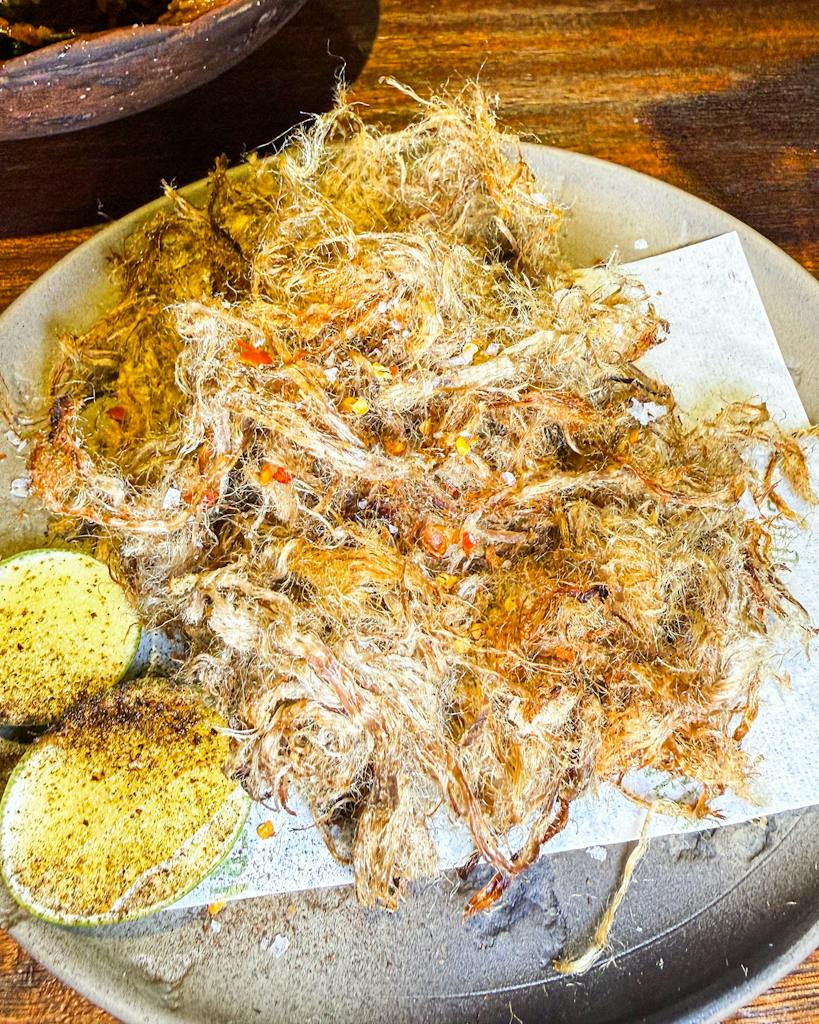
The carne seca (dried beef) was served in the shape of a disintegrating bird’s nest, from which diners pull twinelike strands that melt like cotton candy in the mouth. The fideo seco arrived at the table in a large bowl with raw egg yolk in the center. The server mixed the egg in with spoons before serving the noodles on corn tortillas, making a powerfully rich taco. The fideo made the shape of Mexico across the tortilla. It wasn’t deliberate, but it was auspicious. Other stunners included fish from Tamaulipas grilled over mesquite with a curry of goat’s milk and hidden lilies (a relative of ginger with bitter and mustardy notes) and bone marrow dressed in a costra and garnished with a vinegar-based chile-piquín salsa. Ribeye, aguja (chuck-eye steak), and arrachera (skirt steak) were equally heart-stopping (in a good way). It was my best meal of the year thus far.
There are a few hallmarks that you’ll find on most norteño-steakhouse menus. One is the Lilliputian, inferno-creating chile piquín. Adding it to marinades and salsas, “is the norteño way of doing it,” Núñez says. Others fideo seco; ribeye, a signature cut alongside arrachera; and guacamole capped with salty blocks of crunchy chicharrón, known as chicharrón norteño. More recently, there’s been an influx of tacos and bone marrow. Tacos were added to menus at customers’ demand after they saw how popular tacos had become worldwide. Once upon a time, “tacos were for the street, not the restaurant,” says Jonathan Vitery, a restaurateur and Monterrey native. “Now steakhouses have to serve them. People won’t come in without tacos.” Bone marrow was once complimentary at steakhouses. “Restaurants couldn’t give it away fast enough,” Vitery says. Now that it’s skyrocketed in popularity with affluent diners, it has also increased in cost. “[Bone marrow is] like caviar now,” Guajardo says.
This type of steakhouse has been spreading across the border. It makes sense in this beef-loving state, where norteño steakhouses offer a vibe similar to that of traditional Texas steakhouses, but with more diverse cuts at varied price points.
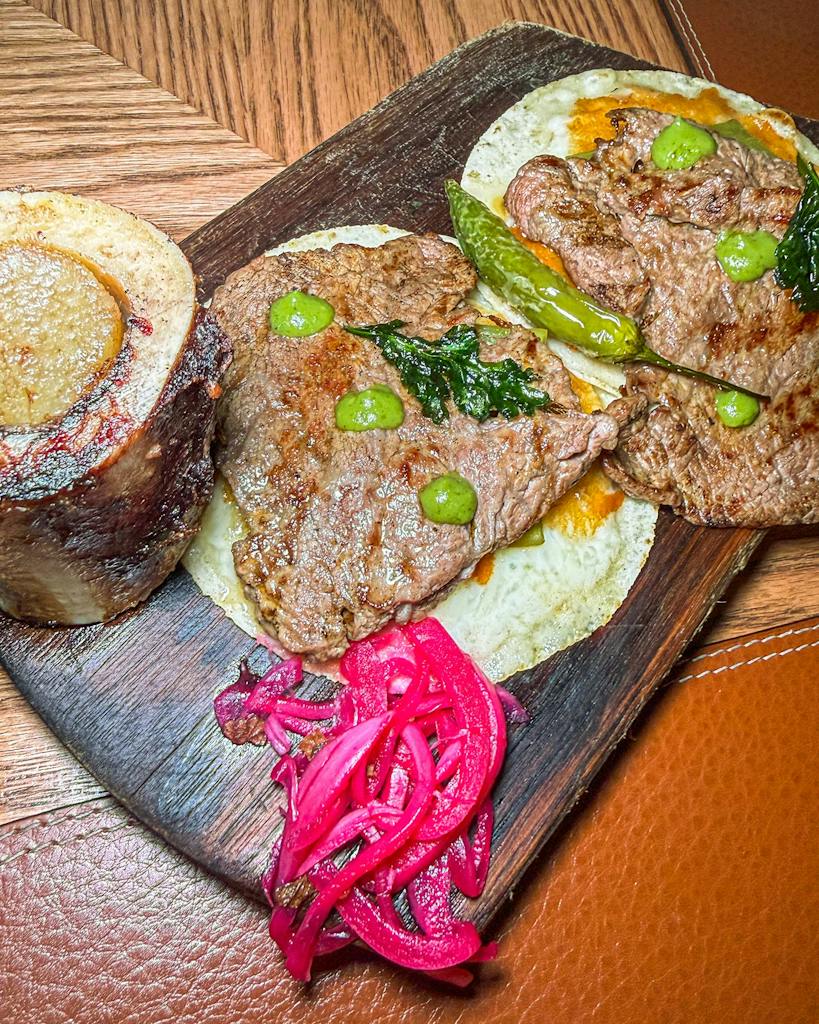
Palominos, a steakhouse chain that opened its original location in Hermosillo, Sonora, in 1974, expanded to McAllen in 2024. In its first U.S. restaurant, Palominos moved away from its paquetes-style ordering, in which an assortment of meats—massive beef ribs, skirt steak, sausages, and more—is available in affordable, family-style bundles. In Texas, the restaurant focuses on well-known individual cuts, such as filet mignon and tenderloin. Its Sonoran roots can still be found in the appetizers, which include burritos, tablitas, and guacamole with chicharrón. The tender and juicy ojo de ribeye, a premium cut, was $4.80 per ounce, which is expensive for the Rio Grande Valley, where the poverty rate hovers around 27 percent.
República Cantina de México, in Laredo, leans hard into the festive element, with electronic dance music and strobe lights surrounding diners eating ribeye with piquín-lacquered bone marrow, ribeye aguachile negro, and tacos. In San Antonio, Tu Asador attempts to replicate El Jonuco’s style. While it’s elevated in presentation and pricing, its flavors are bland and its plating choices quixotic. The empalmes are served in a manner resembling quesadillas. Though both are usually favorites of mine, I found the frijoles con veneno disappointing and the tacos de fideo greasy.
One norteño-inspired restaurant in Texas I highly recommend is Fort Worth’s Almacén el Gallo. Rodrigo Rivera-Río, a co-owner of a Michelin-starred restaurant in his hometown of Monterrey, balances accessibility, tradition, and creativity. A meal there evokes one you might have at a norteño steakhouse in Mexico. I enjoyed the shrimp tacos olvidados, roasted bone marrow, guacamole with smoked hoja santa, and ribeye, to name a few dishes.


I’m also eagerly anticipating the winter opening of Eledi, in Dallas, from chef Anastacia Quiñones-Pittman, a three-time James Beard Award semifinalist. During a telephone conversation, Quiñones-Pittman told me that Eledi is based on norteño live-fire practices and fine-dining carne asada.
“I think fire becomes part of the dish,” Quiñones-Pittman says. “It becomes an ingredient because it changes the vegetable, the meat, the tortilla, the salsas, and it changes the composition of everything that you cook.”
Although she insists that she’s not trying to replicate a restaurant from northern Mexico or Monterrey or Nuevo León, where her mother was from, it seems to me that Eledi will likely develop into something like Vernáculo, incorporating showstopping presentations and regional homage. It bodes well for the norteño-steakhouse model’s future in Texas.
The lines between what is Texan, Mexican, and American are blurring, leading to a new form of steakhouse that Suerte’s pop-up, Almacén el Gallo, and Eledi epitomize—or soon will. Núñez is planning another norteño-steakhouse takeover at Suerte early next year and is conscious of keeping the menu premium but affordable—a true marker of that kind of establishment. “Don’t raise the entry level,” he says, referring to prices. “Raise the roof.”
- More About:
- Mexico
- Fort Worth
- Dallas
- Austin


