


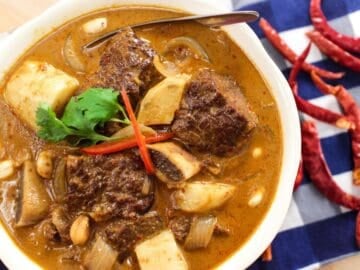
Moo Hong is one of the best things I make, and I know what a bold statement that is! Pork belly is slowly braised in soy sauce, palm sugar, garlic and black pepper until the meat is tender and the sauce is reduced until rich and luscious. It's salty, sweet, and off-the-charts umami. It's one of the best hidden gems of Thailand. It's also surprisingly easy to make, with very few ingredients!

Recipe Quick Overview - The TL;DR!
What is it? A Southern Thai dish local to Phuket. Braised pork belly in a flavourful sauce made primarily of soy sauce, dark soy sauce, and palm sugar, served with jasmine rice.
How to make it? Make a simple Thai herb paste with garlic, black pepper and cilantro stems. Saute the paste, then add the pork, sugar, soy sauces, chicken stock and let it braise for 2.5 hours.
Why you'll love it. The pork belly ends up incredibly tender and flavourful. The sauce is bold and balanced, and is incredibly when mixed with rice. 100% guaranteed to be loved by anyone who loves pork. Modification for chicken provided!
Cultural Background: Moo Hong and Its Peranakan Roots
Moo hong หมูฮ้อง is a specialty of Phuket, the island of sandy beaches that's one of Thailand's most famous tourist destinations. It's culturally different from other dishes I've shared because it is a Peranakan dish!
Phuket is the hub of Peranakan people in Thailand, and Thai Peranakans are mostly of mixed Hokkien Chinese and Malay descent. There's even a Peranakan museum in Phuket! The term Peranakan more generally refers to those who are born to a local Malay/Indonesian and a foreigner. Many of these foreigners are Chinese, but they may also be Arabic, European, or anything else. So a Peranakan person in Southeast Asia can be of various mixes, but the vast majority of those in Thailand are Chinese-Malay.
Not surprisingly then, you can find versions of moo hong in other countries where Peranakan people live. The version found in Malaysia and Singapore is called hong bak, and there is also a Hokkien Chinese version called kong bak as well. Spices and seasonings vary, but they are all some version of braised pork belly in soy sauce.
Ingredients and Important Notes
Here are all the ingredients you'll need and important notes about them. For amounts, see the the full recipe card below.

- Pork belly, cut in 1.5- to 2-inch cubes. When buying pork belly, choose a piece with as much meat as possible. I usually go to a butcher where I can ask them to cut me a piece that has a lot of meat. Traditionally, moo hong uses skin-on pork belly, and the skin adds collagen and richness to the sauce. If you don’t like to eat the skin, it is okay to use skinless pork belly, although if your pork comes with skin, it's easier to remove the skin after it's cooked as the pork will be very tender. If you want a dish with less fat, you can do half pork belly and half pork butt (a.k.a. pork shoulder) and cut the pork butt into 1-inch cubes)
- Soy sauce. I am using Thai soy sauce for this recipe, but Chinese regular soy sauce or light soy sauce will also work.
- Dark soy sauce. This adds that iconic dark colour and the rich flavour and is absolutely critical in this dish. Traditionally one would Thai black soy sauce, but I am currently unable to source it where I live, so I made this recipe using Chinese dark soy sauce (Lee Kum Kee), which works great. If you have Thai black soy sauce, you can use it, but because it is less salty than Chinese dark soy, at the final tasting stage be prepared to add more soy sauce or salt.
- Black peppercorns. While most Thai cooking calls for white pepper, Southern Thai food is unique in that it uses black pepper more than the rest of the country!
- Cilantro roots or stems. If you can get cilantro with roots, great, that is what we use traditionally. But if not, the stems will work just fine.
- Garlic
- Chicken or pork stock, unsalted. Store bought is fine as long as it's unsalted. You can also make Thai style chicken stock or Thai style pork stock.
- Palm sugar. Palm sugar quality varies greatly between brands. This is the palm sugar I use, and of the ones that are available overseas, it's quite good. You can also substitute dark brown sugar for this recipe.
- Optional spices. Some versions of moo hong use spices like cinnamon and star anise, and others don't add any. I personally prefer it without these spices so it tastes more distinct from our five-spice pork belly stew, but feel free to add it to yours!
Step-By-Step
Here's a bird's eye view of the process. The full instructions are in the recipe card below, and if this is your first time, I highly recommend watching the video tutorial to ensure success!

- Cut the pork belly into 1.5- to 2-inch cubes, then toss them with the soy sauce and dark soy sauce. If you have time, marinate for 30 mins and up to overnight, flipping once or twice in between. If you're in a rush you can just let it sit while you do the next few steps.

- Grind the peppercorns until fine using a mortar and pestle. Then add the garlic and chopped cilantro stems (I like to use scissors to cut them directly into the mortar.)

- Pound into a paste; it does not have to be super fine, but there should be no big chunks. This mixture of garlic, pepper, and cilantro roots/stems is called saam gler in Thai, and it is a basic herb paste that is often used in meat dishes.
Tip: If you don't have a mortar & pestle, you can grind the peppercorns in a coffee grinder, finely grate the garlic, and finely mince the cilantro stems.

- Saute the herb paste in a little bit of oil for about 2 minutes over medium heat, or until the garlic turns slightly golden and is aromatic.
Tip: Choose a pot that's just big enough for the pork to fit snugly together in one layer; for this recipe, a 7-8 inches diameter pot is perfect. If the pot is too large, you will need to add more liquid, which will then take longer to reduce to the right consistency.

- Deglaze with chicken or pork stock, scraping up everything that has stuck to the pot.

- Add the palm sugar, the pork, and all of the marinade. Make sure the skin is sideways so it is submerged. Cover the pot but keep the lid slightly ajar, and let the pork simmer gently on low heat for 1 hour, flipping them once in between.
Tip: The liquid level should be at or just below the pork; if there isn't enough, add a little water, but do not add too much.

- After 1 hour, it should look like this. Now open the pot to allow the sauce to reduce, and keep it simmering gently on low heat for another 1.5 hours for a total cooking time for 2.5 hours. Come back to flip the pork a few times during this time so both sides get a chance to be submerged.
Tip: During this time, keep an eye on the liquid amount to make sure it does not dry up too fast. If the liquid goes below halfway up the pork pieces, top it up with water so it sits at about the halfway point.

- When it is done, it should look like this! The sauce should be significantly darker than before. Poke the meatiest piece of pork with a fork, and it should go in with no resistance. Check the skin also, a fork should easily go through it. If it's a bit tough, add more water and keep it cooking longer.
Tip: 2-inch pork pieces should take about 2.5 hours. If you cut them a bit bigger, they might take 3 hours. If you cut them smaller, it may take only 2 hours. Always check with a fork, and don't just go by time.

- Skim and taste - very important! Before you can taste the sauce, you have to remove the fat. Tilt the pot and use a thin ladle or spoon to skim off the fat until you can no longer skim without losing too much sauce along with it. Once you can access the sauce, taste it; it should taste strong, leading with salt and followed by sweet to balance. If it's overly salty, add a little water to dilute. If it tastes weak and the sauce is watery, reduce it further.
Tip: If not serving today, you can refrigerate and remove the solidified fat off once its cold.

- Plate and garnish with chopped cilantro leaves. Serve with jasmine rice!
Pro Tip: Reusing Leftover Sauce & Chicken Hong
You may find yourself with sauce leftover, if that's the case, don't throw it out! It took hours to create this luscious, rich, peppery sauce full of umami, you gotta use every last drop!
I recommend cooking some chicken in this sauce. Simply cut up some boneless chicken thighs into ½-inch thick strips, and let it simmer gently in the sauce until cooked through. No need to add any liquid as the chicken will release juices as it cooks. That's it. You'll have yourself a delicious bowl of chicken that you can put on rice. You can also try cooking thinly sliced pork shoulder in this sauce.
Or try making "chicken hong"! If you don't eat pork, or you are just short on time, use chicken thighs! Cut each thigh into about 4 chunky pieces, and follow the recipe as is but let it braise only for about 30 minutes or until fork tender with the lid open the whole time. You may need to crank the heat at the end to reduce the sauce further.
Save this recipe!
Other Dishes to Serve with Moo Hong
Thai meals are all about "balance," so it should be no surprise that moo hong is not typically the only thing we are eating in a meal because it's too rich and fatty on its own. You want to pair it with something lighter and leaner, maybe with a bit of a spicy kick! Here are some suggestions:
- Any kind of Thai salads. Thai salads are by definition bright, spicy, lean (no oil in our dressing!), and fresh, the perfect thing to balance the heaviness of moo hong! Any of my salad recipes will be great, but my top picks would be: boiled egg salad (yum kai tom), corn and cucumber salad (tum tang kao poad), and my signature spicy brussels sprouts salad.
- Vegetables! If you're really short on time, a quick veggie stir fry will do the trick with very few ingredients and literally 5 minutes cooking time. Garlicky cabbage fish sauce stir fry never fails, and neither does this Chinese broccoli oyster sauce stir fry. And the old classic mixed veggie stir fry is also a good fridge cleanout dish.
- Leaner proteins. There isn't that much meat on pork belly compared to other cuts, so you may want to supplement your meal with some lean proteins. Here are some really quick and easy meat dishes you can add to this meal: Chili garlic chicken requires very few ingredients, pad prik king (chicken and curry paste stir fry) will be a nice flavour contrast, and pan fried fish with sweet and sour chili sauce (pla raad prik) will add acidity to the meal.
- Light and brothy soups. Thais LOVE to have soups in our meal to "wash down the rice," and a tart, spicy brothy soup is the perfect thing to sip in between fatty bites of moo hong. Try tom yum soup with fish, or to stick to the southern theme try Southern turmeric chicken soup. If you have kids, this light chicken potato soup is always a hit.
Advance Prep Tips
This recipe takes a few hours from start to finish, so here are some ways to split up the work to make it easier
- Marinate the pork a day ahead. Then the next day you just make the herb paste and drop the pork into the pot!
- Make the whole dish a day ahead. This has a couple of benefits: the pork will have time to further absorb flavour, so if you do this you can skip marinating altogether. The fat will also be solidified and easier to skim off, so you can leave the fat skimming and final sauce adjustments on serving day.
Storage & Reheating
This dish keeps really well, and it will keep in the fridge for at least a week. Simply reheat in the microwave until the pork is hot all the way through, but the large amount of fat may "pop" in the microwave, so use a cover when reheating! I'd also consider using 70% power for a longer time for more even heating, and/or cutting the pieces in half prior to microwaving.
If you're reheating it in a pot, keep in mind the chunky pieces of pork will take 4-5 minutes to heat through, so consider cutting it in half before reheating. Use low heat, and it may take a little added water to keep the sauce from drying up during the reheat.
Before you start, if this is your first time, be sure to watch the video tutorial to ensure success!

Southern Thai Braised Pork Belly in Soy Sauce (Moo Hong)
Equipment
Save this recipe!
This recipe may contain affiliate links.
Ingredients
- 1.5 lb pork belly, cut in 2-inch cubes (see note 1)
- 2 Tablespoon soy sauce
- 1 ½ Tablespoons dark soy sauce, see note 2
- 2 teaspoons black peppercorns
- 10-12 Cilantro stems, chopped, save the leaves for garnish
- 1 oz garlic, about 6-7 large cloves
- 1 Tablespoons neutral oil
- 1 cup chicken or pork stock, unsalted
- 3 Tablespoons palm sugar, finely chopped, packed, or sub dark brown sugar
- Optional spices: 1 cinnamon stick 4-6 inches and 1 star anise , (see note 3)
- Jasmine rice, for serving
Notes
- When buying pork belly, choose a piece with as much meat as possible. Traditionally moo hong uses skin-on pork belly, and the skin adds richness to the sauce, but if you don’t like to eat the skin, it is not necessary. If you want a dish with less fat, you can do half pork belly and half pork butt (cut the pork butt in 1-inch cubes).
- Traditionally this recipe uses Thai black soy sauce, which I can't get here so I used Chinese dark soy sauce for this recipe. If you have Thai black soy sauce, you can use it, but because it is less salty than Chinese dark soy, be prepared to add a bit more soy sauce or salt at the tasting stage.
- Some versions of moo hong use spices like cinnamon and star anise. I personally prefer it without, but feel free to add it to yours!
FULL VIDEO TUTORIAL
All my recipes come with step-by-step video tutorials with extra tips not mentioned in the blog post, so make sure you watch the video to ensure success. If you enjoy them, consider subscribing to the YouTube Channel to not miss an episode. Thank you!
Subscribe to my YouTube ChannelInstructions
- In a ziptop back or a dish just large enough to hold the pork, marinate the pork in both the soy sauces for 30 mins and up to overnight, stirring or flipping the pork once in between. If you’re in a rush, just let it sit while you do the next few step; any marinating time is better than nothing!1.5 lb pork belly, 2 Tablespoon soy sauce, 1 ½ Tablespoons dark soy sauce
- In a mortar and pestle, pound the black peppercorns until fine, then add the garlic and cilantro stems and pound into a paste - it doesn’t have to be super fine, but there should be no big chunks.2 teaspoons black peppercorns, 10-12 Cilantro stems, 1 oz garlic
- In a pot just large enough to fit all the pork snugly in one layer, put it on medium low heat and add the oil and the herb paste. Saute the herb paste for about 2 minutes or until it starts to turn golden.1 Tablespoons neutral oil
- Deglaze with the stock, scraping off anything that’s stuck to the bottom. Add the palm sugar, followed by the pork pieces and all of the marinade, making sure the skin is sideways so it is submerged. If you want to add the spices, add them at this stage. The amount of liquid should be at or slightly below the level of the pork pieces; if it is much lower, add a little more chicken stock or water.1 cup chicken or pork stock, 3 Tablespoons palm sugar, Optional spices: 1 cinnamon stick 4-6 inches and 1 star anise
- Bring to a gentle simmer on medium heat, then turn the heat down to low and cover the pot loosely, keeping the lid slightly ajar. Let the pork simmer gently for 1.5 hour, flipping the pork once or twice in between so the part that is above the liquid gets a chance to be submerged.
- After 1.5 hour, open the lid and continue to braise for another 1 hour, or until the pork is completely fork tender (if you cut the pork smaller than 2 inches it may take less time). We want to keep the lid open during this stage to reduce the sauce, but keep the heat low and the bubbling very gentle so it does not dry up too soon. During this time, stir or flip the pork a few times so the part that’s out of liquid gets a chance to be submerged. The final amount of sauce (not including the fat) should come up between a third to halfway up the pork pieces; if it is drying up too quickly, add a splash of water.TIP: In the last hour of cooking, regularly check on the amount of sauce to make sure it isn't too low and at risk of scorching. Be sure to look at the amount of the dark sauce at the bottom, and not the layer of fat at the top! When in doubt, add a little water to give yourself a bigger buffer.
- Once the pork is fork tender, tilt the pot and use a thin ladle or spoon to skim off the fat from the surface; you can stop when you can no longer skim without losing a lot of sauce along with it. If not serving today, you can refrigerate and remove the fat once it’s solidified. Discard the fat, or keep it for cooking.
- Most important step: final seasoning adjustment! At this point, the dish should look saucy, but not soupy. Taste the sauce; it should be strong and flavourful, but not too salty. If it tastes overly salty, add more water to dilute. If it tastes too mild and there is too much liquid, you can remove the pork pieces and cook the sauce for a few more minutes to reduce.
- Serve with jasmine rice, ideally with a side of vegetables or a salad!Jasmine rice





Tin says
This is a wonderful recipe - easy to follow directions and the result was very tender and tasty. I didn't have stock on hand and used water instead. I also substituted cilantro roots for the stems since I have those available.
Thank you for sharing.
Callie says
This was phenomenal!! We were able to get skin-on pork belly and our CSA farm share had cilantro with the roots so we were able to follow the recipe totally.
The house smelled heavenly while it cooked. The pork belly was melt in your mouth tender with amazing flavor.
This one is a total keeper! Thank you for sharing it with us.
C says
I really loved it but I have a question. How quickly should one use the sauce? 🙂 Kind regards, C
Pailin Chongchitnant says
You mean the leftover sauce from the dish? Would last at least a week in the fridge.
Madeleine says
Saw this recipe this morning and ran out to get pork belly. I had to simmer uncovered about 30-45 minutes more than 1-1/2hrs but the result is delicious. Such an easy recipe.
Matthieu says
Thank you for your superb recipes which I use very often. Is it possible to substitute indonesian kecap manis for black soy sauce ? I guess that in this case the sugar should probably be removed ?
Pailin Chongchitnant says
I think that should be fine, and yes, I would omit the sugar altogether to start, and you may need to add more at the end when you do the tasting.