EXCLUSIVE!
It was a select few who took the controls of the Anglo-French supersonic airliner, whether for testing or in service. The challenge, and the experience, was never to be taken for granted. To mark the 50th anniversary of the type’s maiden flight, the sole surviving manufacturer’s Concorde test pilot describes five memorable years at the sharp end

“With no instruction whatsoever, I found myself in a dreadfully archaic three-axis simulator”
Concorde was not an easy aircraft to fly. By that I don’t mean it was difficult, just that it was rather better flown by an above-average pilot. The real issue was getting onto the beast in the first place. With only one or two exceptions, unless you worked either for the manufacturer or the customer you stood little or no chance. Over a period of some seven years there were six prototypes involved: three with the British Aircraft Corporation at RAF Fairford and three with Sud Aviation/Aérospatiale at Toulouse.
The Fairford trio notched up just short of 3,000 hours between 1969 and 1976, and to play a part in that was a highlight of my career.
I had flown for 20 years before I joined BAC in 1968 as a One-Eleven training and test pilot, based at the Wisley flight test centre but flying globally. Special memories of Wisley include seeing ‘Dizzy’ Addicott with the Vimy replica in 1969 and David Lockspeiser’s first flight in his selfdesigned and built LDA-01. They both shared an office next to mine and we often flew together in the company DH Heron or Beagle 206 communications aircraft. Unforgettable characters, superb pilots.
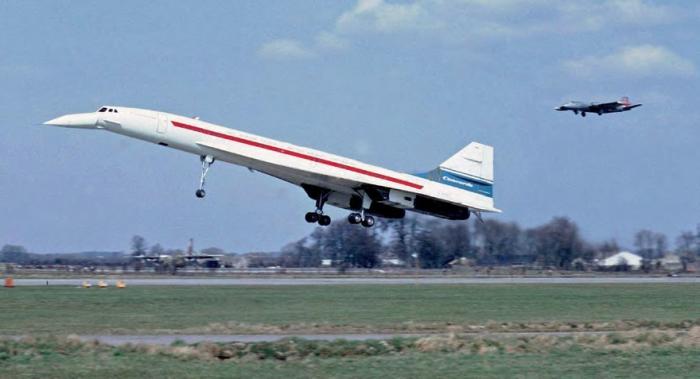
With the closure of Wisley in 1972, and by dint of good fortune in surviving numerous redundancies, I found myself at Fairford in 1973 — close to Concorde but not yet flying it. The first Concorde to arrive at the Gloucestershire base was 002/G-BSST, at the conclusion of its maiden flight from Filton on 9 April 1969. It wasn’t until 17 December 1971 that the second, 101/G-AXDN, followed. Eventually there were 11 test/training pilots to fly those aircraft, plus 202/G-BBDG, which joined the fleet on 13 February 1974.
Brian Trubshaw, flight test director and chief test pilot, himself flew almost half of the total test hours.
No problem there, as responsibility for the programme lay on his able shoulders, but it left the other 10 of us scrambling for the remaining half of the flying time. I was very pleased to be invited to join the team at Fairford, becoming the youngest of the pilot line-up. Five flight engineers and three navigators made up the rest of the aircrew, complemented, I must say, by a very professional and capable team of flight test engineers backed by a superb flight test department under the leadership of Bob McKinlay.
In April 1973 things changed. With no instruction whatsoever, I found myself in a dreadfully archaic threeaxis Concorde development simulator at Toulouse, practising four-engine flame-out procedure. Much more importantly, I was given a spare seat on 002 observing Brian Trubshaw flying a period of circuits and bumps.
At that time flying clothing was an important issue, for this was no champagne and caviar enterprise. What I call the ‘A’ crews flew with a combination of immersion suits, partial pressure-breathing suits, bonedomes, oxygen systems (plus emergency oxygen), lifejackets, parachutes, dinghies and so forth. It was very, very expensive kit and, as I recall, only five full sets were available. This was necessary to enable the crew to bail out of the aircraft in a dire emergency via two escape hatches, fitted to the first two British aircraft, which were blown explosively out of the fuselage. Early in the programme, if any of this kit didn’t fit you, you couldn’t fly. Water ingestion trials were to play a big part in my life during 1973.
The flight test department created a trough on the stand-by runway/parallel taxiway at Fairford, which was then filled with various depths of water. We would drive Concorde 002 through at speeds ranging from 30 to 130kt to see if the engines would ingest water and surge — they did. A suitable spray deflector was eventually produced but only after further extensive trials on 101 in 1974. Apart from this, I took part in simulator exercises at Toulouse, rehearsing London, New York and Paris arrival and departure procedures.
All of this was fine but it wasn’t getting me airborne in a Concorde. So, I hit upon the idea of volunteering to fly our Canberra. If successful, I would at least get onto the flying programme.
The Canberra was used for chase duties, continuation flying and, as I was to find out, delivering flight recorder tapes back to base for analysis, which was to be my role. My fellow training pilots were not interested, so I had a clear field, should I be approved.
John Cochrane, my immediate boss as the deputy chief test pilot, went along readily with my request and set about seeing that I would have a proper conversion. It was, after all, a Ministry of Defence aircraft rather than a BAC one.
Canberra WH793 was an oddball. Ex-RAE Aero Flight, ex-Farnborough, the prototype PR9 — there wasn’t another quite like it. Those who knew more than I said it was a ‘Mk7/8/9’. From that I gathered it had more powerful engines and a larger centre wing section. Well, maybe. All I knew was that, as a much-developed prototype, the cockpit was a mess.
I duly went to Boscombe Down for aeromedical lectures, the decompression chamber and other tortures. It was all very necessary and overseen by a delightful gentleman who would start the day with a friendly greeting and a champagne cocktail. Memorable!


My conversion included a course at the School of Combat Survival and Rescue at RAF Mount Batten.
There were lots of interesting lectures, culminating in our sailing out of the harbour and into open waters where we went off the back of the boat. Sometimes we would jump, sometimes we were towed on the end of a strop; eventually we ended up in a dinghy.
Both single and multiple crew drills were covered. My overriding memory is that the emergency locator beacon device in the Mae West, so amply covered in the lectures, was now a piece of yellow-painted wood.
For the flying part, I went off to Boscombe Down and completed three dual sorties in a Canberra T4 before going solo. Then it was back to Fairford to fly WH793. My introduction to ’793 was near-farcical.
Having kitted-up, established myself in the cockpit with a brave volunteer navigator, strapped in and started engines, all I had to do was transmit for taxi clearance. Could I find the transmit button? No way. It certainly wasn’t where it was in the T4. After lots of hand-waving, eventually I heard a click, so it was there somewhere. In fact, it was out of sight on the front of the control yoke. A mess, as I said.
A week after that I had my first Concorde flight as second pilot to my friend Peter Baker in 002, conducting icing trials. What a Christmas present — two famous types in one week. I was now an MoD test pilot to boot!
Flying 002 was quite an experience. For a start we had to wear most of the safety kit; happily, I managed to fit into enough of it. There were four crew on that flight deck, for unlike later aircraft 002 had a navigation station. This was necessary because the preferred inertial navigation systems were not ready in time for the pilots’ and flight engineer’s positions. The navigator had a dated inertial system and a non-directional beacon under his control, and a lot of responsibility.
Much of our initial testing was carried out over the Bay of Biscay with London Military radar keeping a watchful eye. We communicated via a specially allotted radio frequency.
There were specific flights down the west coast of the UK and other areas for the purpose of monitoring sonic booms and attendant complaints, genuine or otherwise. Some sorties went further afield and occasionally we flew as far as 40° west, into Gander airspace and back, simulating a full trans-Atlantic crossing. Of course, much earlier 002 had flown a world tour, but not with me.
And then there was the metal visor, which streamlined the nose and shielded the windscreen from overheating in flight. As the stateof- the-art glass was not sufficiently advanced for the two prototypes, metal was used. This meant that when the nose and visor were raised after take-off at, say, 250kt, forward visibility almost vanished, though a basic periscope device gave some forward vision. Happily it always retracted for landing, otherwise things would have been interesting.
It goes without saying that the arrangement was totally unacceptable for certification and airline use.
1974 started off well, as on 9 January I flew to Tangier as assistant crew member with John Cochrane and Eddie McNamara in G-AXDN. Flight level 540, Mach 2.06, two hours 15 minutes — this was the life.
This aircraft was to fly an extensive period of intake development, enduring many engine surges. My job was to fly the recording tapes back to Fairford in the Canberra for analysis and then return to Tangier.
In general, this took an hour longer in flight time than in Concorde. After a week — from which I still have my Moroccan fez — I was allowed to ride on board ’DN as we went back to Fairford in one hour 40 minutes. The exercise was repeated in April. My next few weeks were spent on icing trials in 002. We picked up a lightning strike but not much ice, perhaps unsurprisingly for me, as in my flying career I was ‘struck’ 13 times.
By far the biggest event of February 1974 was the arrival at Fairford of aircraft 202, G-BBDG. With a small group of people I watched her land, and we were immediately struck by her beauty. The long productionstandard fuselage, of nearly 205ft, added grace to an already beautiful aeroplane. I didn’t have too long to wait for my first flight in her, either. I even flew her three times in one day.


“The flying controls matched the flight instruments in terms of precision and one could fly it to a knot, a foot or a kilo”
On 17 July John Cochrane and I flew ’DG to abeam the Canary Islands and back in three hours 35 minutes, reaching FL570 and Mach 2.12 — and all of this in shirtsleeves. In my logbook I commented, “simply the greatest”, and it was. This Concorde was a delight to fly. The flying controls matched the flight instruments in terms of precision and one could quite easily fly it to a knot, a foot or a kilo.
With three inertial systems and a glass visor, you also knew and could see where you were going.
A welcome variation to testing was a seat next to John Cochrane when we flew an air display at the Filton Families Day in ’DN. Equally excitingly, I was given some chase flying in the Canberra on ’DG. To fly Concorde was, of course, the best thing, but to sit on its wingtip was something else. In a word, awesome. Not a lot of people have done that and, believe me, it was special.
I did quite a lot of formation flying during my time in the RAF: Meteors, Venoms, that sort of thing. Providing you know what you’re doing, it’s no big deal. But with Concorde it was something else. For a start, there was its sheer elegance, and then the noise.
In the Canberra you could clearly hear the four Olympus engines screaming at you. Most of all, you had the feeling that the Concorde was drawing you in towards it, so holding station was very demanding. I remembered the North American XB-70 which was destroyed when an accompanying F-104 drifted into a collision, partly due to the Starfighter being affected by the Valkyrie’s wingtip wake vortex.
The amazing thing was that with all this power, beauty and drama close at hand, the flight test engineer sitting next to me and filming ’DG was capturing the water flowing from the drain mast, while his colleague on ’DG was pouring soapy water down the galley sink. It sounds trivial but it was important that fluids cleared all sensitive areas of the aircraft, such as those used for instrumentation.
For me, 1974 was the greatest and perhaps the most memorable of my 50 years of flying. It finished off back on the ground with more water ingestion trials in 002.
A different sort of icing test, meanwhile, involved flying behind a specially modified Canberra B(I)8, WV787, from Boscombe Down.
It sprayed water from a large pipe connected to a tank in its bomb bay, while we positioned the intakes on Concorde’s number one and two engines into the spray and looked for engine icing. It was a bit like doing long-distance in-flight refuelling.


“Disappointingly, we heard BA had criticised the standard of training. The 30 per cent failure rate was a shame”
1975 brought a lot of mixed flying for me on ’DN and ’DG, plus the all-important start of British Airways crew training. In the spring, BA produced a nucleus group of crew for type instruction on the Toulouse simulator, basic as it was.
These pilots were eventually to take part in the route proving flights prior to the granting of a certificate of airworthiness.
With our five training pilots having been denied a lot of aircraft time, and hardly any left-hand seat captain’s time, this presented a bit of a dilemma. The solution was that a training pilot would accompany a test pilot to see that the simulator training progressed along near-conventional airline lines — proper briefings, checklists and so on. It all seemed to work. The BA pilots were exceptional chaps and a pleasure to fly with. A dose of mutual goodwill resulted in a satisfactory conclusion, at least from BAC’s point of view.
Interestingly, an increased awareness of the disparity between the salaries of the two bodies of aircrew resulted in BAC paying a Concorde allowance. Mine was an extra £500 per annum — I would have done it for nothing.
Another difficulty then reared its head.
The pending route proving had to be carried out with a mixed crew composed of BA and BAC captains. No problem, except that the senior test pilots didn’t have the necessary CAA licences to match the BA captains. Of course, neither did the BA captains have test approval.
There was a two-pronged solution. Firstly, our training pilots, who had licences equivalent to those of the BA pilots, were given training on the aircraft. Yes, that’s right: after two years of testing it, we finally received type training, which we obviously enjoyed. Secondly, the senior test pilots were given ex gratia licences by the CAA under the proviso that they could only be used while in the service of BAC. This effectively put the most experienced pilots on the aircraft and kept the training pilots, including me, off it. As I had spent the whole year of 1959 studying for these licences while on the dole at £6 a week, I was understandably miffed, and far from alone in that.
However, I did get a small consolation prize. I was allowed to fly and captain the first productionstandard aircraft, G-BOAC, to Heathrow for the start of the trials, with my wife sitting on the jump-seat behind me. By and large I believe the route flying went off well, but resulted in a very senior BA captain being taken off the fleet. I remember him most kindly.
There was a range of flight-testing to do that year on ’DG, ’DN and now ’AC. Memorable missions included a trip to Beirut with Gordon Corps, the CAA’s Concorde project pilot, who was responsible for the certification of the aircraft. As BA’s examples started to come off the Filton production line, I also flew G-BOAA on its second production test flight with John Cochrane.
The big event of 1976 was the coming on-line of the Concorde flight training simulator at Filton. Under the supervision of test/training pilot Johnnie Walker, many hours were spent on perfecting this magnificent device, a modern — and expensive — full-blown six-axis simulator. Sadly it was without a computer-generated visual system and suffered somewhat as a result. Rather like 002, it was both a little behind and ahead of its time in some areas. However, it was ready for the contractual training of BA crews, which would result in their taking over the production aircraft in due course. I always thought Johnnie Walker never received full credit for the work he put in to the commissioning of simulator AC19.
My friend and colleague Paddy Cormican, a popular test/training pilot, and I spent many hours devising the training programme necessary to meet the requirements of the CAA licensing department and BA. Eventually our planned course involved 85 hours of shared simulator time between captain and co-pilot, followed by nine hours on the aircraft.
The aircraft time was very necessary because the simulator wasn’t really up to teaching the final stages of landing.
Training BA was a challenge to us all, not helped by the disappearance of Trubshaw and Walker on an overseas trial to South Africa. ‘Mr T’ didn’t like simulators. The task fell to the remaining test pilots, aided by the training pilots. I personally found it most stimulating. Happily for me, my principal students were Senior First Officer Christopher Orlebar and Capt Leo Budd. Chris was, quite frankly, exceptional. I didn’t have to train him — I just set up the simulator and off they went, with Chris training himself and keeping a good eye on his captain.
Sadly no longer with us, Chris was the author of what I consider to be the finest book on Concorde.
Rather disappointingly, we heard BA had criticised the standard of training. I suppose, to be fair, it was an expected result of all that had gone before with the varied crewing. For my part, I knew I was training some exercises I hadn’t seen before. The resulting 30 per cent failure rate was a shame, particularly after a fivemonth course, but when BA took over training we heard the rate was comparable. To us it all pointed to the initial selection system. Any such system based on seniority will not necessarily produce the best results.
The choice of crew for the route proving trials nucleus group was proof of this, with no failures.
With the certification of the aircraft, prospects of future Concorde flying for our pilots were going to be limited, if they would exist at all. However, I did manage a short tour to Casablanca with Peter Baker in ’DG flying contingency power tests.
Contingency power could be used in an emergency during take-off and increased engine power with a fuel flow of some 85 tonnes per hour. We did have a problem during one test flight, when we dumped 40 tonnes of fuel and landed.
Worried about a possible lack of flying I took the radical step of signing up for the RAF Volunteer Reserve. I joined No 6 Air Experience Flight at Abingdon and flew air cadets in Chipmunks whenever I could. A contrast to Concorde, for sure. Quite what ‘Mr T’ thought I have no idea, as we never had the conversation.
After a few production test flights in G-BOAB and ’AD, as well as the faithful ’DG, our world changed. The future of the Fairford flight test centre was in question, but I was saved from redundancy by being seconded to Monarch Airlines to fly Cyprus Airways One-Elevens out of Larnaca.
There were four Concorde training pilots in our party and we did a lot of flying, both training their pilots and plying the line routes. When our time was up in 1977, two of my colleagues remained in Cyprus full-time.


“I returned to the UK to find the facility at Fairford closed and my office packed up in a cardboard box at Filton”
I returned to the UK to find the facility at Fairford closed and my office packed up in a cardboard box at Filton.
With the aircraft having received its C of A and now in service, there wasn’t going to be much test-flying. G-BSST had been taken to Yeovilton and G-AXDN was bound for Duxford, both for museum display. For flying at Filton there was a well-used HS125, G-AVPE, plus the much-altered prototype One- Eleven, G-ASYD, and — happily – Concorde G-BBDG.
Several redundancies and retirements meant I was now one of only four Concorde test pilots, an improvement on number 11. I also became the in-house instrument rating examiner, which further strengthened my position, for even the boss needed an annual instrument rating to preserve the validity of his licence — power at last!
In the summer of 1977, by which time BAC had become British Aerospace, I was sent to Casablanca to assist with intake trials on ’DG.
Gordon Corps from the CAA also took part. Eight months later, in early 1978, I was the only qualified pilot available to crew ’DG with Brian Trubshaw on a fortnight’s trial, again in Casablanca. Eight months’ time off the world’s fastest passenger aeroplane — no problem there, then…
Why Casablanca? In order to get the maximum power, height and speed out of the aircraft you had to fly high and in cold air. Near the equator is where the cold upper air is. We were testing a revised thin lip to the engine intake offering improved performance.
Casablanca was an ideal base for this with its relatively quiet airspace. With a team of some 50 engineers and two flight engineers, Brian Trubshaw and I positioned out there.
A typical flight would be to turn south when airborne and pass between the Canary Islands and the African coast while accelerating. We were normally supersonic in nine minutes and climbing to find the conditions required. The coldest I ever saw was an outside air temperature of -83°C, with a skin temperature of +118°C. The maximum permitted skin temperature was +127°C. On one sortie we achieved Mach 2.21 and FL620, not far off the fastest Concorde speed of all, which stands at Mach 2.23 and was achieved by G-AXDN.
It is important to realise that a jet engine will not accept supersonic air and operate normally. While Concorde was flying at speeds of up to 1,400mph/Mach 2.2, say, the air in the intake has to be subsonic, in the order of Mach 0.50. This was achieved by a system of moveable ramps and spill doors in the intake, fully automatic but capable of being controlled by the flight engineer. These basically reduced the speed of the air in the 12ft intake by nearly 1,000mph, one of the many miracles of Concorde.
Just short of the equator we would turn about and head back north. I often wondered if we boomed the Canaries. I remember quite well when I was based in Cyprus that the BA flight to Bahrain would regularly boom the island, enough to make you jump off your sun lounger.
For the intake tests, once on station the flight engineer would take control of the intake ramps/ doors and open them slowly until the engine surged. Sometimes this would trigger off a sympathetic surge in the adjacent engine. It is not pleasant, and a four-engine surge was all hell let loose. In a bad case there could be severe mechanical consequences, as the French found with an intake destroyed and engine damage on 001.
As conditions changed during the flight, further surges would be induced. Information received would eventually be programmed in to the digital control system to ensure safe, smooth, automatic operation in airline service. Intake testing took place over many years, as the success of the aircraft depended upon it. Our last tour at Casablanca was in 1978, and the return leg to Filton marked the end of my Concorde flying.
For the next decade I continued to do occasional work on the Filton Concorde simulator, in-house instrument ratings on the whole, with some training of CAA, Accidents Investigation Branch and US Federal Aviation Administration pilots. On Christmas Eve 1981 I witnessed ’DG’s last landing at Filton, quite a sad occasion. After a time standing alone like a beached whale, it was bought by BA for spares and housed in its own exclusive hangar. Eventually, of course, it was taken to pieces by an excellent team from Air Salvage International and transported down the M4 to Brooklands Museum where it now rightly stars, a huge attraction alongside its much-modified flight simulator. With its sister test aircraft now superbly displayed at Yeovilton and Duxford, there are many opportunities to recall probably the most extensive flight-test programme ever undertaken on a commercial airliner.
WHERE ARE THEY NOW?
002/G-BSST Fleet Air Arm Museum, Yeovilton (owned by Science Museum)
101/G-AXDN Duxford Aviation Society British Airliner Collection, IWM Duxford
202/G-BBDG Brooklands Museum, Weybridge


