 EN | English UK
 DE | Deutsch
 ES | Español
 FR | Français
 IT | Italiano

Datassential has facilitated innovation sessions for food and beverage teams of every size. Here’s what separates the ones that fill a pipeline from the ones that fill a whiteboard and stop there.
Almost every food and beverage company runs innovation sessions, and almost every one runs them differently. Some are half-day workshops with a tight brief. Some are two-day marathons with a hundred sticky notes. Some are a handful of people in a conference room trying to name next summer’s limited-time offer (LTO) before lunch.
While there isn’t one right way to do it, Datassential has a clear point of view on what works after years of helping clients plan, facilitate, and follow through on these sessions. It starts with a reframe.
A good innovation session might give you fewer ideas. But it will give you better ones. Generating innovative ideas isn’t about volume; it’s a list of concepts grounded in data, pressure-tested for feasibility, and ready to act on. You may walk out with dozens of ideas instead of hundreds. That’s a win, not a shortfall.
Why Food and Beverage Innovation Deserves a Better Process
Innovation sits behind more decisions than most teams give it credit for: in addition to net new products or limited-time offers (LTOs), innovation can mean reformulations, fitting a product to new engineering parameters, deciding where to put promotional, marketing, and sales support, or menu optimization, including determining which SKUs to cut and which to double down on.
The market rewards it. Operators who emerged strongest from both the 2008–2010 recession and the COVID-19 pandemic were the ones that kept investing in new products, processes, and technology, rather than leaning solely on price increases.
Consumers are asking for it, too. Three-quarters of consumers are motivated to visit an operator specifically to order an LTO, a number that is even higher among Millennials (88%) and Gen Z (84%). Roughly a third of consumers are more likely to order an LTO if it was something they couldn’t get anywhere else, indicating that novelty and uniqueness can help win consumers over.

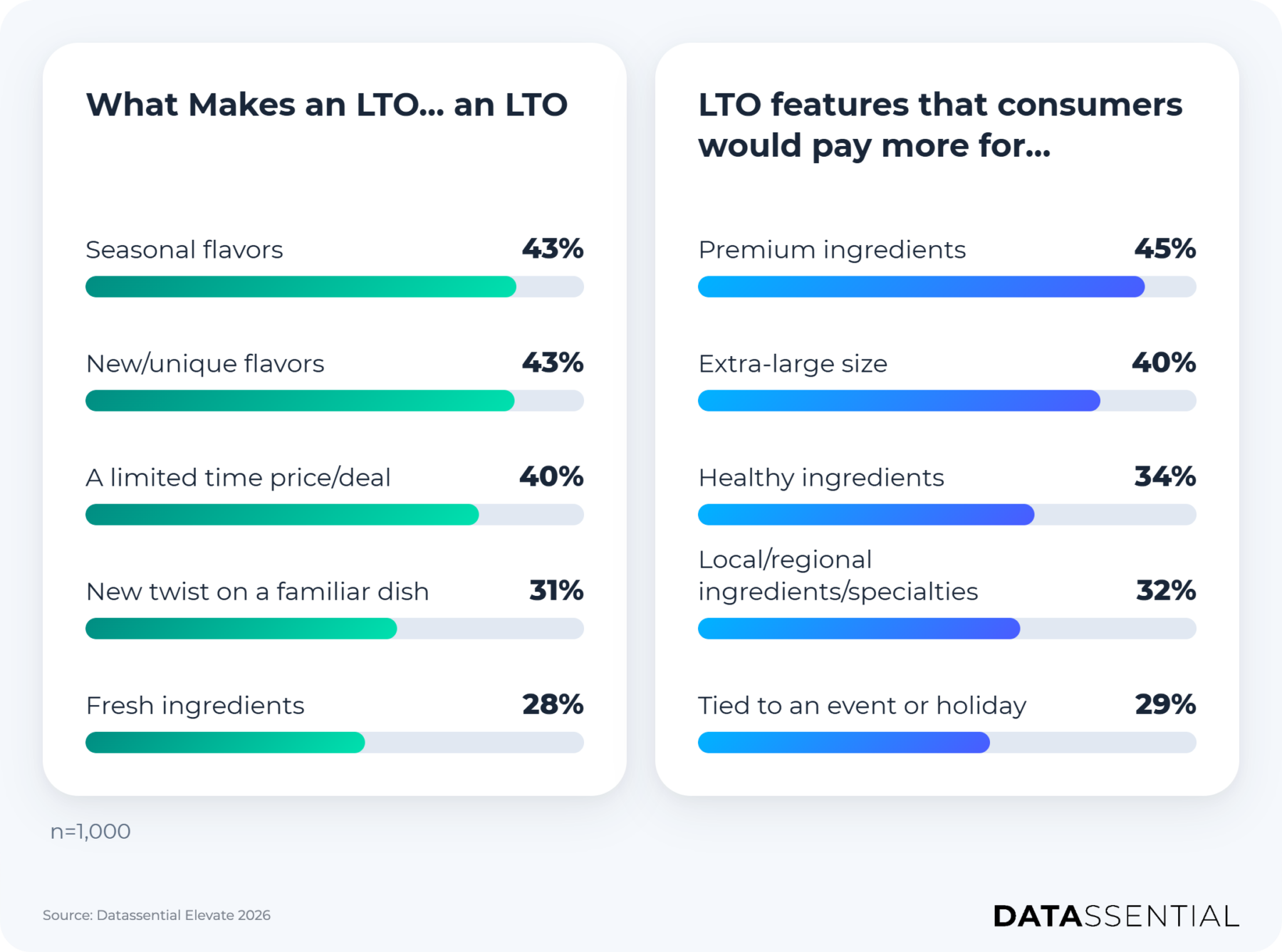
Newness doesn’t have to mean novelty for its own sake. Around 30% of consumers are looking for a new twist on a classic or a strong mid-priced value play. Seasonal flavors (43%), unique flavors (43%), and fresh ingredients (28%) are among the top qualities that consumers believe make an LTO an LTO, and many of these moves don’t rock the boat operationally. Consumers also say they’ll pay more for premium ingredients (45%), extra-large sizes (34%), and healthy ingredients (34%), as long as those benefits are called out.
In short, innovation is a demand signal, not a nice-to-have. The question is how to do it well.
Step 1:
Pick the Right Format
Before anything else, decide what kind of session you’re running.
We typically work in one of three formats:
Facilitated ideation workshop
8–15 people · half day
The workhorse. Best when the goal is a focused list of concepts tied to a specific brief. We typically recommend between eight and fifteen people. Fewer than eight and you lose viewpoints; more than fifteen and people go quiet. A half day limits fatigue.
In-market immersion
Up to ~15 per group · a day or evening
Dine-arounds, grocery tours, market walks. Nothing replaces tasting trends firsthand and experiencing them in the context of service and ambiance. These cost more, so we recommend splitting larger groups into smaller teams to cover more ground (and avoid herding 40 people through a market).
Rapid insight screening
Small core team · 1–2 hours
Ideal for a narrow question, like next season’s flavor extensions. The goal is a large batch of ideas fast, which can then be whittled down through consumer screening.
Step 2:
Do the Homework Before Anyone Enters the Room
The best sessions react to evidence.
That means the groundwork happens before day one.

Ground the team in data
Start by mapping the gap between what’s on your menu or in your portfolio and what consumers say they want. Pull in trends from your category and adjacent ones, plus LTO activity, consumer preferences, social conversation, and retail activity. Walk in knowing:
- How consumers perceive your brand (not how you perceive it)
- Which trend signals are relevant to you
- The drivers and barriers keeping people from buying today
- Who you’re targeting now versus who you should be targeting
- Where the white space is in your portfolio
This context helps you avoid the most familiar failure mode in innovation: the idea that moves forward because a senior leader likes it, not because it fits the brand or the consumer.
When we evaluate LTO and product concepts at Datassential, we tend to focus on three questions:
- Purchase intent: Would someone buy this, and how likely are they to?
- Uniqueness: Is it new and different?
- Craveability and draw: Will it bring people in or make someone’s life easier?
Group similar ideas, check each one for feasibility as well as appeal, and lead with data rather than emotion.
Prime people to think creatively
Give participants something to read and react to, and something to do. A dine-around works beautifully. So do picture sorts or a set of prompts.
One of our favorite examples came during the pandemic, when in-person immersion wasn’t an option. After a trends presentation built around three innovation pillars, we gave each participant a $50 budget to explore on their own. They could visit local spots or order something from a regional food-shipping marketplace that fit one of the pillars. Each person answered a few questions:
- Does this prove or disprove one of our themes?
- Do you think it has staying power or will it be short-lived?
- What will it look like in five years?
- How does it resonate with different consumer groups?
The share-out was the highlight of the process. People had finally walked into places they’d driven past for a decade. Midwest-based teammates were tasting items from New York and LA. It was an immersive experience on a limited budget.
Bring every function to the table
Never run an innovation session with a single department. A team working alone will fall in love with an idea and take it straight to someone who immediately says no. The best practice is to get as many teams – culinary, operations, marketing, sales, supply chain, insights, etc. – in the room together. A great idea that ops can’t execute or procurement can’t source is also not going to work (at least not yet).
Start with a specific prompt
This is where facilitators disagree most, and we’ll take a side: more specific is better. “Indulgent, shareable desserts under $6” will produce sharper, more usable ideas than “dessert night.” Good off-brief ideas will still surface. Park them for a future session.
Step 3: Structure the Day for Generating Innovative Ideas
Here’s the loose framework we use to allocate time in the room:

Choose your technique based on your goal. For example, mash up two trends, write five-word concept headlines, use picture prompts and menu triggers, or run a triggered brain walk around the room. Everyone’s brain works differently. Some people think out loud; others need to step away and let an idea surface. Put pictures and things to fidget with on the tables, and give people reasons to get up and move.
House rules that keep the room productive
- Staff enough facilitators.
Plan for one facilitator per five or six people, and mix functions within every small group. - Assign a scribe (separate from the facilitator). The facilitator keeps the conversation moving; a designated scribe captures it.
- Time-box everything. It’s a long day of hard thinking. Stick to the schedule.
- Use silent-idea writing before group talk so ideas don’t get lost while the data is being presented.
- Keep the data visible. Printouts of key slides pull people back to the “why.”
- No judgment until the end. Save evaluation for convergence. Park tangents; don’t kill them.
- Close every stage with a decision and a visible output so momentum carries forward.
Step 4: Get to a Shared Yes
Buy-in comes from hearing every voice. Culinary may love a concept that the supply chain can’t support. In a restaurant, something as small as two pumps of syrup instead of one can derail a launch at store level. Surface those constraints up front and in the room, before new restaurant concepts reach the testing stage.
Use whatever voting method fits the group: dot voting, clustering, hand raises, thumbs up or down, a secret ballot. At a recent cross-functional workshop with 15 to 20 participants from the U.S. and EMEA, we had each person post ideas on color-coded sticky notes under innovation themes, then place five dot stickers on the ideas or pillars they wanted to pursue. The discussion it sparked, including how differently the U.S. and EMEA teams prioritized, was as valuable as the votes.
Then ask: who isn’t in the room who needs to be? Identify the stakeholders who still need to be consulted so you don’t reach the end of the road before learning something can’t be done.
Step 5: Keep the Pipeline Moving
Here’s where most sessions quietly die. Everyone leaves energized, a month goes by, and no one wants to be the person who asks, “So who’s doing this?”
Avoid that with three habits:
- Name an owner and a deadline for every idea on the shortlist before you leave.
- Send the recap within 48 hours, while excitement is still high.
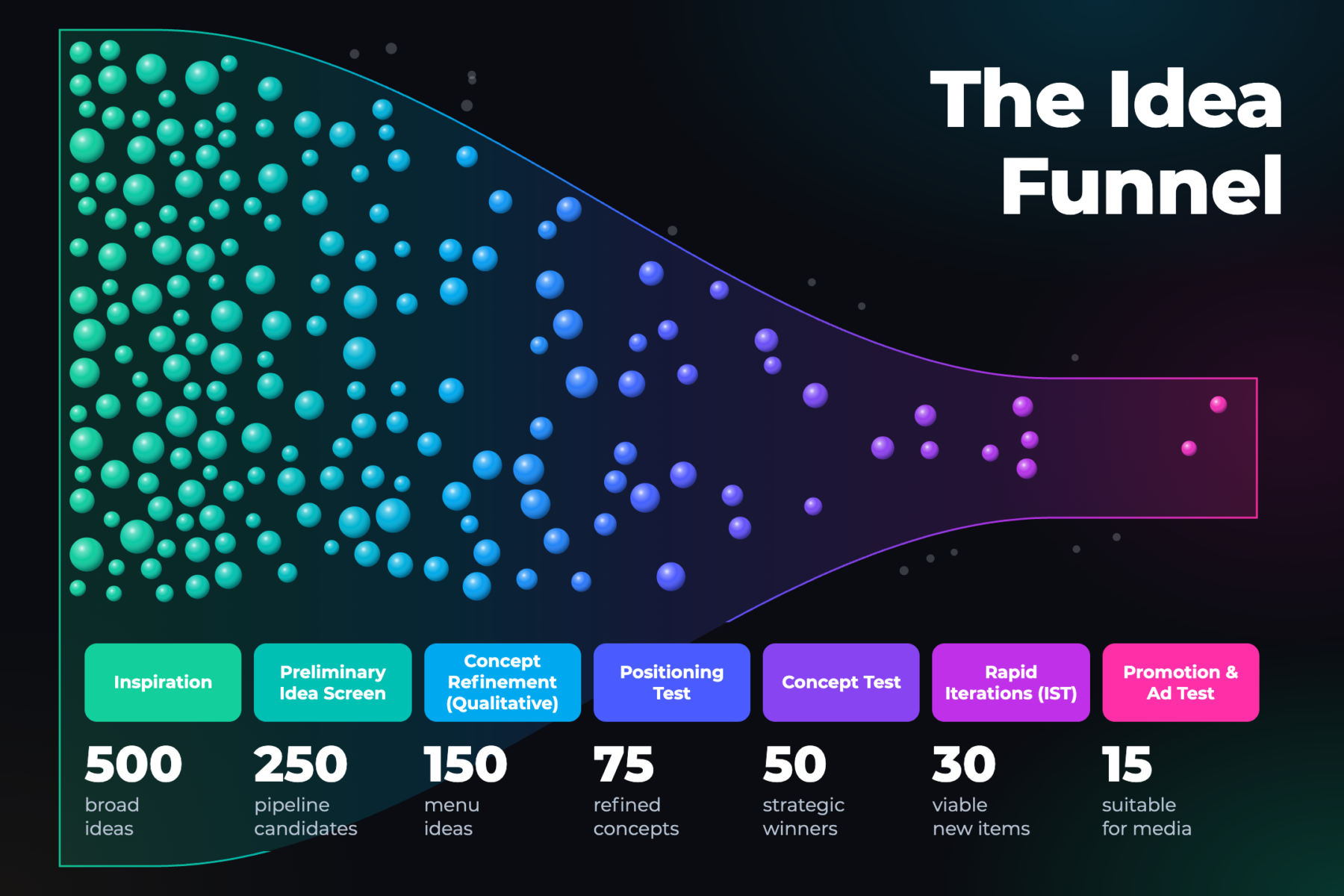
- Think funnel, not shortlist. A session might produce 500 broad ideas that get narrowed through concept refinement, consumer testing, in-market testing, and launch. The ideas that don’t make this cut become fuel for the next round.
That last point matters most. Innovation sessions shouldn’t be a once-a-year event. Put them on a regular calendar, and let each session inform the next. If a dessert session keeps surfacing Asian flavors, maybe the next one is about bringing those flavors to the core menu. If half the best ideas turned out to be beverages, maybe beverages deserve their own session.
Where Innovation Sessions Go Wrong
- The prompt is vague or unfocused
- The room is too big for the number of facilitators
- Ideas rest on opinions, not data
- Next steps are not assigned
- The team doesn’t align on outputs
- The session is treated as a one-off
Your Food and Beverage Innovation Session Checklist

The Bottom Line
A great innovation session isn’t a room full of random ideas. It’s an action plan. Standardize the format so everyone knows what to expect. Make the team smarter going in by giving them the data to make real decisions. And leave with a clear next step that keeps the process moving. It’s also one of the most fun days on the calendar. Treat it that way, and your team will look forward to the next one.
Planning your next menu innovation session? Datassential supports every stage of the innovation process, from trend exploration and pre-session data synthesis to facilitation, concept screening, and post-launch measurement. Talk to our team about grounding your next session in data.