

Visualized: What Are Stablecoins Backed By?


Save to Inbox
Visualized: What Are Stablecoins Backed By?
This was originally posted on our Voronoi app. Download the app for free on iOS or Android and discover incredible data-driven charts from a variety of trusted sources.
Key Takeaways
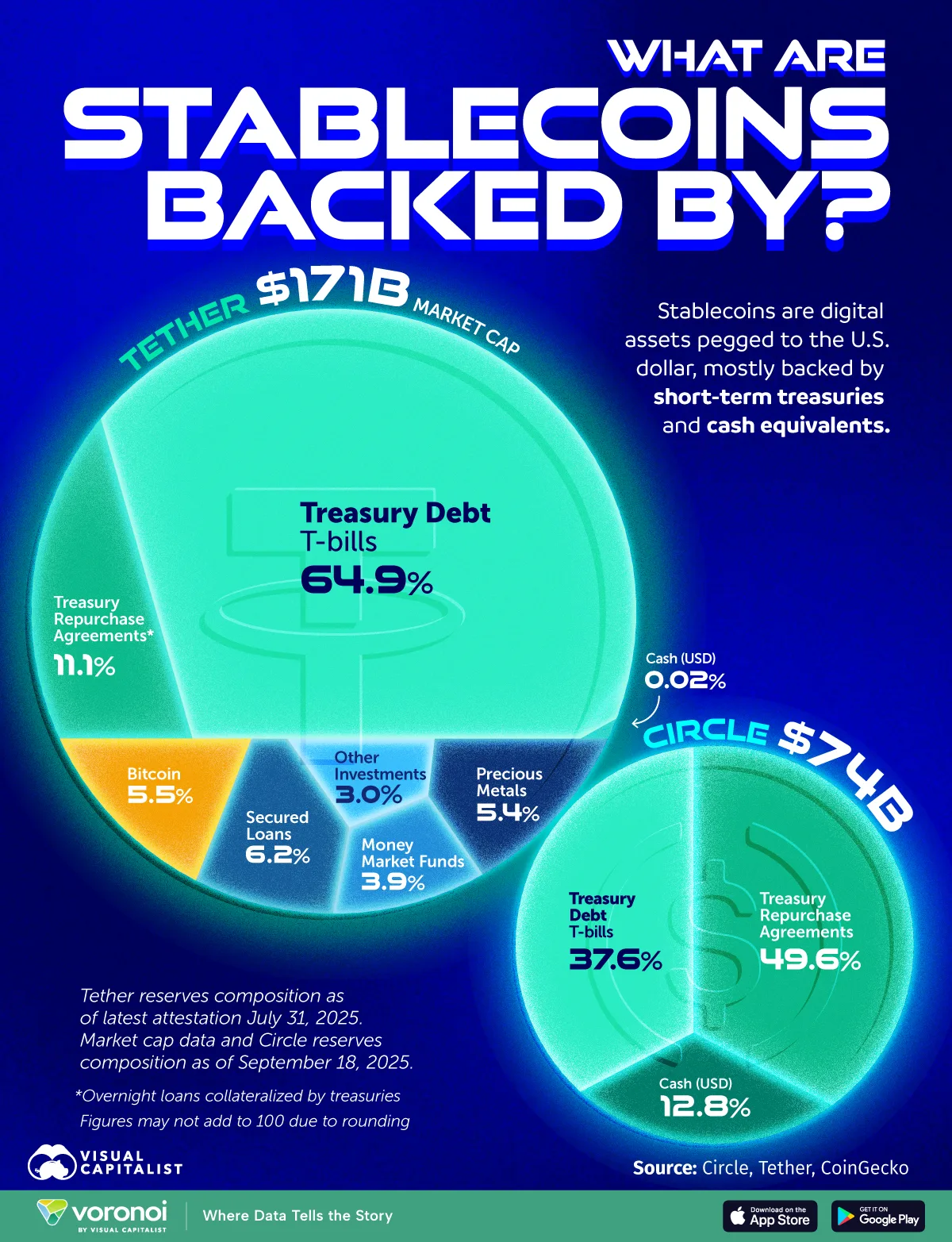
- Tether, with a market cap of $171 billion, is primarily backed by U.S. Treasury T-bills (64.9%), followed by Treasury repurchase agreements (11.1%) and other assets like bitcoin (5.5%) and precious metals (5.4%).
- Circle (USDC), with a market cap of $74 billion, has a more concentrated backing in T-bills (37.6%) and repo agreements (49.6%), with 12.8% in cash reserves.
Stablecoins have become a central pillar of the crypto economy, offering traders and investors a digital asset pegged to the stability of the U.S. dollar. But behind their promise of stability lies an important question: what are they backed by?
This visualization breaks down the asset reserves of the two largest stablecoins, Tether (USDT) and Circle (USDC), which together represent over $240 billion in market value.
The Assets Backing Stablecoins Tether and Circle
The data table below breaks down the assets backing Tether and Circle, and comes directly from Tether’s latest reserve attestation as of July 2025 and Circle’s transparency page. Market cap data comes from CoinGecko and is as of September 18, 2025.
| Asset | Tether ($171B market cap) | Circle ($74B market cap) |
|---|---|---|
| Treasury Debt (T-bills) | 64.9% | 37.6% |
| Treasury Repurchase Agreements (Overnight loans collateralized by Treasurys) | 11.1% | 49.6% |
| Cash (USD) | 0.02% | 12.8% |
| Other Investments | 3.0% | |
| Bitcoin | 5.5% | |
| Precious Metals | 5.4% | |
| Money Market Funds | 3.9% | |
| Secured Loans | 6.2% |
Tether, the dominant stablecoin in the cryptocurrency ecosystem, holds nearly two-thirds of its $171 billion reserves in short-term U.S. Treasury bills. These highly liquid assets provide security and quick convertibility.
An additional 11% is in overnight Treasury repurchase agreements, with the remainder spread across bitcoin, precious metals, cash, and other investments.
Circle is built on a simpler balance sheet. Nearly 88% of reserves sit in either Treasury securities (37.6%) or repo agreements (49.6%) in the Circle Reserve Fund managed by BlackRock, while cash deposits make up the rest at 12.8%.
Unlike Tether, Circle avoids allocating reserves to riskier assets like bitcoin, metals, or unspecified investments, giving it a cleaner—but less diversified—profile.

Comparing Stablecoins Tether and Circle’s Reserves
Both companies rely heavily on U.S. government-backed securities, but their strategies differ.
Tether’s inclusion of bitcoin and metals reflects a willingness to diversify, potentially increasing returns but also introducing volatility.
Circle’s concentration in Treasuries and cash emphasizes safety and simplicity. For investors and regulators, these differences raise questions about transparency, risk, and how resilient each stablecoin might be under stress.
Learn More on the Voronoi App 

To learn more about where stablecoins stand in the overall crypto ecosystem, check out this graphic breaking down the top 20 cryptocurrencies by market cap on Voronoi, the new app from Visual Capitalist.



The World’s Biggest Cryptocurrencies in 2025
The global cryptocurrency market cap stands at almost $3 trillion.

The World’s Biggest Cryptocurrencies in 2025
This was originally posted on our Voronoi app. Download the app for free on iOS or Android and discover incredible data-driven charts from a variety of trusted sources.
Key Takeaways
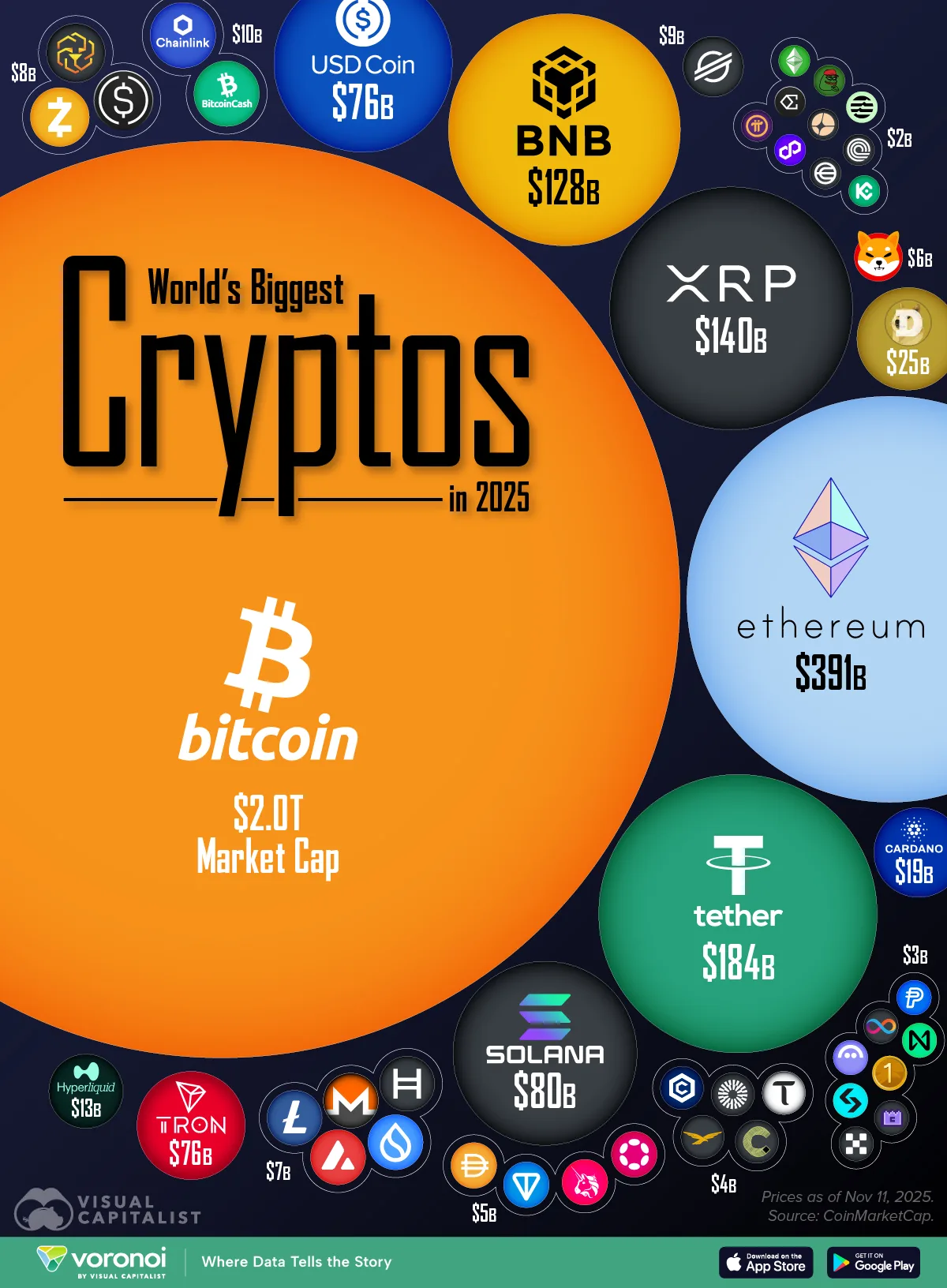
- Bitcoin remains the world’s largest cryptocurrency, nearing a $2 trillion market cap in 2025.
- Stablecoins like Tether and USDC now occupy significant positions in the market.
The global cryptocurrency market cap stands at almost $3 trillion. This visualization ranks the world’s biggest cryptocurrencies in 2025, showing how value is distributed across major networks, stablecoins, and emerging digital assets.
The data for this visualization comes from CoinMarketCap. It represents the latest market capitalization figures for the largest cryptocurrencies as of November 11, 2025. Market cap is calculated by multiplying a token’s price by its circulating supply.
Bitcoin and Ethereum Continue to Dominate
Bitcoin remains the clear market leader at nearly $2 trillion, reflecting its status as the most widely held and institutionally recognized crypto asset. Ethereum follows at $391 billion, supported by its role as the leading smart contract platform. Together, the two represent the core of the crypto landscape.
| Rank | Name | Market Cap |
|---|---|---|
| 1 | Bitcoin | $1,997,165,600,925 |
| 2 | Ethereum | $391,239,568,163 |
| 3 | Tether | $183,930,453,416 |
| 4 | XRP | $140,020,028,628 |
| 5 | BNB | $127,574,296,502 |
| 6 | Solana | $80,406,801,155 |
| 7 | USDC | $75,575,532,783 |
| 8 | TRON | $27,726,199,749 |
| 9 | Dogecoin | $24,884,478,723 |
| 10 | Cardano | $19,037,021,093 |
| 11 | Hyperliquid | $13,036,113,804 |
| 12 | Chainlink | $10,165,780,197 |
| 13 | Bitcoin Cash | $10,119,032,710 |
| 14 | Stellar | $8,659,896,374 |
| 15 | UNUS SED LEO | $8,443,694,797 |
| 16 | Zcash | $8,201,255,752 |
| 17 | Ethena USD | $8,195,997,122 |
| 18 | Litecoin | $7,428,846,643 |
| 19 | Monero | $7,161,607,062 |
| 20 | Hedera | $7,014,544,404 |
| 21 | Avalanche | $6,960,020,607 |
| 22 | Sui | $6,907,821,704 |
| 23 | Shiba Inu | $5,500,679,553 |
| 24 | Dai | $5,364,314,220 |
| 25 | Toncoin | $4,940,611,045 |
| 26 | Uniswap | $4,886,752,988 |
| 27 | Polkadot | $4,681,240,652 |
| 28 | Cronos | $4,400,321,655 |
| 29 | Mantle | $3,977,642,836 |
| 30 | Canton | $3,940,854,545 |
| 31 | World Liberty Financial | $3,586,042,424 |
| 32 | Bittensor | $3,514,471,572 |
| 33 | PayPal USD | $3,416,282,717 |
| 34 | Internet Computer | $3,189,227,358 |
| 35 | NEAR Protocol | $3,151,910,974 |
| 36 | Aave | $3,043,905,646 |
| 37 | World Liberty Financial USD | $2,819,404,867 |
| 38 | Bitget Token | $2,787,410,634 |
| 39 | MemeCore | $2,509,460,029 |
| 40 | OKB | $2,464,330,852 |
| 41 | Ethereum Classic | $2,327,032,820 |
| 42 | Pepe | $2,294,432,168 |
| 43 | Aptos | $2,187,451,666 |
| 44 | Ethena | $2,177,400,156 |
| 45 | Aster | $2,174,151,441 |
| 46 | Ondo | $1,944,426,626 |
| 47 | Pi | $1,829,238,754 |
| 48 | Polygon | $1,753,982,749 |
| 49 | Worldcoin | $1,699,117,284 |
| 50 | KuCoin Token | $1,620,080,843 |
Other top cryptocurrencies in our list include layer-1 networks such as Solana, BNB, and Cardano.
The Rise of Stablecoins and Alternative Layer-1 Networks
Stablecoins are cryptocurrencies designed to maintain a steady value, typically by pegging to fiat currencies, commodities, or other financial instruments. They serve as a bridge between traditional finance and digital markets, offering price stability that makes them useful for trading, payments, and storing value on-chain.
Stablecoins like Tether and USDC now occupy significant positions in the market, with market capitalization of $184 billion and $76 billion.
Their rapid growth reflects rising demand for reliable, dollar-pegged assets across exchanges, payment networks, and decentralized finance applications.
Emerging Assets and New Entrants
Beyond the major players, a range of mid-size tokens have gained traction.
Projects like Hyperliquid, Chainlink, and Hedera highlight strong demand for specialized tools such as oracle data, liquidity infrastructure, and enterprise-grade networks. Meme-driven and community-led tokens, including Dogecoin, Shiba Inu, and Pepe, remain notable for their cultural influence despite more volatile fundamentals.
Learn More on the Voronoi App
If you enjoyed today’s post, check out Inflation Watch: Countries Losing the Most Purchasing Power in 2025 on Voronoi, the new app from Visual Capitalist.
Stablecoin Week: 6 Insights Shaping the Future of Money
Explore 6 key insights from Stablecoin Week, from regulation to market size, and see how stablecoins are reshaping money movement.


Stablecoins have gone from a niche cryptocurrency to one of the fastest-growing forces in global finance. They’re transforming payments and even influencing government debt.
For Stablecoin Week, we partnered with Plasma, a blockchain built for global stablecoin payments, to explore the shifting dynamics. From overtaking Visa in transfer volumes to bold market size forecasts, the series revealed just how big this movement has become.
Below, we’ve compiled six key takeaways.
1. Mapping Stablecoin Regulation
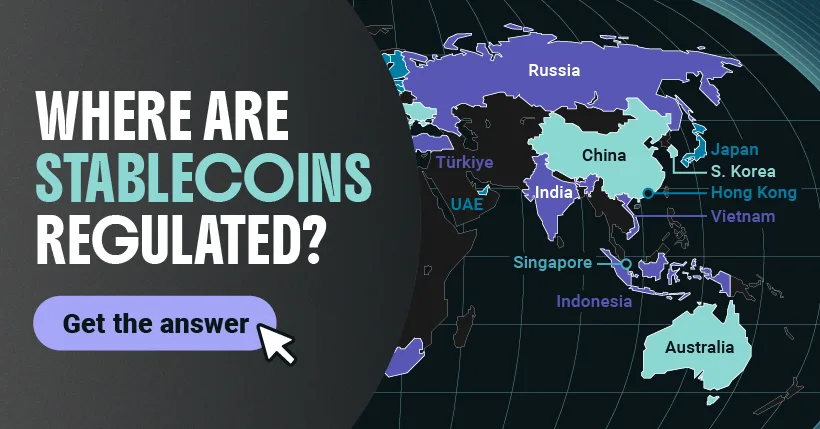
Clear regulations can be a catalyst for institutional adoption and cross-border expansion. However, the status of regulations differs quite a bit globally.
While some countries have outright bans on cryptocurrency, others have set out specific legislation that acts as guardrails for issuers, custodians, and/or users.
2. The Assets Backing Stablecoins
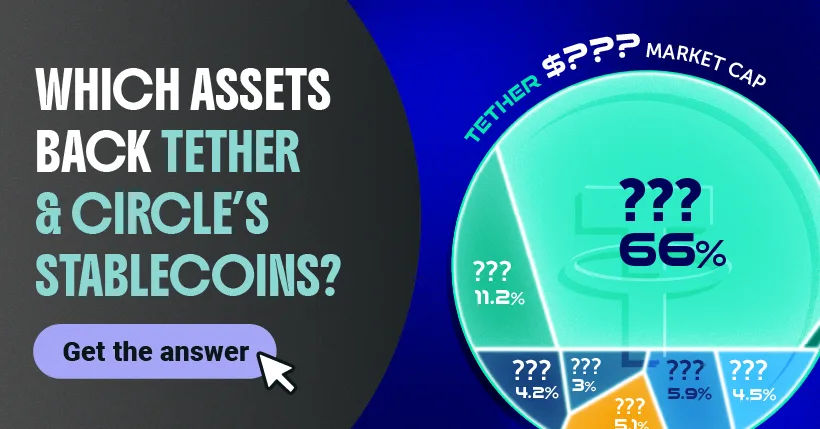
Alongside regulation, the stability of being pegged to the U.S. dollar (for 99% of stablecoins) helps boost confidence among users. But the assets held to support that stability differ depending on the issuer. Circle holds a more conservative balance sheet, while Tether has diversified into riskier assets.
3. Stablecoins’ Role in the U.S. Debt Market
Because Treasury securities play such a big role in the reserves of stablecoin issuers, Tether and Circle buy a lot of U.S. debt. So much, in fact, that their purchases surpass entire countries in some cases.
4. Stablecoins vs. Visa and Mastercard

Outside of debt markets, stablecoins are also a major player in the global payments landscape. Their near-instant, very low-cost transfers have fueled stablecoins’ popularity.
As recently as 2020, stablecoin transfer volume was far below that of Visa or Mastercard. Now, stablecoins have skyrocketed to outpace both major payment networks.
5. Comparing Stablecoin Value to U.S. Cash

Stablecoins are growing quickly, but it can be hard to grasp just how much they’re growing without context. We measured the stablecoin market cap relative to the value of all physical U.S. cash in circulation, which includes paper bills and coins.
In 2020, the value of stablecoins was equivalent to just 1% of U.S. cash in circulation. However, their market cap has surged over the last five years.
👉 See the growth of stablecoins
6. Stablecoin Market Size by 2030
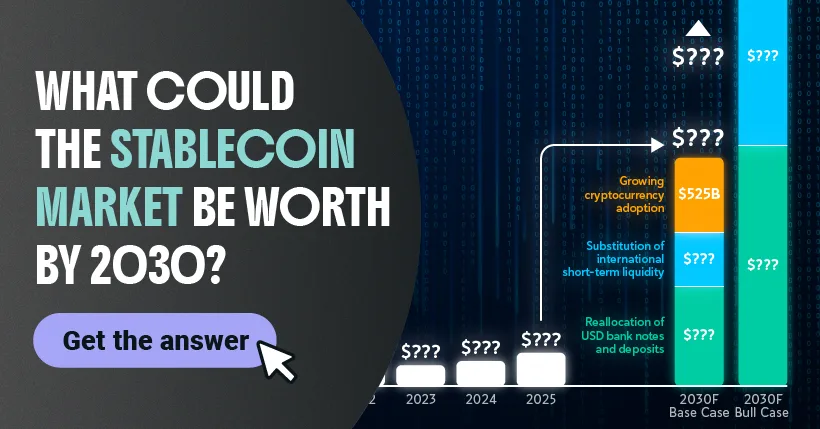
How big could the stablecoin industry get within the next five years? According to Citi, the market could grow more than 14 times larger by 2030.
Experts expect this growth will be driven by three factors: the shift of U.S. cash and deposits into digital tokens, the replacement of international short-term liquidity tools with stablecoins, and the growing role of stablecoins as the backbone of cryptocurrency adoption.
Looking Ahead: The Digital Dollar Era
Stablecoins are no longer on the periphery of finance. Instead, they’re redefining how money moves. From evolving regulations to their momentum against traditional payment methods, their trajectory points toward deeper integration with global markets.
Plasma is building the infrastructure to power this next era, enabling global stablecoin transactions that move money with speed and scale.

-

 China2 weeks ago
Ranked: The World’s Best Countries at Math in 2026
-

 Countries4 weeks ago
Ranked: The Best and Worst Countries to Live In 2026
-

 Debt1 week ago
Ranked: Countries With the Most Government Debt Per Person
-

 Jobs4 days ago
Mapped: The Best Employer in Every U.S. State
-

 Housing3 weeks ago
Ranked: 100 Global Cities by Quality of Life and Cost
-

 Brands3 weeks ago
Ranked: Cars That Hold and Lose Their Value the Most
-

 Money3 weeks ago
Ranked: Countries With the Highest Debt-to-GDP Ratios
-

 Urbanization1 week ago
Ranked: The World’s Strongest City Economies by 2050


