

Ranked: The World’s 10 Biggest Foreign Investors


Save to Inbox
Which Companies Invested the Most Abroad?
Key Takeaways
- Five of the world’s 10 largest foreign investors in 2025 were tech companies.
- TSMC led the ranking with $100 billion in announced investment tied to its Arizona expansion.
- The top 10 companies accounted for more than a quarter of the $1.3 trillion in new foreign investments announced globally.
In 2025, multinational companies announced more than $1.3 trillion in new foreign investments, up 2.2% from the previous year. The largest commitments spanned semiconductor fabs, data centers, energy projects, and other major infrastructure.
This visualization ranks the 10 largest foreign investors of 2025 using announced investments from The fDi Report 2026. Only greenfield foreign direct investment (FDI) announcements are included, meaning mergers and acquisitions (M&A) and intercompany loans are excluded.
Why TSMC Invested $100B in Arizona
Taiwan Semiconductor Manufacturing Company (TSMC), the world’s largest semiconductor fabricator, topped the ranking after announcing an additional $100 billion investment in its Arizona operations in 2025.
TSMC is also the world’s largest non-U.S. company by market capitalization. Amid record profits and rising demand for its chips, the company planned to use the investment to accelerate production at its facilities in the Phoenix area. The expansion is projected to create more than 18,000 jobs.
The table below ranks the world’s 10 largest foreign investors in 2025 by announced capital expenditure.
| Rank | Company | Capital Expenditure (billions $) | Sector |
|---|---|---|---|
| 1 | 🇹🇼 TSMC | 100.0 | Tech |
| 2 | 🇨🇳 ByteDance | 45.1 | Tech |
| 3 | 🇦🇪 MGX Fund Management | 43.4 | Finance |
| 4 | 🇨🇦 Brookfield Asset Management | 28.2 | Finance |
| 5 | 🇺🇸 Alphabet | 25.1 | Tech |
| 6 | 🇦🇪 DAMAC Holding | 24.6 | Real Estate |
| 7 | 🇪🇸 Iberdrola | 24.3 | Utilities |
| 8 | 🇺🇸 Microsoft | 17.7 | Tech |
| 9 | 🇦🇺 Woodside Energy | 17.5 | Energy |
| 10 | 🇺🇸 Micron Technology | 16.6 | Tech |
TSMC first pledged roughly $12 billion in 2020 to open an Arizona fabrication plant. These facilities, known as “fabs,” were designed to reduce semiconductor supply-chain risk by shifting some production away from Taiwan.
The company steadily expanded its investment over the following years as U.S.-China tensions increased, particularly around advanced chip technology. TSMC plans to produce some of its most advanced chips in Arizona as part of a 2024 deal with the U.S. government.
Despite labor challenges and higher costs, TSMC has continued to deepen its investment in Arizona. Following additional pledges in 2026, the firm’s overall greenfield investment in the state stands at $265 billion, making it the largest foreign investment in U.S. history.
Free-Flowing Tech Capital
TSMC stood well ahead of the field, but tech companies dominated the ranking overall, taking five of the top 10 spots.
ByteDance, the Chinese parent company of TikTok, ranked second with $45.1 billion in announced investment. Nearly $40 billion of that total came from plans to build a major data center in Brazil, a project expected to create roughly 5,000 jobs.
Big Tech firms including Alphabet ($25.1 billion) and Microsoft ($17.7 billion) also announced sizable foreign investments. Alphabet subsidiary Google, for example, pledged more than $5 billion for a large data center campus in Belgium to help meet growing demand for Google Cloud.
The Non-Tech Firms Want In Too
Digital infrastructure also shaped the investment priorities of companies outside the tech sector, particularly in Europe.
Emirati state-owned investment firm MGX Fund Management, for example, focuses heavily on global AI technologies. The company announced about $43.4 billion in investment, including a major French data center project aimed at creating one of Europe’s largest campuses of its kind.
Meanwhile, Canadian firm Brookfield Asset Management also targeted Europe’s AI and digital infrastructure market. Brookfield pledged about $28.2 billion in greenfield FDI in 2025, primarily for projects in France and Sweden. Its announced investments are expected to create roughly 4,800 jobs.
Learn More on the Voronoi App
For a breakdown of the sectors driving global FDI, check out The Top 10 Sectors for Foreign Direct Investment (FDI) on Voronoi.


Ranked: The Top 10 Sectors for Foreign Investment in 2026
Halfway through 2026, the communications sector has dominated global investment, powered by $130 billion in data center development.


Where Foreign Investment Is Flowing in 2026
Key Takeaways
- Communications is the top sector for global foreign direct investment, attracting $139 billion in H1 2026.
- Data centers accounted for more than 94% of communications investment.
- Renewable energy attracted $73 billion, roughly $29 billion more than coal, oil, and gas.
Global investors announced roughly $538 billion in cross-border greenfield investments in the first half of 2026, with AI infrastructure emerging as a major driver of where that capital is flowing.
This visualization ranks the top 10 sectors for global foreign direct investment (FDI) from January to June 2026, using data from fDi Intelligence.
Only greenfield FDI is included, meaning investment in new projects and facilities. Mergers and acquisitions (M&A) and intercompany loans are excluded.
Why Communications Leads Global Investment
Businesses pledged $139.3 billion in new capital to the communications sector in the first half of 2026. That is nearly as much as the next three largest sectors combined.
The driving force is data centers, which attracted more than $131 billion in pledged investment.
The table below ranks the world’s 10 largest greenfield FDI sectors in the first half of 2026.
| Rank | Sector | Capital Expenditure (billions $) |
|---|---|---|
| 1 | Communications | 139.3 |
| 2 | Renewable energy | 73.3 |
| 3 | Coal, oil, and gas | 44.7 |
| 4 | Semiconductors | 38.8 |
| 5 | Transportation & Warehousing | 24.9 |
| 6 | Real estate | 23.9 |
| 7 | Metals | 23.7 |
| 8 | Industrial equipment | 14.6 |
| 9 | Electronic components | 13.7 |
| 10 | Software & IT services | 13.7 |
Businesses are pouring billions into data centers to support the ongoing artificial intelligence (AI) boom. This digital infrastructure provides the computing power required to train and run large AI models.
Nearly a quarter of pledged FDI in data centers comes from a single transaction. In May 2026, SoftBank committed more than $50 billion to data center investment in France. The Japanese tech firm plans to deliver 3.1 gigawatts of data center capacity in the country beginning in 2031.
This would reportedly be the largest investment of its kind in Europe.
Energy Investment Follows the Data Center Boom
The AI infrastructure buildout is also spilling into energy. Renewable energy and fossil fuels ranked second and third for greenfield FDI as new data centers increase demand for large, reliable sources of electricity.
Renewables attracted $73.3 billion in new capital investment. Solar power drew the most pledged FDI within the sector, followed by hydrogen and emerging clean technologies, as well as wind. Renewable investment has pulled back slightly in 2026, partly due to lower prioritization by U.S. firms. The U.S. is the world’s top FDI source.
Meanwhile, coal, oil, and gas attracted $44.7 billion in greenfield FDI despite turbulence in major hydrocarbon-producing regions such as the Persian Gulf. Roughly 75% of this investment came from a new natural gas plant in Ohio that is being developed to serve a nearby data center under construction.
How AI Runs Through the Rest of the Ranking
The influence of AI and digital infrastructure extends through much of the remainder of the top 10 sectors for global FDI.
Semiconductors, for example, attracted $38.8 billion in FDI, well below the $138 billion seen across all of 2025. One major pledge came in January 2026, when American chipmaker Micron committed to investing $24 billion in chip production in Singapore.
Companies also allocated $24.9 billion to transportation and warehousing, with a majority of this investment going toward freight and distribution.
Taken together, the ranking shows how the AI investment boom extends well beyond data centers themselves. Semiconductors, power generation, electronic components, industrial equipment, and software all appear among the top sectors, highlighting the scale of infrastructure being built around rising demand for computing power.
Learn More on the Voronoi App
To see which developing countries are attracting the most FDI, check out The Best Emerging Markets to Invest In, According to fDi Intelligence on Voronoi.
Companies Gone Public in 2021: Visualizing IPO Valuations
Tracking the companies that have gone public in 2021, their valuation, and how they did it.

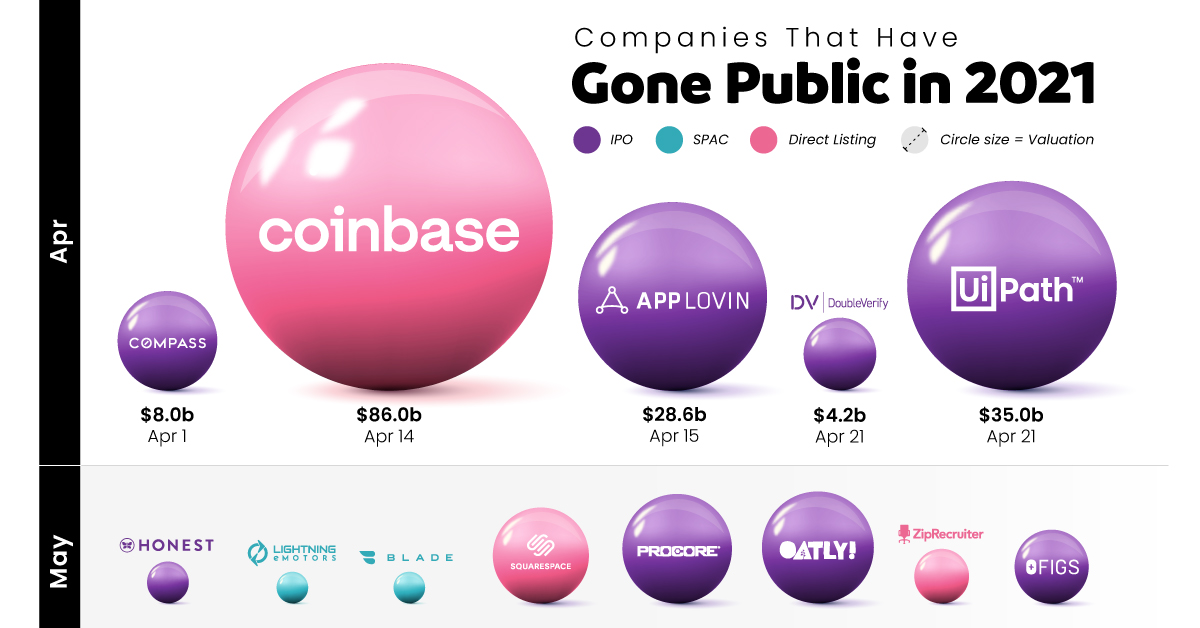
Companies Gone Public in 2021: Visualizing Valuations
Despite its many tumultuous turns, last year was a productive year for global markets, and companies going public in 2021 benefited.
From much-hyped tech initial public offerings (IPOs) to food and healthcare services, many companies with already large followings have gone public this year. Some were supposed to go public in 2020 but got delayed due to the pandemic, and others saw the opportunity to take advantage of a strong current market.
This graphic measures 68 companies that have gone public in 2021 — including IPOs, SPACs, and Direct Listings—as well as their subsequent valuations after listing.
Who’s Gone Public in 2021?
Historically, companies that wanted to go public employed one main method above others: the initial public offering (IPO).
But companies going public today readily choose from one of three different options, depending on market situations, associated costs, and shareholder preference:
- Initial Public Offering (IPO): A private company creates new shares which are underwritten by a financial organization and sold to the public.
- Special Purpose Acquisition Company (SPAC): A separate company with no operations is created strictly to raise capital to acquire the company going public. SPACs are the fastest method of going public, and have become popular in recent years.
- Direct Listing: A private company enters a market with only existing, outstanding shares being traded and no new shares created. The cost is lower than that of an IPO, since no fees need to be paid for underwriting.
The majority of companies going public in 2021 chose the IPO route, but some of the biggest valuations resulted from direct listings.
| Listing Date | Company | Valuation ($B) | Listing Type |
|---|---|---|---|
| 08-Jan-21 | Clover Health | $7.0 | SPAC |
| 13-Jan-21 | Affirm | $11.9 | IPO |
| 13-Jan-21 | Billtrust | $1.3 | SPAC |
| 14-Jan-21 | Poshmark | $3.0 | IPO |
| 15-Jan-21 | Playtika | $11.0 | IPO |
| 21-Jan-21 | Hims and Hers Health | $1.6 | SPAC |
| 28-Jan-21 | Qualtrics | $15.0 | IPO |
| 09-Feb-21 | Metromile | - | SPAC |
| 11-Feb-21 | Bumble | $8.2 | IPO |
| 26-Feb-21 | ChargePoint Holdings | - | SPAC |
| 03-Mar-21 | Oscar Health | $7.9 | IPO |
| 10-Mar-21 | Roblox | $30.0 | Direct Listing |
| 11-Mar-21 | Coupang | $60.0 | IPO |
| 23-Mar-21 | DigitalOcean | $5.0 | IPO |
| 25-Mar-21 | VIZIO | $3.9 | IPO |
| 26-Mar-21 | ThredUp | $1.3 | IPO |
| 31-Mar-21 | Coursera | $4.3 | IPO |
| 01-Apr-21 | Compass | $8.0 | IPO |
| 14-Apr-21 | Coinbase | $86.0 | Direct Listing |
| 15-Apr-21 | AppLovin | $28.6 | IPO |
| 21-Apr-21 | UiPath | $35.0 | IPO |
| 21-Apr-21 | DoubleVerify | $4.2 | IPO |
| 05-May-21 | The Honest Company | $1.4 | IPO |
| 07-May-21 | Lightning eMotors | $0.82 | SPAC |
| 07-May-21 | Blade Air Mobility | $0.83 | SPAC |
| 19-May-21 | Squarespace | $7.4 | Direct Listing |
| 19-May-21 | Procore | $9.6 | IPO |
| 19-May-21 | Oatly | $10.0 | IPO |
| 26-May-21 | ZipRecruiter | $2.4 | Direct Listing |
| 26-May-21 | FIGS | $4.4 | IPO |
| 01-Jun-21 | SoFi | $8.7 | SPAC |
| 02-Jun-21 | BarkBox | $1.6 | SPAC |
| 08-Jun-21 | Marqueta | $15.0 | IPO |
| 10-Jun-21 | Monday.com | $7.5 | IPO |
| 16-Jun-21 | WalkMe | $2.5 | IPO |
| 22-Jun-21 | Sprinklr | $3.7 | IPO |
| 24-Jun-21 | Confluent | $9.1 | IPO |
| 29-Jun-21 | Clear | $4.5 | IPO |
| 30-Jun-21 | SentinelOne | $10.0 | IPO |
| 30-Jun-21 | LegalZoom | $7.0 | IPO |
| 30-Jun-21 | Didi Chuxing | $73.0 | IPO |
| 16-Jul-21 | Blend | $4 | IPO |
| 21-Jul-21 | Kaltura | $1.24 | IPO |
| 21-Jul-21 | DISCO | $2.5 | IPO |
| 21-Jul-21 | Couchbase | $1.4 | IPO |
| 23-Jul-21 | Vtex | $3.5 | IPO |
| 23-Jul-21 | Outbrain | $1.1 | IPO |
| 28-Jul-21 | Duolingo | $3.7 | IPO |
| 28-Jul-21 | Riskified | $3.3 | IPO |
| 29-Jul-21 | Robinhood | $32.0 | IPO |
| 22-Sep-21 | Toast | $22.0 | IPO |
| 22-Sep-21 | Freshworks | $10.1 | IPO |
| 23-Sep-21 | Remitly | $6.9 | IPO |
| 28-Sep-21 | Amplitude | $6.4 | Direct Listing |
| 29-Sep-21 | Warby Parker | $6.0 | Direct Listing |
| 14-Oct-21 | GitLab | $11.0 | IPO |
| 27-Oct-21 | Rent the Runway | $1.7 | IPO |
| 29-Oct-21 | Udemy | $4.0 | IPO |
| 03-Nov-21 | Allbirds | $2.2 | IPO |
| 04-Nov-21 | NerdWallet | $1.2 | IPO |
| 10-Nov-21 | Rivian | $66.5 | IPO |
| 10-Nov-21 | Expensify | $2.2 | IPO |
| 11-Nov-21 | Winc | - | IPO |
| 11-Nov-21 | Weave | - | IPO |
| 17-Nov-21 | UserTesting | - | IPO |
| 17-Nov-21 | Braze | $6.0 | IPO |
| 18-Nov-21 | Sweetgreen | $3.0 | IPO |
| 09-Dec-21 | Nubank | $41.0 | IPO |
Though there are many well-known names in the list, one of the biggest through lines continues to be the importance of tech.
A majority of 2021’s newly public companies have been in tech, including multiple mobile apps, websites, and online services. The two biggest IPOs so far were South Korea’s Coupang, an online marketplace valued at $60 billion after going public, and China’s ride-hailing app Didi Chuxing, the year’s largest post-IPO valuation at $73 billion.
And there were many apps and services going public through other means as well. Gaming company Roblox went public through a direct listing, earning a valuation of $30 billion, and cryptocurrency platform Coinbase has earned the year’s largest valuation so far, with an $86 billion valuation following its direct listing.
Big Companies Going Public in 2022
As with every year, some of the biggest companies going public were lined up for the later half.
Tech will continue to be the talk of the markets. Payment processing firm Stripe was setting up to be the year’s biggest IPO with an estimated valuation of $95 billion, but got delayed. Likewise, online grocery delivery platform InstaCart, which saw a big upswing in traction due to the pandemic, has been looking to go public at a valuation of at least $39 billion.
Of course, it’s common that potential public listings and offerings fall through. Whether they get delayed due to weak market conditions or cancelled at the last minute, anything can happen when it comes to public markets.
This post has been updated as of January 1, 2022.
-

 China2 weeks ago
Ranked: The World’s Best Countries at Math in 2026
-

 Countries4 weeks ago
Ranked: The Best and Worst Countries to Live In 2026
-

 Debt1 week ago
Ranked: Countries With the Most Government Debt Per Person
-

 Jobs4 days ago
Mapped: The Best Employer in Every U.S. State
-

 Housing3 weeks ago
Ranked: 100 Global Cities by Quality of Life and Cost
-

 Brands3 weeks ago
Ranked: Cars That Hold and Lose Their Value the Most
-

 Money3 weeks ago
Ranked: Countries With the Highest Debt-to-GDP Ratios
-

 Urbanization1 week ago
Ranked: The World’s Strongest City Economies by 2050


