

The World’s Largest IPOs Adjusted For Inflation


Save to Inbox
The World’s Largest IPOs Adjusted For Inflation
Billion-dollar initial public offerings (IPOs) are always eyebrow-raising events, and many have already made headlines in 2020.
Following the recent trend of tech IPOs outnumbering and out-hyping the competition, software has led the way. Cloud storage company Snowflake raised $3.4 billion in the largest ever software IPO, while gaming software developer Unity completed an IPO above its target price for a total of $1.3 billion and big data firm Palantir opted for a direct listing for a valuation of $22 billion.
More big names are still on the horizon. DoorDash just completed an above-range IPO and ended up raising $3.37 billion, and Airbnb raised $3.5 billion before shares opened more than 100% above the IPO price. It’s a big recovery for an IPO market that in 2019 saw major IPOs from Uber and Lyft underperform estimates.
But it was the last-minute cancellation of Ant Group’s IPO in November that would have been the largest public offering ever. At $34.5 billion, it would have eclipsed the massive $25.9 billion raised by energy giant Saudi Aramco in 2019.
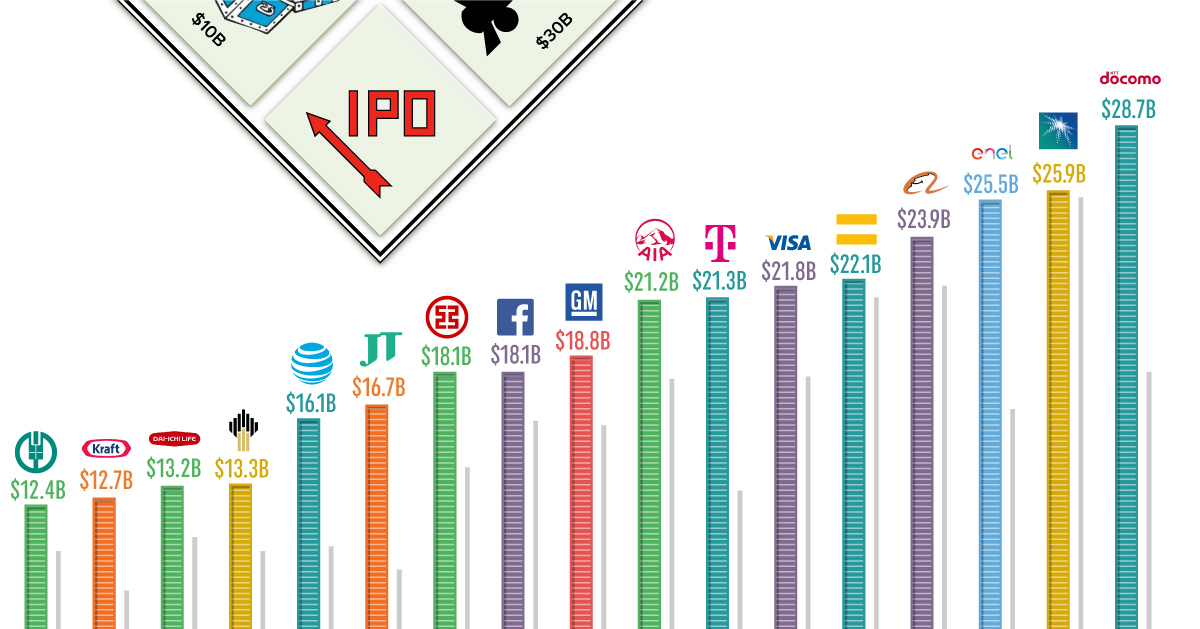
How would this have stacked up against the world’s largest IPOs in history? We took the 25 largest global IPOs by nominal offering size as tracked by research firm Renaissance Capital, and adjusted them for inflation to October 2020 dollars.
NTT Docomo Tops the (Adjusted) Chart
Unicorn IPOs might be the current flavor in 2020, but they pale in comparison to communication and resource giants.
When adjusted for inflation, the largest ever IPO was Japan’s major mobile phone carrier NTT Docomo. The company went public as NTT Mobile Communications Network for a then-record $18 billion in 1998, which is $28.7 billion when adjusted for inflation to 2020.
| Company | IPO Date | Industry | Deal Size ($B) | Inflation Adjusted ($B) |
|---|---|---|---|---|
| NTT Mobile | Oct 1998 | Communication Services | 18.1 | 28.7 |
| Saudi Aramco | Dec 2019 | Energy | 25.6 | 25.9 |
| ENEL SpA | Nov 1999 | Utilities | 16.5 | 25.5 |
| Alibaba (U.S.) | Sep 2014 | Technology | 21.8 | 23.9 |
| SoftBank Corp | Dec 2018 | Communication Services | 21.3 | 22.1 |
| Visa | Mar 2008 | Technology | 17.9 | 21.8 |
| Deutsche Telekom | Nov 1996 | Communication Services | 13 | 21.3 |
| AIA Group | Oct 2010 | Financials | 17.8 | 21.2 |
| General Motors | Nov 2010 | Consumer Discretionary | 15.8 | 18.8 |
| May 2012 | Technology | 16 | 18.1 | |
| ICBC | Oct 2006 | Financials | 14 | 18.1 |
| Japan Tobacco Inc. | Oct 1994 | Consumer Staples | 9.6 | 16.7 |
| AT&T Wireless Group | Apr 2000 | Communication Services | 10.6 | 16.1 |
| Rosneft Oil Company | Jul 2006 | Energy | 10.4 | 13.3 |
| Dai-ichi Life | Mar 2010 | Financials | 11 | 13.2 |
| Kraft Foods | Jun 2001 | Consumer Staples | 8.7 | 12.7 |
| Agricultural Bank (H.K.) | Jul 2010 | Financials | 10.4 | 12.4 |
| Bank of China | May 2006 | Financials | 9.2 | 11.8 |
| France Telecom | Oct 1997 | Communication Services | 7.3 | 11.7 |
| Glencore | May 2011 | Materials | 10 | 11.5 |
| Alibaba (H.K.) | Nov 2019 | Technology | 11.2 | 11.3 |
| Electricite De France | Nov 2005 | Utilities | 8.3 | 11 |
| Agricultural Bank (China) | Jul 2010 | Financials | 8.9 | 10.6 |
| Hengshi Mining | Nov 2013 | Materials | 9.3 | 10.4 |
| Japan Airlines | Sep 2012 | Industrials | 8.5 | 9.5 |
Despite the recent flurry of IPO activity, only two of the largest 10 inflation-adjusted IPOs occurred in the last two years, with second place Saudi Aramco and Japan’s communications and tech conglomerate SoftBank.
Including NTT Docomo, three of the top 10 occurred in the 1990’s. Italy’s energy giant ENEL SpA raised the equivalent of $25.9 billion in 1999, and German communications company Deutsche Telekom raised the equivalent of $21.3 billion in 1996.
Communications services accounted for five of the top 25 IPOs, and four of the top 10. Only the financials were more prominent with six of the top 25.
Final IPO Numbers can Outperform (and Underperform)
One important consideration to make is that the final amount raised by an IPO can vary from the original deal size.
Though they are underwritten by a large financial institution for a set amount at a specific price range, companies often grant underwriters the “greenshoe option” to sell more shares than the original issue amount, usually up to 15% more.
This over-allotment option lets an underwriter capitalize on a strong market by offering more shares at a surging share price (which they cover at the original price). In the opposite case of falling share prices, the underwriter can buy back shares at market rate to stabilize the price and cover their short position.
Many of the largest ever IPOs have managed to capitalize on their much-hyped debuts. Saudi Aramco ended up raising $29.4 billion, almost $4 billion more than its original offering. In similar fashion, Chinese e-commerce giant Alibaba raised $25 billion on an offering of $21.8 billion, and Visa raised $19.7 billion on an offering of $17.9 billion.
Additionally, large corporations can take advantage of market sentiment by going public in multiple equity markets. Alibaba’s $25 billion debut on the New York Stock Exchange in 2014 was followed by a secondary offering on the Hong Kong Stock Exchange in 2019 for $11.2 billion. Likewise, the Agricultural Bank of China listed on both the Hong Kong and Shanghai Stock Exchanges in 2010 for a combined $22.1 billion haul.
More IPOS on the Docket for 2021
With excitement around IPOs bubbling once again, more companies are lining up to become the next big breakthrough on public markets.
2021’s list of IPO candidates include shopping app Wish (which has already filed for an offering), gaming companies Epic Games and Roblox, payment processing firm Stripe and even dating app Bumble.
And Ant Group’s massive potential IPO shadow looms over all, though regulatory overhauls in China might push it back to 2022 and lower the size of the offering.
For now, the list of the world’s largest IPOs looks to be relatively stable. But with social media giant Facebook cracking the Top 10 list in 2012, and SoftBank’s massive IPO in 2018, the next +$10 billion dollar IPO is always around the corner.


Ranked: The World’s 10 Biggest Foreign Investors
Tech firms made many of the world’s largest investments in 2025, led by a Taiwanese company’s $100-billion investment in Arizona.


Which Companies Invested the Most Abroad?
Key Takeaways
- Five of the world’s 10 largest foreign investors in 2025 were tech companies.
- TSMC led the ranking with $100 billion in announced investment tied to its Arizona expansion.
- The top 10 companies accounted for more than a quarter of the $1.3 trillion in new foreign investments announced globally.
In 2025, multinational companies announced more than $1.3 trillion in new foreign investments, up 2.2% from the previous year. The largest commitments spanned semiconductor fabs, data centers, energy projects, and other major infrastructure.
This visualization ranks the 10 largest foreign investors of 2025 using announced investments from The fDi Report 2026. Only greenfield foreign direct investment (FDI) announcements are included, meaning mergers and acquisitions (M&A) and intercompany loans are excluded.
Why TSMC Invested $100B in Arizona
Taiwan Semiconductor Manufacturing Company (TSMC), the world’s largest semiconductor fabricator, topped the ranking after announcing an additional $100 billion investment in its Arizona operations in 2025.
TSMC is also the world’s largest non-U.S. company by market capitalization. Amid record profits and rising demand for its chips, the company planned to use the investment to accelerate production at its facilities in the Phoenix area. The expansion is projected to create more than 18,000 jobs.
The table below ranks the world’s 10 largest foreign investors in 2025 by announced capital expenditure.
| Rank | Company | Capital Expenditure (billions $) | Sector |
|---|---|---|---|
| 1 | 🇹🇼 TSMC | 100.0 | Tech |
| 2 | 🇨🇳 ByteDance | 45.1 | Tech |
| 3 | 🇦🇪 MGX Fund Management | 43.4 | Finance |
| 4 | 🇨🇦 Brookfield Asset Management | 28.2 | Finance |
| 5 | 🇺🇸 Alphabet | 25.1 | Tech |
| 6 | 🇦🇪 DAMAC Holding | 24.6 | Real Estate |
| 7 | 🇪🇸 Iberdrola | 24.3 | Utilities |
| 8 | 🇺🇸 Microsoft | 17.7 | Tech |
| 9 | 🇦🇺 Woodside Energy | 17.5 | Energy |
| 10 | 🇺🇸 Micron Technology | 16.6 | Tech |
TSMC first pledged roughly $12 billion in 2020 to open an Arizona fabrication plant. These facilities, known as “fabs,” were designed to reduce semiconductor supply-chain risk by shifting some production away from Taiwan.
The company steadily expanded its investment over the following years as U.S.-China tensions increased, particularly around advanced chip technology. TSMC plans to produce some of its most advanced chips in Arizona as part of a 2024 deal with the U.S. government.
Despite labor challenges and higher costs, TSMC has continued to deepen its investment in Arizona. Following additional pledges in 2026, the firm’s overall greenfield investment in the state stands at $265 billion, making it the largest foreign investment in U.S. history.
Free-Flowing Tech Capital
TSMC stood well ahead of the field, but tech companies dominated the ranking overall, taking five of the top 10 spots.
ByteDance, the Chinese parent company of TikTok, ranked second with $45.1 billion in announced investment. Nearly $40 billion of that total came from plans to build a major data center in Brazil, a project expected to create roughly 5,000 jobs.
Big Tech firms including Alphabet ($25.1 billion) and Microsoft ($17.7 billion) also announced sizable foreign investments. Alphabet subsidiary Google, for example, pledged more than $5 billion for a large data center campus in Belgium to help meet growing demand for Google Cloud.
The Non-Tech Firms Want In Too
Digital infrastructure also shaped the investment priorities of companies outside the tech sector, particularly in Europe.
Emirati state-owned investment firm MGX Fund Management, for example, focuses heavily on global AI technologies. The company announced about $43.4 billion in investment, including a major French data center project aimed at creating one of Europe’s largest campuses of its kind.
Meanwhile, Canadian firm Brookfield Asset Management also targeted Europe’s AI and digital infrastructure market. Brookfield pledged about $28.2 billion in greenfield FDI in 2025, primarily for projects in France and Sweden. Its announced investments are expected to create roughly 4,800 jobs.
Learn More on the Voronoi App
For a breakdown of the sectors driving global FDI, check out The Top 10 Sectors for Foreign Direct Investment (FDI) on Voronoi.
Ranked: The Top 10 Sectors for Foreign Investment in 2026
Halfway through 2026, the communications sector has dominated global investment, powered by $130 billion in data center development.


Where Foreign Investment Is Flowing in 2026
Key Takeaways
- Communications is the top sector for global foreign direct investment, attracting $139 billion in H1 2026.
- Data centers accounted for more than 94% of communications investment.
- Renewable energy attracted $73 billion, roughly $29 billion more than coal, oil, and gas.
Global investors announced roughly $538 billion in cross-border greenfield investments in the first half of 2026, with AI infrastructure emerging as a major driver of where that capital is flowing.
This visualization ranks the top 10 sectors for global foreign direct investment (FDI) from January to June 2026, using data from fDi Intelligence.
Only greenfield FDI is included, meaning investment in new projects and facilities. Mergers and acquisitions (M&A) and intercompany loans are excluded.
Why Communications Leads Global Investment
Businesses pledged $139.3 billion in new capital to the communications sector in the first half of 2026. That is nearly as much as the next three largest sectors combined.
The driving force is data centers, which attracted more than $131 billion in pledged investment.
The table below ranks the world’s 10 largest greenfield FDI sectors in the first half of 2026.
| Rank | Sector | Capital Expenditure (billions $) |
|---|---|---|
| 1 | Communications | 139.3 |
| 2 | Renewable energy | 73.3 |
| 3 | Coal, oil, and gas | 44.7 |
| 4 | Semiconductors | 38.8 |
| 5 | Transportation & Warehousing | 24.9 |
| 6 | Real estate | 23.9 |
| 7 | Metals | 23.7 |
| 8 | Industrial equipment | 14.6 |
| 9 | Electronic components | 13.7 |
| 10 | Software & IT services | 13.7 |
Businesses are pouring billions into data centers to support the ongoing artificial intelligence (AI) boom. This digital infrastructure provides the computing power required to train and run large AI models.
Nearly a quarter of pledged FDI in data centers comes from a single transaction. In May 2026, SoftBank committed more than $50 billion to data center investment in France. The Japanese tech firm plans to deliver 3.1 gigawatts of data center capacity in the country beginning in 2031.
This would reportedly be the largest investment of its kind in Europe.
Energy Investment Follows the Data Center Boom
The AI infrastructure buildout is also spilling into energy. Renewable energy and fossil fuels ranked second and third for greenfield FDI as new data centers increase demand for large, reliable sources of electricity.
Renewables attracted $73.3 billion in new capital investment. Solar power drew the most pledged FDI within the sector, followed by hydrogen and emerging clean technologies, as well as wind. Renewable investment has pulled back slightly in 2026, partly due to lower prioritization by U.S. firms. The U.S. is the world’s top FDI source.
Meanwhile, coal, oil, and gas attracted $44.7 billion in greenfield FDI despite turbulence in major hydrocarbon-producing regions such as the Persian Gulf. Roughly 75% of this investment came from a new natural gas plant in Ohio that is being developed to serve a nearby data center under construction.
How AI Runs Through the Rest of the Ranking
The influence of AI and digital infrastructure extends through much of the remainder of the top 10 sectors for global FDI.
Semiconductors, for example, attracted $38.8 billion in FDI, well below the $138 billion seen across all of 2025. One major pledge came in January 2026, when American chipmaker Micron committed to investing $24 billion in chip production in Singapore.
Companies also allocated $24.9 billion to transportation and warehousing, with a majority of this investment going toward freight and distribution.
Taken together, the ranking shows how the AI investment boom extends well beyond data centers themselves. Semiconductors, power generation, electronic components, industrial equipment, and software all appear among the top sectors, highlighting the scale of infrastructure being built around rising demand for computing power.
Learn More on the Voronoi App
To see which developing countries are attracting the most FDI, check out The Best Emerging Markets to Invest In, According to fDi Intelligence on Voronoi.
-

 China2 weeks ago
Ranked: The World’s Best Countries at Math in 2026
-

 Countries4 weeks ago
Ranked: The Best and Worst Countries to Live In 2026
-

 Debt1 week ago
Ranked: Countries With the Most Government Debt Per Person
-

 Jobs4 days ago
Mapped: The Best Employer in Every U.S. State
-

 Housing3 weeks ago
Ranked: 100 Global Cities by Quality of Life and Cost
-

 Brands3 weeks ago
Ranked: Cars That Hold and Lose Their Value the Most
-

 Money3 weeks ago
Ranked: Countries With the Highest Debt-to-GDP Ratios
-

 Urbanization1 week ago
Ranked: The World’s Strongest City Economies by 2050


