

Ranked: The Top 10 Most Wanted Skills for AI Jobs

 See this visualization first on the Voronoi app.

Save to Inbox
Ranked: The Top 10 Most In-Demand AI Job Skills
This was originally posted on our Voronoi app. Download the app for free on iOS or Android and discover incredible data-driven charts from a variety of trusted sources.
Key Takeaways
- Python stands as the most sought-after skill across AI job postings in America.
- Data analysis also ranks highly, as employers seek professionals who can extract insights from complex datasets using statistical techniques.
- Additionally, Agile methodology was mentioned in over 88,000 postings—highlighting the value of this iterative project management style, especially in software roles.
In 2024, U.S. private investment in AI soared to $109 billion, driving ripple effects across the job market.
Overall, the number of postings for AI jobs increased by 20% in an ever-expanding field. Among the most frequently mentioned AI skills center around programming languages and data science. In addition, experience in project management ranks in the top 10 given the complexity of AI projects.
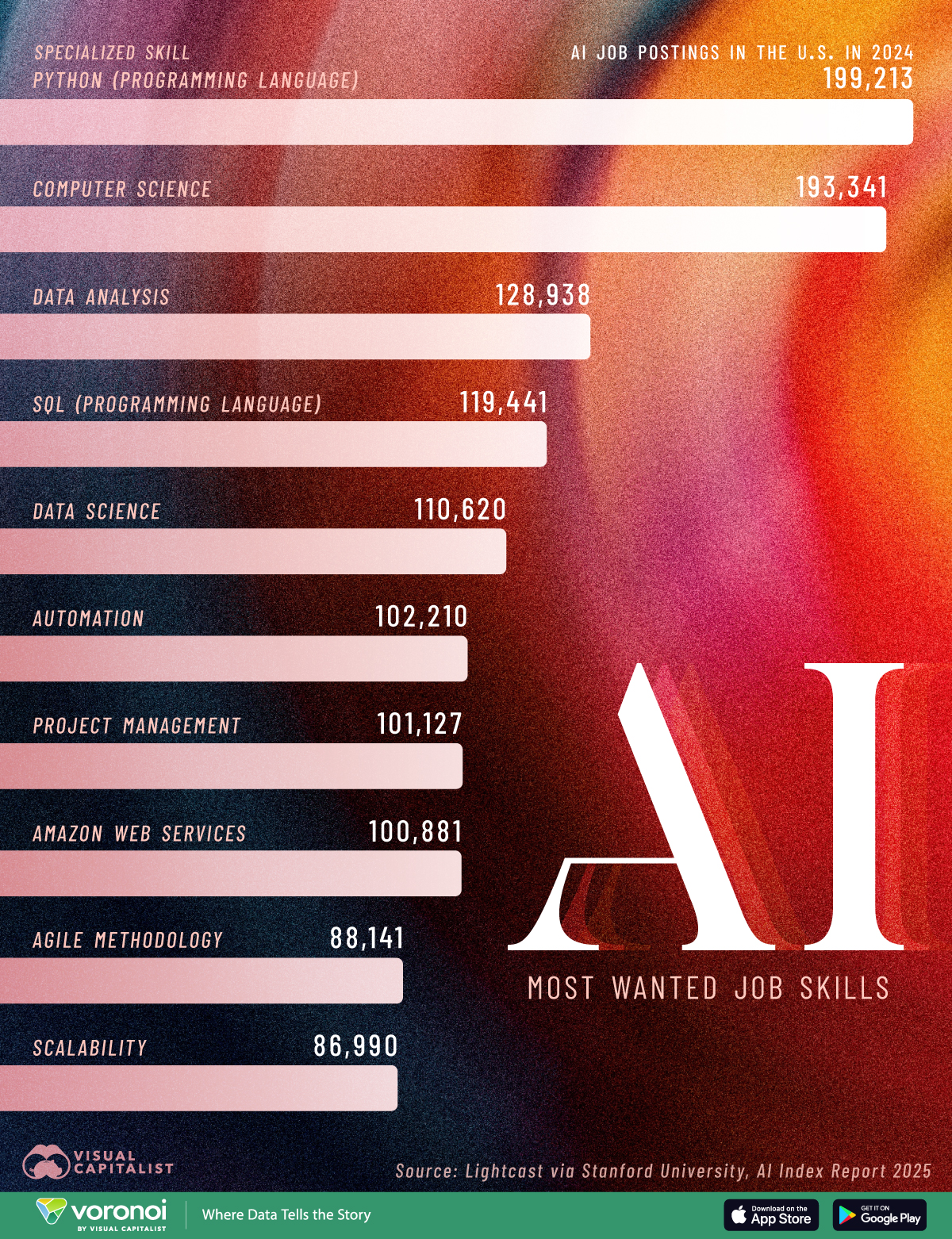
This visualization is part of Visual Capitalist’s AI Week, sponsored by Terzo, and shows the most in-demand skills for AI jobs, based on data from Lightcast via the 2025 AI Index Report.
Python Tops the List
Here are the 10 most wanted skills for AI jobs in 2024 based on the number of mentions in job postings:
| Specialized Skill | # of AI Job Postings in the U.S. 2024 | # of AI Job Postings in the U.S. 2012-2014 | Growth |
|---|---|---|---|
| Python | 199,213 | 31,782 | 527% |
| Computer science | 193,341 | 83,826 | 131% |
| Data analysis | 128,938 | 41,842 | 208% |
| SQL | 119,441 | 51,304 | 133% |
| Data science | 110,620 | 11,861 | 833% |
| Automation | 102,210 | 22,157 | 361% |
| Project management | 101,127 | 54,035 | 87% |
| Amazon Web Services | 100,881 | 5,371 | 1,778% |
| Agile methodology | 88,141 | 20,330 | 334% |
| Scalability | 86,990 | 19,886 | 337% |
With over 199,000 mentions, Python, a programming language, ranked first overall.
Today, Python plays a fundamental role in many AI jobs. This is driven by its simplicity and wide usage in developing, testing, and deploying AI systems. Similarly, SQL, another programming language, ranked among the top three most frequently mentioned AI skills.
As we can see, data analysis and data science skills are also in high demand. Data science skills include using statistical analysis to analyze massive sets of data. Through the use of advanced techniques, insights can be extracted from data sets such as consumer behaviors and demographic profiles.
Meanwhile, scalability skills appeared frequently given the importance of knowing how to manage larger volumes of data without compromising performance and accuracy within AI systems.
Looking beyond technical skills, we can see that project management experience and knowledge in Agile methodology rank among the top 10. Here, Agile methodology is a process that focuses on the self-management of teams to deliver regularly, improve continuously, and adapt quickly as the industry changes rapidly.
Looking for more AI Week content? Visit our AI content hub, brought to you by Terzo.
Learn More on the Voronoi App

To learn more about this topic from a job market perspective, check out this graphic on the jobs that are using AI the most in America.


Who Controls the Critical Minerals Powering AI?
AI’s rapid growth depends on critical minerals. Here’s which countries dominate production of gallium, rare earths, and tantalum.


Three Critical Minerals Behind the AI Supply Chain
Key Takeaways:
- China accounts for 99% of estimated global processed gallium production and 69.2% of rare earth mine production.
- The Democratic Republic of the Congo produces 52% of the world’s tantalum, followed by Rwanda and Nigeria.
- These lesser-known materials are used in high-performance semiconductors, magnets, and power-management components found across AI hardware.
AI infrastructure depends on far more than chips and electricity. It also relies on a range of critical materials, including gallium, rare earths, and tantalum, that are essential to semiconductors, magnets, and power-management systems.
These three materials are highlighted in Figure 2.3 of the World Bank’s World Development Report 2026 because their production is concentrated in a relatively small number of countries.
The figures here are 2025 estimates from the U.S. Geological Survey’s Mineral Commodity Summaries 2026, using processed production for gallium and mine production for rare earths and tantalum.
Gallium: China’s 99% Share
Here is the World Bank’s breakdown of estimated processed gallium production:
| Country/Economy | Share of World Production (%) |
|---|---|
| 🇨🇳 China | 99.0 |
| 🌐 Other countries | 1.0 |
China accounts for 99% of the total. However, that does not mean China holds 99% of the world’s gallium underground. Gallium is generally recovered as a byproduct of processing bauxite for aluminum, and China’s enormous aluminum industry has helped it develop gallium extraction at scale. Earlier oversupply and low prices also contributed to producers elsewhere exiting the market.
Gallium matters because compounds such as gallium nitride (GaN) can operate efficiently at high voltages and temperatures. These properties make gallium useful in high-performance semiconductors and power electronics, an increasingly important consideration as AI data centers require more computing power and electricity.
Rare Earths: More Than One Element
| Country/Economy | Share of World Production (%) |
|---|---|
| 🇨🇳 China | 69.2 |
| 🇺🇸 United States | 13.1 |
| 🇦🇺 Australia | 7.4 |
| 🇲🇲 Myanmar | 5.6 |
| 🇹🇭 Thailand | 1.2 |
| 🇮🇳 India | 0.7 |
| 🌐 Other | 2.6 |
China produces 69.2% of the total, followed by the United States at 13.1% and Australia at 7.4%.
Despite the name, “rare earths” are actually a group of 17 elements. Different members serve different roles across computing hardware. Neodymium and praseodymium, for example, are used in powerful permanent magnets found in hard drives and other equipment, while other rare earths have applications in semiconductors, displays, optics, and data storage.
Tantalum: Power Management for AI Servers
Tantalum production has a very different geographic footprint:
| Country/Economy | Share of World Production (%) |
|---|---|
| 🇨🇩 Congo, Dem. Rep. | 52.0 |
| 🇷🇼 Rwanda | 16.0 |
| 🇳🇬 Nigeria | 15.6 |
| 🇧🇷 Brazil | 7.6 |
| 🇨🇳 China | 3.2 |
| 🇦🇺 Australia | 2.0 |
| 🇪🇹 Ethiopia | 1.6 |
| 🇷🇺 Russian Federation | 1.2 |
| 🌐 Other | 0.8 |
The Democratic Republic of the Congo supplies 52% of estimated mine production, while Rwanda and Nigeria contribute 16% and 15.6%, respectively. Together, those three countries account for 83.6%.
Tantalum’s AI connection is largely about capacitors. Polymer tantalum capacitors can provide high capacitance in a compact package along with stable electrical performance, making them useful in demanding power systems. Industry reporting in 2026 points to AI servers as a growing source of tantalum capacitor demand.
When Mineral Supply Becomes a Strategic Bottleneck
Production concentration does not automatically translate into an AI advantage. Advanced chips, fabrication capacity, energy infrastructure, and capital all matter. However, when one or a handful of countries dominate production of a critical material, export restrictions or other supply disruptions can ripple through global technology supply chains.
That risk is already visible. China has introduced export controls on gallium-related items and selected medium and heavy rare-earth items in recent years. Those measures have encouraged governments and companies elsewhere to pursue alternative suppliers and new production capacity. In Central Africa, concentrated tantalum production presents a different set of challenges, including potential supply disruptions and responsible sourcing concerns.
As AI infrastructure expands, securing the minerals behind chips, servers, and power systems could become increasingly important alongside securing the chips themselves.
Learn More on the Voronoi App
To see where the U.S. is most dependent on foreign mineral supplies, see Ranked: U.S. Import Reliance for 37 Critical Minerals on the Voronoi app.
Mapped: Where U.S. Jobs Are Most Exposed to AI
See which U.S. states have the highest share of AI-exposed jobs, led by Washington, Virginia, and Washington, D.C.


Where AI Exposure Is Highest Across the U.S.
Key Takeaways
- Washington has the highest share of AI-exposed jobs, at 5.7% of its workforce.
- California has the largest number of AI-exposed positions overall, at roughly 724,000 jobs.
- Mississippi has the lowest share of AI-exposed jobs in the study, at 1.9%.
Artificial intelligence is becoming capable of performing tasks across a growing range of white-collar and technical occupations.
This visualization maps all 50 states and Washington, D.C., by the share of workers employed in occupations considered highly exposed to AI-related disruption. It also highlights the states with the largest and smallest numbers of workers in these roles.
The data for this visualization comes from SmartAsset, using U.S. Bureau of Labor Statistics data and research from the Virginia Economic Information and Analytics Division. The analysis covers 26 occupations identified as having particularly high exposure to potential AI-related disruption.
AI exposure does not necessarily mean these jobs will disappear. Instead, it reflects how susceptible their tasks may be to changes such as automation, weaker hiring demand, wage pressure, or restructuring as AI tools become more capable.
Why Washington Tops the Map
Washington ranks first, with 5.7% of its workforce employed in highly AI-exposed occupations.
The state’s large technology sector helps explain its position, with companies such as Microsoft and Amazon supporting a significant concentration of software developers, programmers, database specialists, and other digital roles.
| Rank | State or District | AI-Exposed Jobs (%) |
|---|---|---|
| 1 | Washington | 5.7% |
| 2 | Virginia | 4.6% |
| 3 | District of Columbia | 4.5% |
| 4 | California | 4.0% |
| 5 | Utah | 4.0% |
| 6 | Maryland | 3.9% |
| 7 | Colorado | 3.7% |
| 8 | New Hampshire | 3.7% |
| 9 | Texas | 3.6% |
| 10 | North Carolina | 3.5% |
| 11 | South Dakota | 3.5% |
| 12 | Oregon | 3.4% |
| 13 | New Jersey | 3.4% |
| 14 | Massachusetts | 3.2% |
| 15 | Minnesota | 3.2% |
| 16 | Georgia | 3.2% |
| 17 | Arizona | 3.1% |
| 18 | New York | 3.1% |
| 19 | Tennessee | 3.1% |
| 20 | Nebraska | 3.1% |
| 21 | Florida | 3.0% |
| 22 | Connecticut | 2.9% |
| 23 | Michigan | 2.9% |
| 24 | Missouri | 2.8% |
| 25 | Illinois | 2.8% |
| 26 | Wisconsin | 2.8% |
| 27 | Rhode Island | 2.8% |
| 28 | West Virginia | 2.7% |
| 29 | Kansas | 2.7% |
| 30 | Pennsylvania | 2.7% |
| 31 | Iowa | 2.7% |
| 32 | Delaware | 2.7% |
| 33 | Vermont | 2.7% |
| 34 | Ohio | 2.6% |
| 35 | Alabama | 2.6% |
| 36 | Maine | 2.5% |
| 37 | Idaho | 2.5% |
| 38 | Montana | 2.5% |
| 39 | Nevada | 2.5% |
| 40 | Alaska | 2.4% |
| 41 | South Carolina | 2.4% |
| 42 | North Dakota | 2.3% |
| 43 | Kentucky | 2.3% |
| 44 | Oklahoma | 2.3% |
| 45 | Louisiana | 2.3% |
| 46 | Indiana | 2.2% |
| 47 | Arkansas | 2.2% |
| 48 | Wyoming | 2.2% |
| 49 | New Mexico | 2.1% |
| 50 | Hawaii | 2.1% |
| 51 | Mississippi | 1.9% |
Virginia follows at 4.6%, reflecting its mix of technology firms, federal contractors, and knowledge-based employment. Washington, D.C., ranks third at 4.5%, while California and Utah round out the top five at 4.0% each.
At the other end of the ranking, Mississippi has the lowest share in the study, at 1.9%.
California Has the Most AI-Exposed Jobs
California has the largest absolute number of workers in highly exposed occupations, with approximately 724,000 positions.
Texas follows with about 500,000, while New York and Florida each have roughly 301,000.
| Rank | State | States With the Most AI-Exposed Jobs |
|---|---|---|
| 1 | California | 724K |
| 2 | Texas | 500K |
| 3 | New York | 301K |
| 4 | Florida | 301K |
| 5 | Washington | 202K |
At the other end of the scale, Wyoming has just 6,000 AI-exposed positions, followed by Alaska and Vermont at about 8,000 each.
| Rank | State | States With the Fewest AI-Exposed Jobs |
|---|---|---|
| 1 | Wyoming | 6K |
| 2 | Alaska | 8K |
| 3 | Vermont | 8K |
| 4 | North Dakota | 10K |
| 5 | Montana | 13K |
What Types of Jobs Are Most Exposed to AI?
The 26 occupations span technology, communications, administration, finance, and other knowledge-based fields.
Mathematicians rank as the most exposed occupation, followed by proofreaders, correspondence clerks, court reporters, and media and communication workers. Computer programmers, database administrators, web developers, software developers, writers, translators, payroll clerks, and bookkeeping workers also appear on the list.
Many of these roles involve processing information, generating or reviewing text, working with structured data, or performing routine digital tasks, all areas where generative AI and other automation tools have advanced quickly.
Still, exposure should be interpreted as the potential for jobs to change rather than a direct estimate of how many positions will ultimately be eliminated.
Learn More on the Voronoi App
To learn more about this topic, check out this graphic on the smartest AI models in 2026.
-

 China2 weeks ago
Ranked: The World’s Best Countries at Math in 2026
-

 Countries4 weeks ago
Ranked: The Best and Worst Countries to Live In 2026
-

 Debt1 week ago
Ranked: Countries With the Most Government Debt Per Person
-

 Jobs4 days ago
Mapped: The Best Employer in Every U.S. State
-

 Housing3 weeks ago
Ranked: 100 Global Cities by Quality of Life and Cost
-

 Brands3 weeks ago
Ranked: Cars That Hold and Lose Their Value the Most
-

 Money3 weeks ago
Ranked: Countries With the Highest Debt-to-GDP Ratios
-

 Urbanization1 week ago
Ranked: The World’s Strongest City Economies by 2050


